
2 Minutes
US President Donald Trump has authorized Nvidia to sell its H200 data-center AI chips to approved customers in China — but with strings attached. The move loosens prior export controls, yet significant limits and a 25% US export tariff remain in place.
What’s changed and what still isn’t allowed
The newly permitted shipments cover Nvidia’s H200 accelerators, a step up from the H20 models that were previously the only chips cleared for sale in China. However, the top-of-the-line Blackwell B200 processors remain off-limits for legal export. The US will also impose a 25% export tariff on these H200 sales.
Performance gap and the shadow market
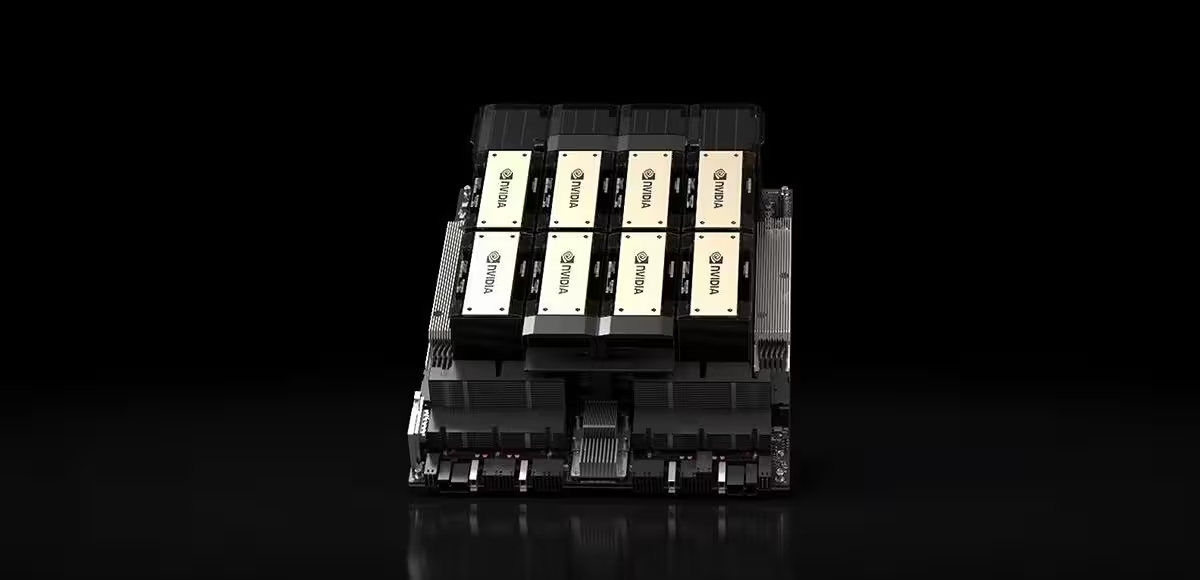
Performance-wise, vendors say the H200 can outpace the H20 by as much as sixfold on certain AI workloads. But that performance still trails the B200, which is reported to deliver nearly ten times the speed of the H200 in some scenarios. That gap helps explain why, despite legal bans, more than $1 billion worth of B200 chips are believed to have reached China through illicit channels.
Why the black market matters
Even with H200 now available legally to vetted buyers, the presence of B200 units in gray-market supply chains underlines persistent enforcement and attribution challenges. Companies and governments tracking semiconductor flows see these leaks as proof that hardware controls alone can’t fully contain technology diffusion.
China’s response and the domestic race
Chinese authorities have repeatedly warned local firms against relying on US technology. That messaging complicates how many Chinese companies will actually purchase H200s, even if they can. At the same time, Huawei has publicly set an ambitious timetable — aiming to close the gap with Nvidia and AMD within three years. Analysts are divided on the feasibility of that target, citing technical hurdles, talent, and supply-chain limitations.
- What companies can buy: Only approved Chinese customers, vetted under US rules.
- Which chips are allowed: H200 is now authorized; B200 remains prohibited.
- Financial impact: A 25% US export tariff applies to permitted shipments.
For global tech markets and AI development, this policy tweak is significant but nuanced: it eases some commercial avenues while preserving a hard line on the most advanced hardware. Watch for follow-up guidance on vetting processes and for any enforcement actions aimed at curbing gray-market transfers.

.webp "Redmi 17C 5G: 6.9-inch Screen and 6,000mAh Power Lands")

Leave a Comment
Comments
No comments yet. Be the first.