

3 Minutes
Google’s recent Android 16 QPR2 rollout is doing more than patching bugs — early tests show notable performance boosts on Pixel devices, especially the new Pixel 10 Pro XL. Benchmarks and user reports hint that under-the-hood improvements in Android 16 are giving Pixels a smoother, snappier feel without any hardware changes.
Where the improvements actually show up
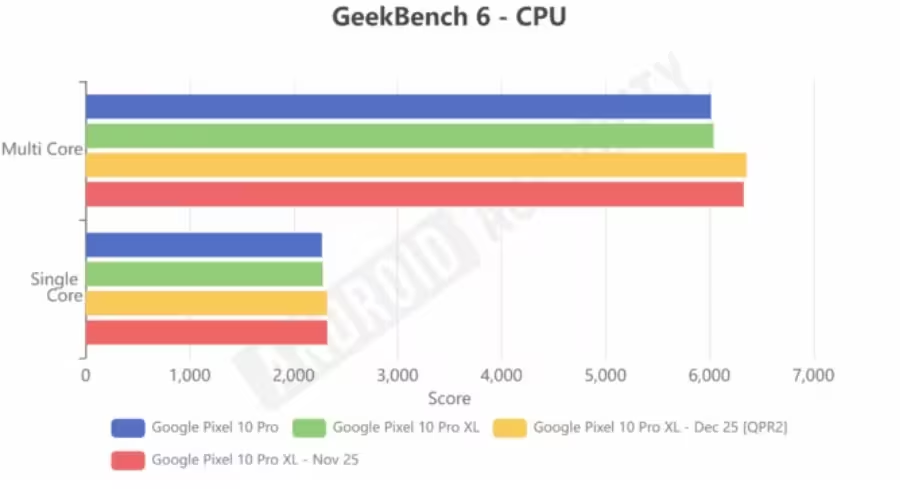
Benchmark results are mixed but promising. In Geekbench 6, the Pixel 10 Pro XL posted modest CPU gains: around 2% for single-core and roughly 5% for multi-core workloads. Those numbers aren’t dramatic, but they’re part of a bigger picture.
PCMark Work 3.0 — a test that simulates everyday tasks like browsing, document editing, and image work — jumped by 19.6%, a much more noticeable improvement for real-world usage. Graphics tests also climbed: 3DMark Wild Life scores rose about 5% to 7%, averaging near 6%.
Perhaps most surprising was the OpenCL result: scores went from about 3,063 to 4,061, a near one-third increase, despite no change to the reported GPU driver version. That suggests software-level optimizations, not just driver bumps.
What’s behind the sudden speed boost?
How can a system update translate into tangible performance increases? Reports point to deeper runtime optimizations in Android 16. One standout change is an improved memory garbage collection system that runs more efficiently, reducing CPU overhead during cleanup cycles. Less time spent pausing for garbage collection equals smoother animations and fewer stutters under load.
Think of it like clearing traffic from a busy highway: the cars (apps and processes) keep moving more consistently when the cleanup crews (garbage collector) work faster and smarter.
Not just for the newest Pixels
These wins aren’t limited to the flagship Pixel 10 line. Community reports and testers have noted improved scores and steadier frame rates on older or midrange Pixels, such as the Pixel 8a. That implies the QPR2 optimizations may benefit a broader range of devices running Google’s Android 16 build.
So, will other Android phones get the same lift?
One open question is whether these gains are tied to Google’s Tensor G-series silicon or if they’re purely software-level enhancements that could benefit phones from other manufacturers. If Android 16’s memory and runtime changes are implemented generically, OEMs running a plain Android base could see similar improvements after applying their own updates. But if parts of the boost rely on Tensor-specific tuning, the effect on non-Tensor devices may be smaller.
Why it matters
- Real-world performance gains (PCMark) matter more to everyday users than raw CPU scores.
- Graphics and compute improvements without driver changes point to meaningful OS-level optimizations.
- Software updates can extend the usable life of phones by improving responsiveness without new hardware.
Imagine buying a phone and getting a tangible speed bump months later through an OS update — that’s the kind of improvement that changes the ownership experience. For Pixel owners, Android 16 QPR2 appears to deliver exactly that: smoother multitasking, better benchmark results, and nicer graphics performance without touching the silicon.
Watch for broader tests across more models and independent verifications, but for now Android 16 is proving that clever system-level engineering can still squeeze significant gains from existing hardware.








Leave a Comment
Comments
No comments yet. Be the first.