
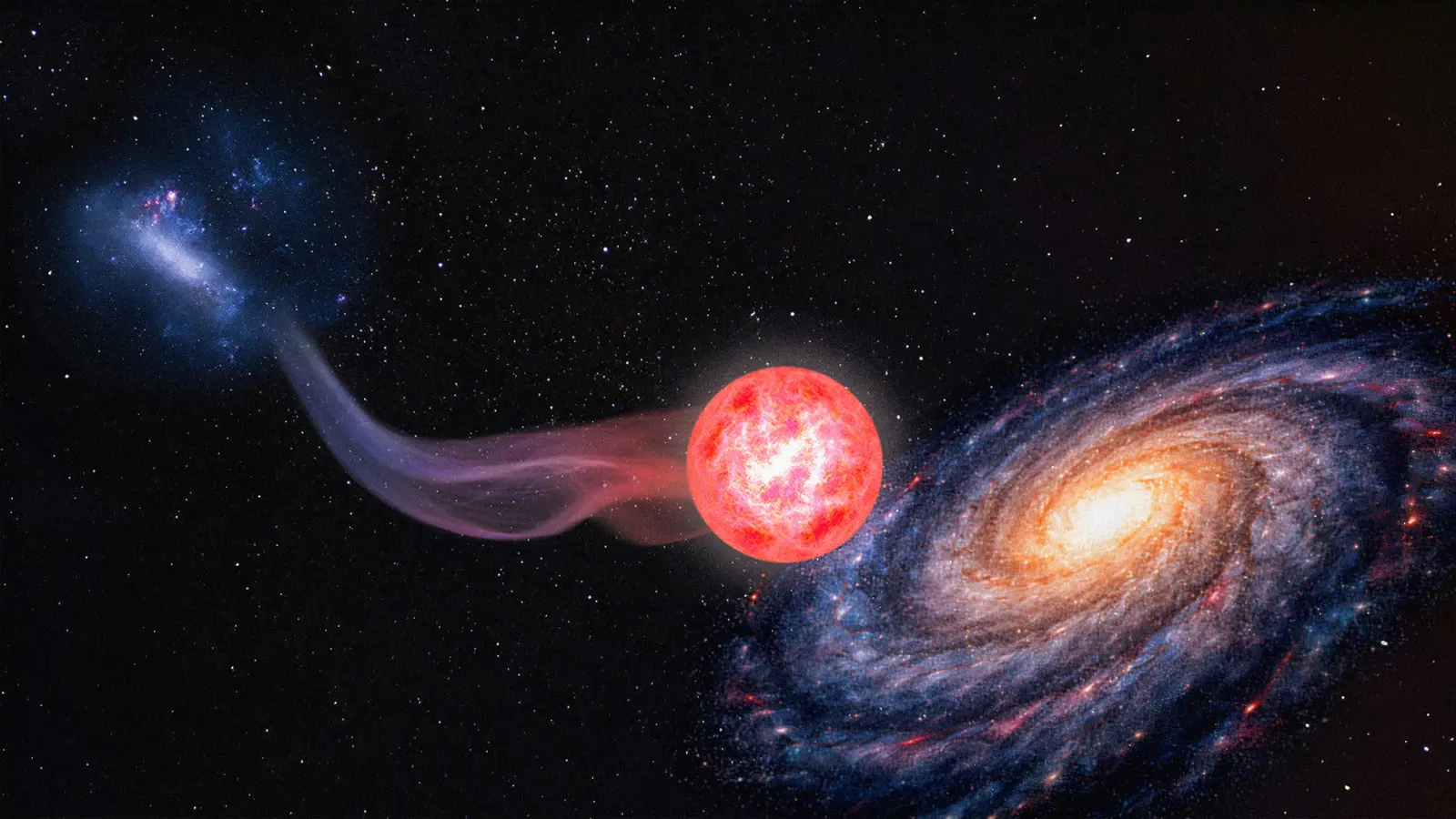
Imagine a star collapsing so far that, instead of forming a black hole, it births something like a tiny cosmos all its own. Strange? Yes. Plausible? A growing number of theorists say it's worth taking seriously.
When the nuclear fire in a massive star goes out, gravity finally wins. The outer layers fall inward. Temperatures and pressures spike. Under textbook physics, that fall ends with a singularity and an event horizon — the classic black hole. Yet those endpoints carry paradoxes that keep physicists awake: infinite density, broken laws of physics, and an impenetrable veil beyond which nothing can be observed.
Enter the gravastar, short for gravitational vacuum star. Think of it as an extreme alternative: a compact object almost as dense as a black hole but without an event horizon or a singularity. The idea hinges on an interior filled not with crushed atoms but with a dark-energy-like substance that pushes outward, balanced by a shell of ordinary matter pressing inward.
For years gravastars were elegant speculation. The missing piece was a credible formation story. How does a collapsing star flip from ordinary matter to an interior behaving like an expanding patch of spacetime? That question is precisely what Daniel Jampolski and Professor Luciano Rezzolla at Goethe University Frankfurt set out to address.

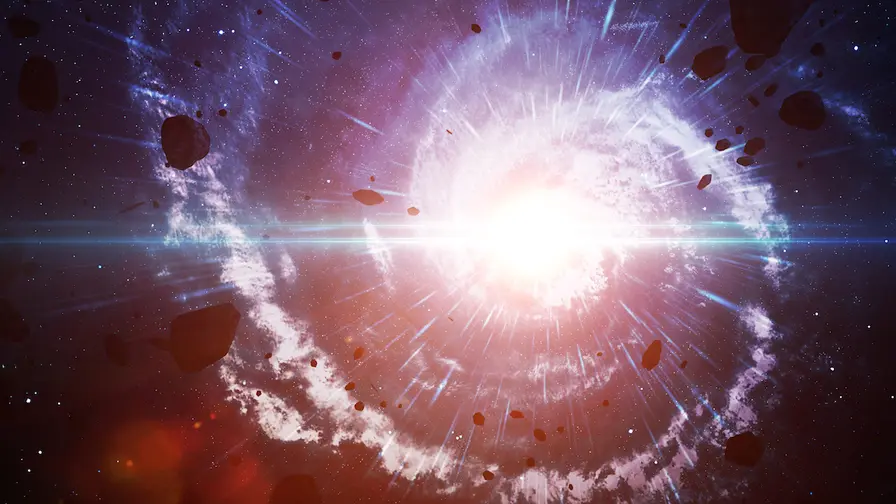
Their breakthrough comes from solving Einstein's field equations in a dynamic scenario. Jampolski, working on his master's thesis under Rezzolla, found a solution in which a miniature universe detonates into existence inside the collapsing stellar core. A little Big Bang, if you will. This fledgling cosmos expands, driven by a dark-energy-like pressure, and pushes back on the infalling stellar material. The result: collapse can be arrested before a horizon or singularity ever forms.

Short sentences then long. The image is vivid. The collapsing star becomes a stage where two forces duel — inward gravity versus an internal expansion. At first, that expansion lurks unseen, blossoming only after matter is compressed to extremes. Yet once it grows, it acts like a counterweight. Over time the expansion and the surrounding matter settle into a quasi-stable balance, producing an object that looks deceptively like a black hole from afar but is fundamentally different within.
This work supplies the first explicit dynamical route from ordinary stellar collapse to a gravastar-like endpoint. That claim matters. Theoretical alternatives have existed for decades, but a mechanism grounded in the full nonlinearity of Einstein's equations is rare. It gives physicists something concrete to test in simulations and to compare with astronomical observations.
Of course, the picture is provisional. The physics of matter at extreme densities — the kind reached just before this mini-universe would ignite — is murky. Exotic states of matter, quantum gravity effects, or unknown interactions could alter the course. Jampolski himself notes that the internal Big Bang is easiest to imagine at a late stage of collapse, when compression has sculpted conditions unlike anything we can reproduce in a lab.
Rezzolla is careful to remind readers that proposing alternatives doesn't amount to rejecting black holes. Black holes remain the simplest and most successful model for many observed compact objects. Yet scientific progress often comes from entertaining the exotic and then checking it against data. Could some detected black-hole candidates instead be gravastars? If so, how would their gravitational-wave signatures or shadow images differ from the canonical predictions? Those are questions ripe for observation-driven answers.
We are living in a moment when theory and observation can close the gap. Gravitational-wave detectors, horizon-scale imaging, and high-energy astrophysics are sharpening their lenses. If a gravastar is hiding in observational catalogs, its fingerprints might be subtle but detectable: tiny deviations in waveform echoes, slightly altered light-bending near the surface, or unusual cooling behavior in the remnant shell.
Whether nature actually produces gravastars remains unknown. But the notion that a dying star might seed a new, compact patch of spacetime feels like the kind of idea that thins the boundary between speculation and discovery. Keep an eye on simulations and on the next generation of observations; they will tell us whether stars sometimes end not with a whisper but with a small, stubborn boom.

Leave a Comment
Comments (2)
Sounds intriguing but skeptical here. Is this even falsifiable? sims might show tiny echoes, but real noise could easily mask them
Whoah, a mini Big Bang inside a dying star? wow, mind blown. If true, the cosmos just got a weird new trick... but can we actually see one?