
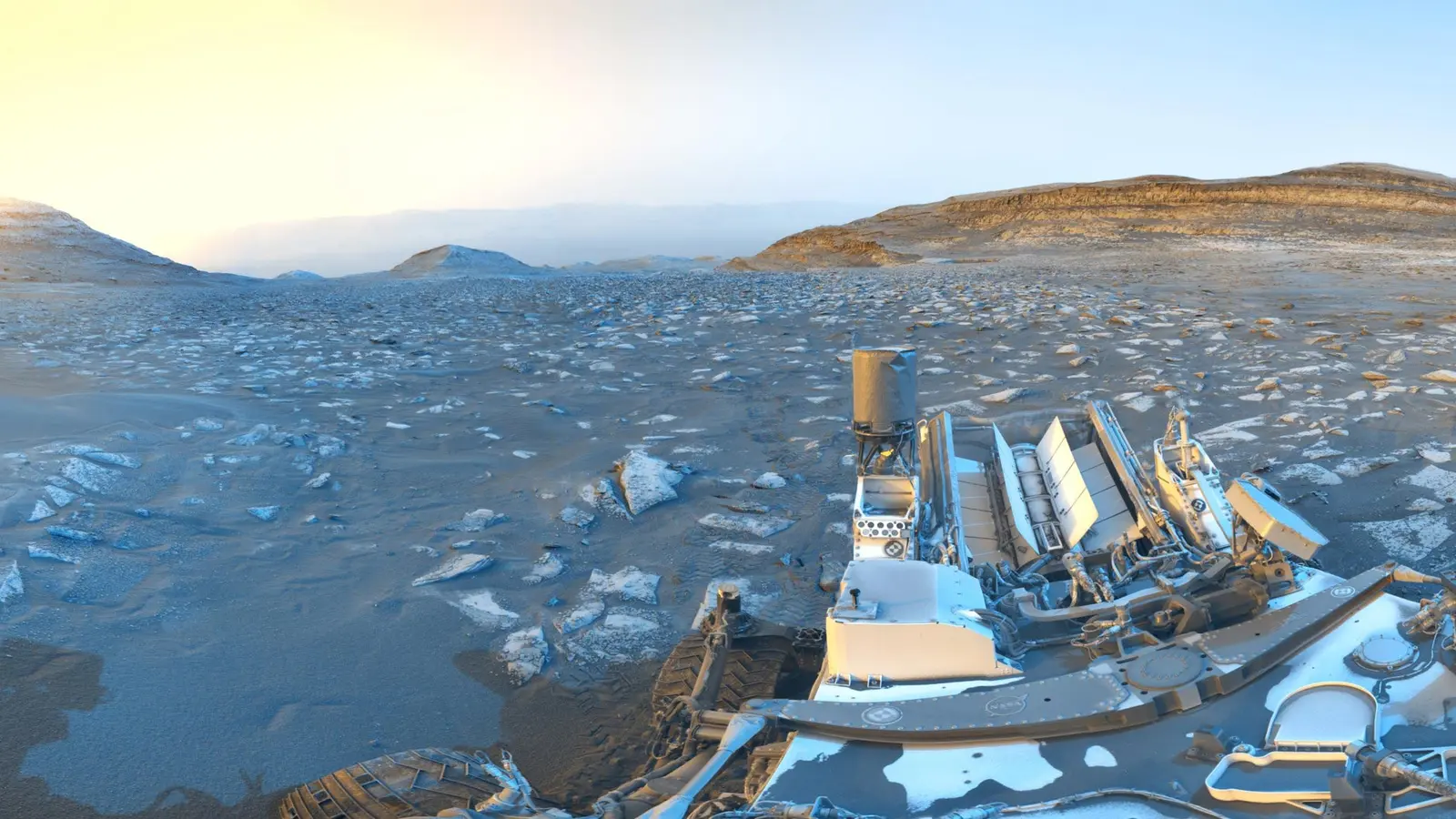
Blue in the morning. Gold by evening. NASA received a single, artful panorama that stitches those two moments together — a postcard from Curiosity on its 5,000th Martian day.
The rover paused on a sandy ridge nicknamed "Chocolatal" and used its black-and-white navigation cameras to photograph the landscape at two distinct times: August 30, 2026, at 9:56 a.m. local Mars time (Sol 5,000) and September 2, 2026, at 5:39 p.m. local Mars time (Sol 5,003). Engineers on Earth then combined the views and applied color as an interpretive overlay, tinting the morning shots blue and the afternoon frames yellow to produce the striking, postcard-like scene.
Curiosity’s deck dominates the foreground. You can pick out the can-shaped UHF antenna that relays data to orbiting spacecraft, and the finned Multi-Mission Radioisotope Thermoelectric Generator — the rover’s steady nuclear power source. Behind the vehicle, its tracks cut across Gale Crater and vanish toward the horizon, a persistent record of where Curiosity has walked.
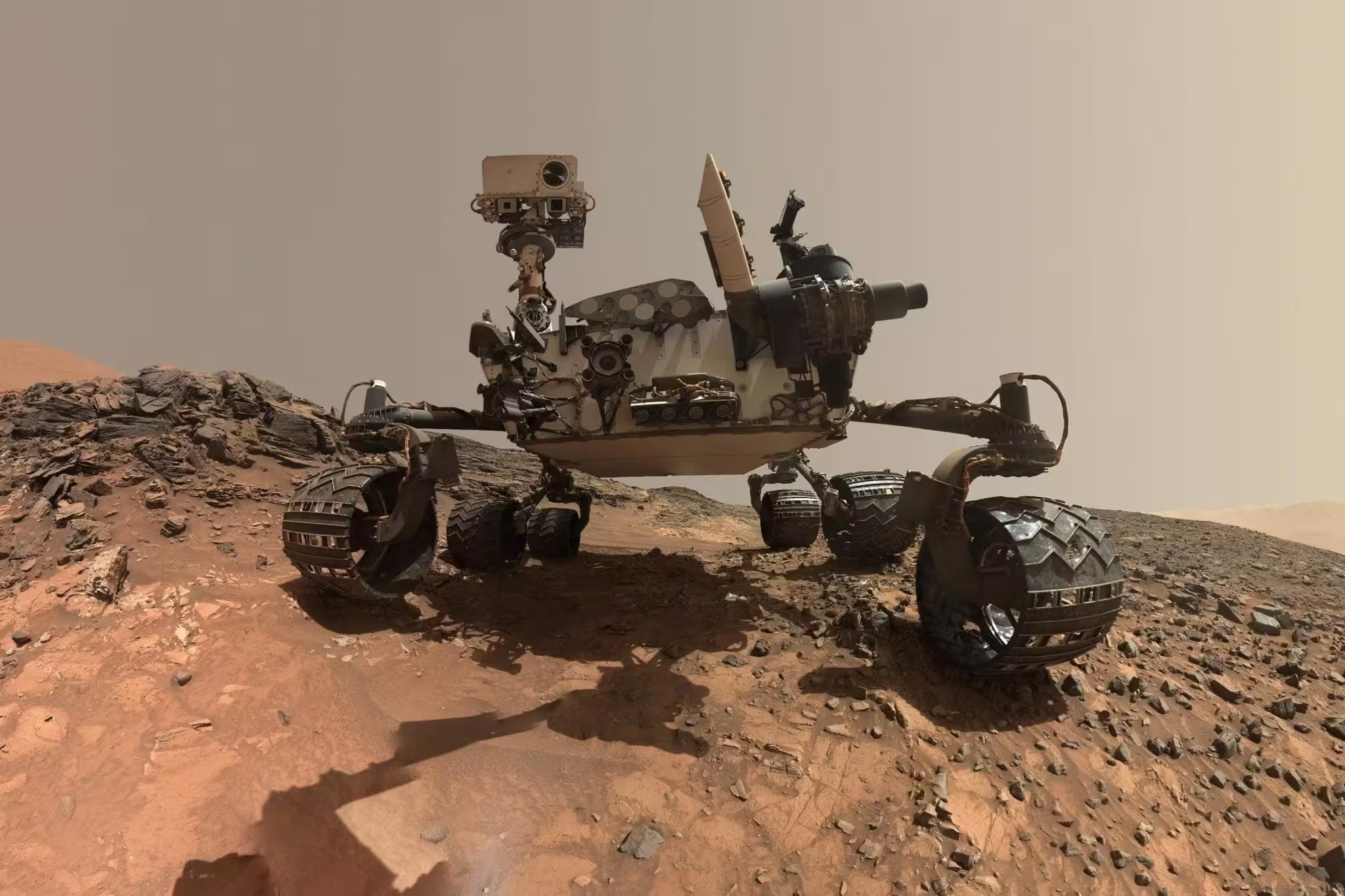
This low-angle self-portrait of NASA’s Curiosity Mars rover shows the vehicle at the site where it reached down to drill a rock target called “Buckskin” on lower Mount Sharp.
The panorama looks down from Curiosity’s current position in the lower foothills of Mount Sharp, the layered mountain rising roughly 3 miles (about 5 kilometers) from the crater floor. From here the far rim of Gale Crater is only a faint line, but the details near the rover are vivid: rippled sand, rocky outcrops, and the subtle slopes the team studies for clues about ancient environments.
These two-time-of-day composites are part science, part storytelling. The navcams themselves capture monochrome views optimized for navigation; color is added afterward to highlight contrast and to convey the sense of time passing on an alien landscape. NASA has used this postcard technique with Curiosity imagery before, notably in a similar composite released in 2021.
Five thousand sols is more than a headline. It’s a testament to careful engineering and long-term planning — the MMRTG keeps systems alive and heaters running through cold nights, while mission teams on Earth keep the science program focused. Curiosity arrived in Gale Crater in 2012 with a list of tasks; over the years it has turned that checklist into a route of discovery, sampling rocks, taking measurements, and leaving a linear trail across Martian soil.
Built and operated by NASA’s Jet Propulsion Laboratory (managed by Caltech in Pasadena), Curiosity remains part of NASA’s Mars Exploration Program, overseen by the agency’s Science Mission Directorate. The rover keeps sending back views and data, and with each image the planet reveals another line of its story — one step, one sol at a time.


Leave a Comment
Comments
No comments yet. Be the first.