
Imagine listening to a place where nothing can escape. Strange, but that’s close to what happened when researchers tuned into an exceptionally loud gravitational-wave event and heard a whisper from the very edge of a black hole.
Black holes don’t shine. Their defining border — the event horizon — is the ultimate one-way gate: cross it and even light can’t come back. For decades, astronomers have inferred horizons from how matter and light behave outside them. Directly probing the horizon itself felt like a fantasy. Then theory suggested a new route: a faint, final oscillation woven into the merger’s aftermath, a so-called direct wave that carries information from the near-horizon zone.
That theoretical footprint has now been flagged in the signal GW250114, an unusually strong detection captured by the global network of gravitational-wave observatories. The team behind the result, led in part by theorist Sizheng Ma of the Perimeter Institute, reports that the late-time portion of this collision’s waveform matches predictions for a direct wave tangled with the familiar ringdown modes. In everyday terms: as two black holes fuse, spacetime itself is yanked and spun so violently that, for a fleeting instant, the new object gives off a rapid, fading swirl tied to the horizon’s rotation.

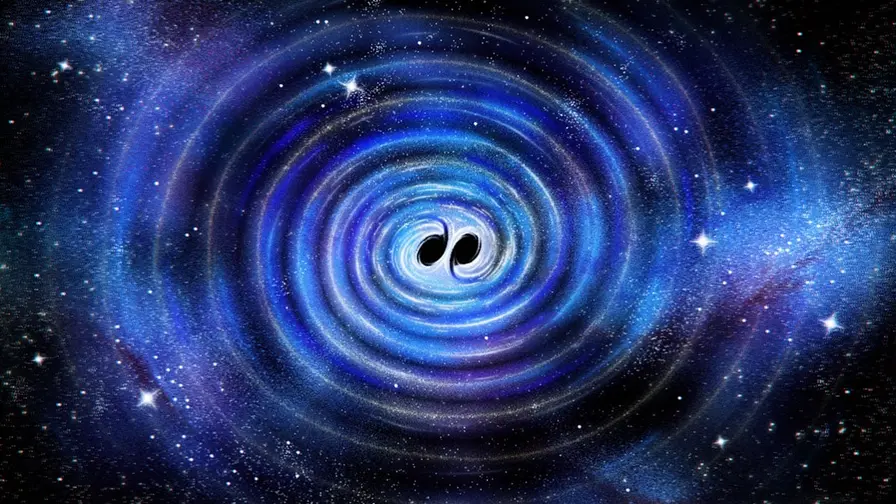
A diagram of the gravitational wave emission near the merger stage of a black hole collision.
Quasinormal modes — the ring-like vibrations of a freshly formed black hole — have been our primary tool for measuring mass and spin. Those modes are set largely by the light ring just outside the horizon. The direct wave is different. It emerges from motion closer still, from material and spacetime being dragged into the horizon’s immediate neighborhood. Gravity redshifts and damps outgoing ripples there, so the signal comes out fast and faint, oscillating at nearly twice the horizon’s rotation rate before it dies away.
'The event horizon is not something we can see directly with light,' Ma has said, 'but gravitational waves give us a different pathway.' He and colleagues say the GW250114 waveform behaved in a way their model predicted — not perfectly, not trivially, but with the sort of consistency that moves a claim from intriguing to plausible. The team ran checks to avoid false positives; the data was unusually clean, and the late-time evolution matched a direct-wave signature rather than noise.
If validated, this would be the first direct observational fingerprint of an event horizon.
It’s worth pausing to appreciate the scale of the achievement. By the time gravitational waves reach Earth they stretch and squeeze distances by amounts smaller than an atomic nucleus. Only a very loud, very clean merger could reveal the subtle near-horizon features the theory predicts. GW250114 happened to be that event.

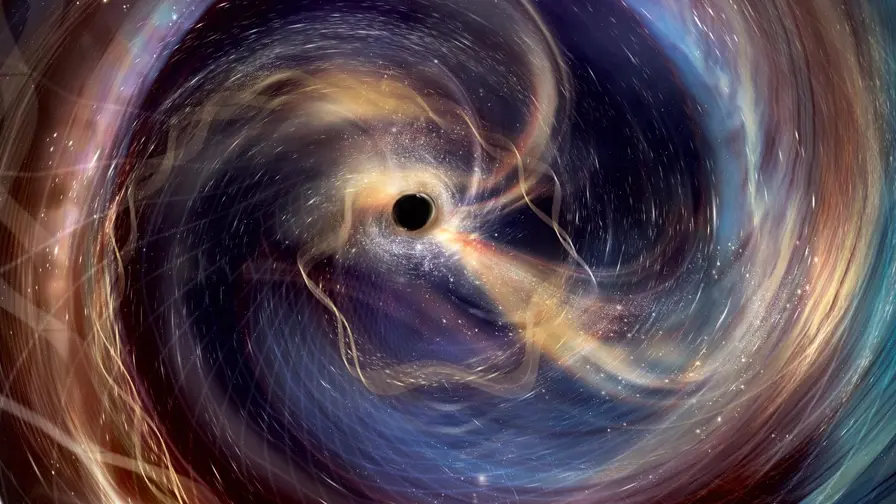
A visualization of the ringdown phase of GW250114, an unusually hefty gravitational wave event.
Still, caution remains. One detection does not a revolution make. The result will be pored over, compared with other events, and used to refine theoretical models. Instrument teams — LIGO, Virgo and KAGRA collaborators among them — and the wider community will want to see similar signatures in additional mergers before rewriting textbooks.
Why does this matter beyond the headline? Because a trustworthy direct wave would let us measure properties of the horizon itself: how quickly it rotates, how strongly gravity damps information near it, and whether those behaviors match Einstein’s predictions. In short, this is a new handle on tests of general relativity in the most extreme gravitational regime we can access.
For decades black holes were objects we studied at a remove — through the dance of gas, the orbits of stars, or the shadow they cast in radio images. Gravitational waves have been changing that story, letting us listen to the final breaths of merging systems. If the direct-wave interpretation survives scrutiny, it pushes us even closer, offering a rare observational doorway to the horizon’s immediate neighborhood. And with more sensitive detectors and more heavy mergers ahead, the whisper from the abyss may soon turn into a steady conversation.

Leave a Comment
Comments (2)
if that's real then cool, but one detection isnt proof. how do they exclude modeling bias or subtle instrument quirks? skeptical but hopeful… show me more events.
wow... a whisper from the edge of a black hole? gives me chills. insane that we can actually 'hear' the horizon. kinda poetic, kinda terrifying. want more data!!