
Imagine a densely packed city of stars, lanes of light threading through dust and darkness. That is what the Euclid space telescope captured when it turned its gaze to the galaxy’s bulge: a single, record-breaking mosaic teeming with roughly 60 million stars.
Euclid was parked at the Sun–Earth L2 point, about 1.5 million kilometres away, when its visible-light camera recorded this region across 26 hours on 23 March 2025. The final picture is a stitched mosaic of nine frames, each covering an area larger than the full Moon, and the black-and-white exposures were later given color using observations from the Canada-France-Hawaii Telescope.
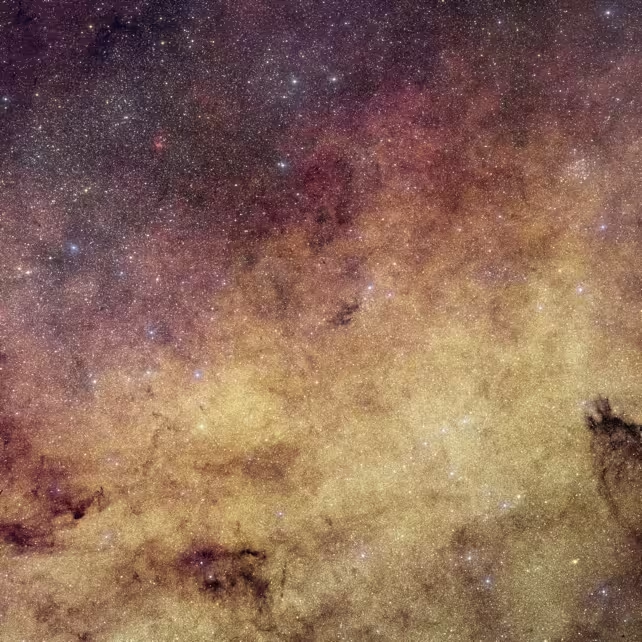
This mosaic is the most detailed visible-light portrait of our galaxy’s core to date. But the goal was never merely an aesthetic triumph. By revealing enormous numbers of stars against the cluttered backdrop of the galactic center, Euclid gives astronomers a new laboratory for measuring the hidden mass of planets and mapping gravitational micro-events.
How does a dense starfield help find planets? Through gravitational microlensing. When a foreground star passes in front of a more distant one, it briefly magnifies the background light. If the foreground star carries a planet, the planet’s gravity leaves a tiny, telltale wiggle in that brightening. Those micro-variations are subtle, but with a high-resolution map of the bulge, scientists can locate and characterize such events with greater precision.
Euclid’s image already encompasses 51 known planetary systems; it won’t necessarily reveal brand-new exoplanets on the photo itself, but it will dramatically improve the ability to measure the masses of planets found by microlensing—both those discovered earlier from ground surveys and those identified in the future. In other words, the telescope turns a chaotic stellar crowd into a precise weighing scale for faraway worlds.
The mission behind this view began in 2023, when Euclid lifted off to survey roughly one-third of the sky with the ultimate aim of probing dark matter and dark energy. Pointing the observatory at the bright, busy center of the Milky Way was a strategic pivot: instead of faint, empty expanses, astronomers asked Euclid to study the most crowded neighborhood it could find. The payoff has been immediate.

Not every patch is equally revealing. The image highlights structures such as a dense foreground cloud cataloged as LDN 10, which blocks starlight in places and paints a ragged silhouette across the bulge. These dust lanes are not just obstacles; they help astronomers map the three-dimensional structure of the inner galaxy and refine models of stellar populations and extinction.
There is also a human thread to the science. Teams who have chased microlensing signals for decades see this as the next step. Two decades ago, a group led by French researchers used ground-based telescopes to find an icy, distant planet—nicknamed in popular culture as akin to the frozen worlds in science fiction—by harnessing microlensing. Euclid’s sharp, wide-field view will expand those methods, enabling deeper mass measurements and uncovering more subtle lensing signatures.
The image is a reminder that astronomical discovery often arrives when instruments are asked new questions. Euclid was designed for cosmology, yet when trained on the Milky Way’s brightest heart, it becomes an exquisite tool for exoplanet forensics and stellar cartography. Expect follow-up analyses and targeted microlensing campaigns that will mine this mosaic for years to come.
Beyond the science, the picture reconnects us to a simple wonder: when we look toward the galaxy’s center we are not peering at abstractions, but at billions of individual suns, each with its own story. Euclid has given astronomers sharper eyes; now the work of reading those stories begins.

Leave a Comment
Comments
No comments yet. Be the first.