
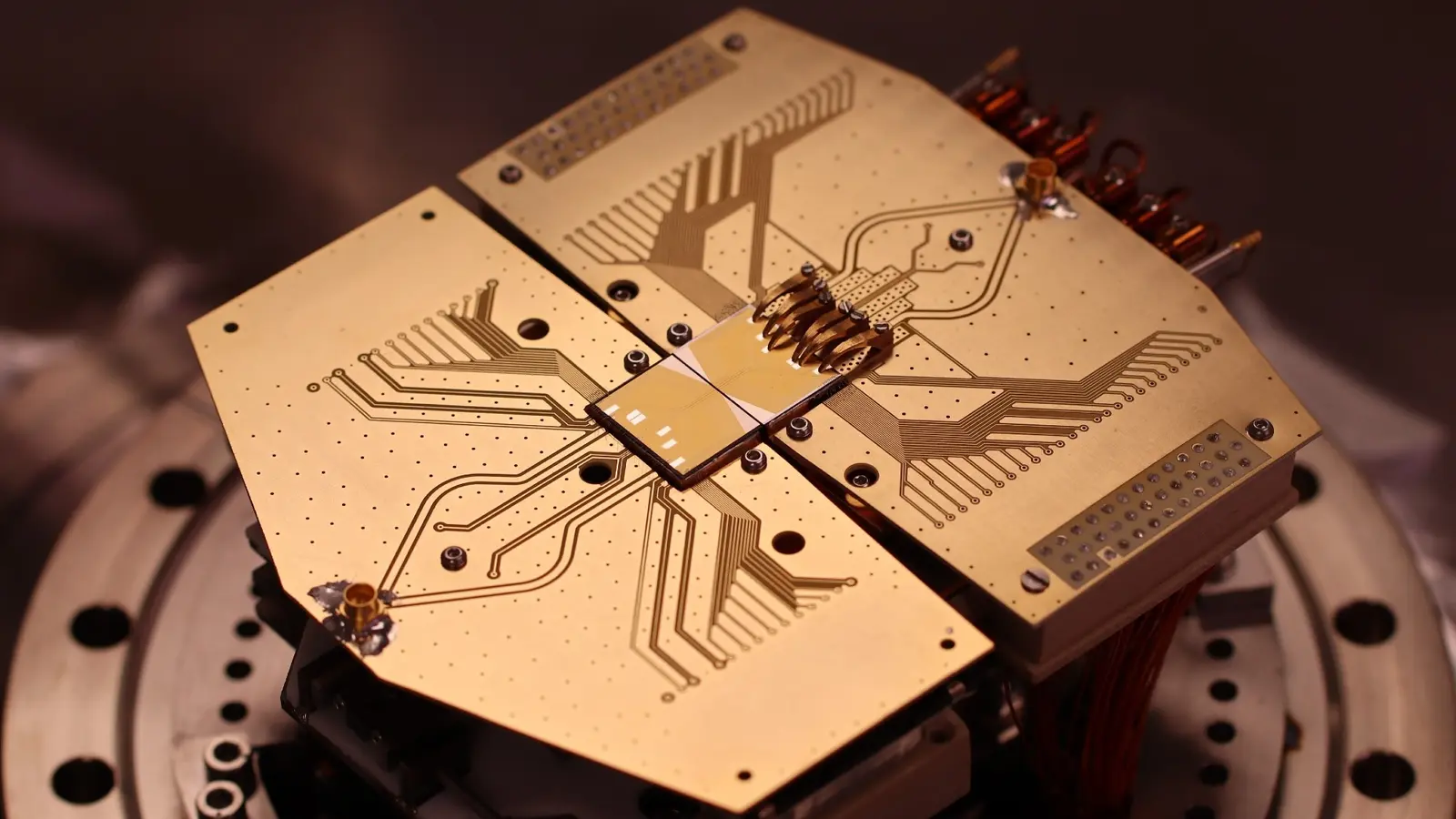
Imagine a quantum processor small enough to fit on a coin. Sounds like science fiction. But a team led by Andrii Chumak at the University of Vienna has nudged that image closer to reality by stretching the life of magnons — tiny magnetic ripples that could ferry quantum information — from mere blink-and-you-miss-it nanoseconds into the microsecond realm.
Magnons are not particles you can hold; they are collective excitations, waves of magnetization traveling through a solid. Think of dropping a pebble in a pond and watching concentric ripples spread. Except these ripples live inside crystals, can shrink to nanometer wavelengths and naturally interact with photons, phonons and other quantum players. That combination makes them unusually promising for on-chip quantum devices that need to link disparate components without bulky interfaces.
For years, the snag has been their fragility. Previous experiments found magnons fading away within a few hundred nanoseconds — far too brief to serve as reliable quantum memories or communication channels. The Vienna-led group shattered that ceiling. By generating short-wavelength magnons in ultra-pure spheres of yttrium iron garnet (YIG) and cooling them to a frigid 30 millikelvin, they recorded lifetimes as long as 18 microseconds — nearly 100 times longer than prior records. At that scale, magnons stop being ephemeral signals and start behaving like usable elements in quantum hardware.
The trick was twofold. Short-wavelength magnons are less sensitive to surface imperfections than uniform, long-wavelength modes. And material quality matters enormously: the team tested three YIG spheres with different impurity levels and found a clear pattern — the cleaner the crystal, the longer the magnons lived. Even the least pure of their samples outperformed all earlier measurements. That’s important because it shifts the bottleneck away from fundamental physics and toward engineering: better fabrication and purer materials could yield even longer-lived magnons.
They cooled the samples in a mixed-phase cryostat, freezing out thermal processes that normally sap magnon lifetimes. At 30 millikelvin, thermal noise is almost a nonfactor. Combine that with short wavelengths and pristine YIG, and suddenly lifetimes that once seemed unreachable are routine. The work appears in Science Advances and reads like a materials science roadmap as much as a physics breakthrough.

Why does this matter for quantum technology? Because long-lived magnons could serve as dense, on-chip quantum buses — channels that shuttle quantum states between hundreds of qubits without heavy wiring or bulky photonic links. Their ability to couple to multiple quantum platforms means magnons could act as translators: linking microwave superconducting qubits to optical photons, or bridging mechanical resonators with spin systems. In hybrid architectures, that versatility is gold.
Practical devices remain a way off. Cooling to 30 mK isn’t casual lab work, and fabricating ultra-pure YIG at scale is still challenging. Yet the implication is encouragingly straightforward: improve materials, and magnons get even better. This is a different kind of bottleneck than discovering a new physical limit — it’s one that engineers and chemists can address.
Short sentences here. Long sentences there. The upshot: magnons have moved from fleeting curiosities to contenders for solid-state quantum infrastructure. A coin-sized quantum chip might sound fanciful today, but with these longer-lived magnetic waves, the pieces of that puzzle are snapping into place.
Who will perfect the materials next, and how quickly can industry scale cryogenic and fabrication techniques? The answers will help decide whether magnons become the quiet workhorses inside tomorrow’s compact quantum machines.


Leave a Comment
Comments
No comments yet. Be the first.