
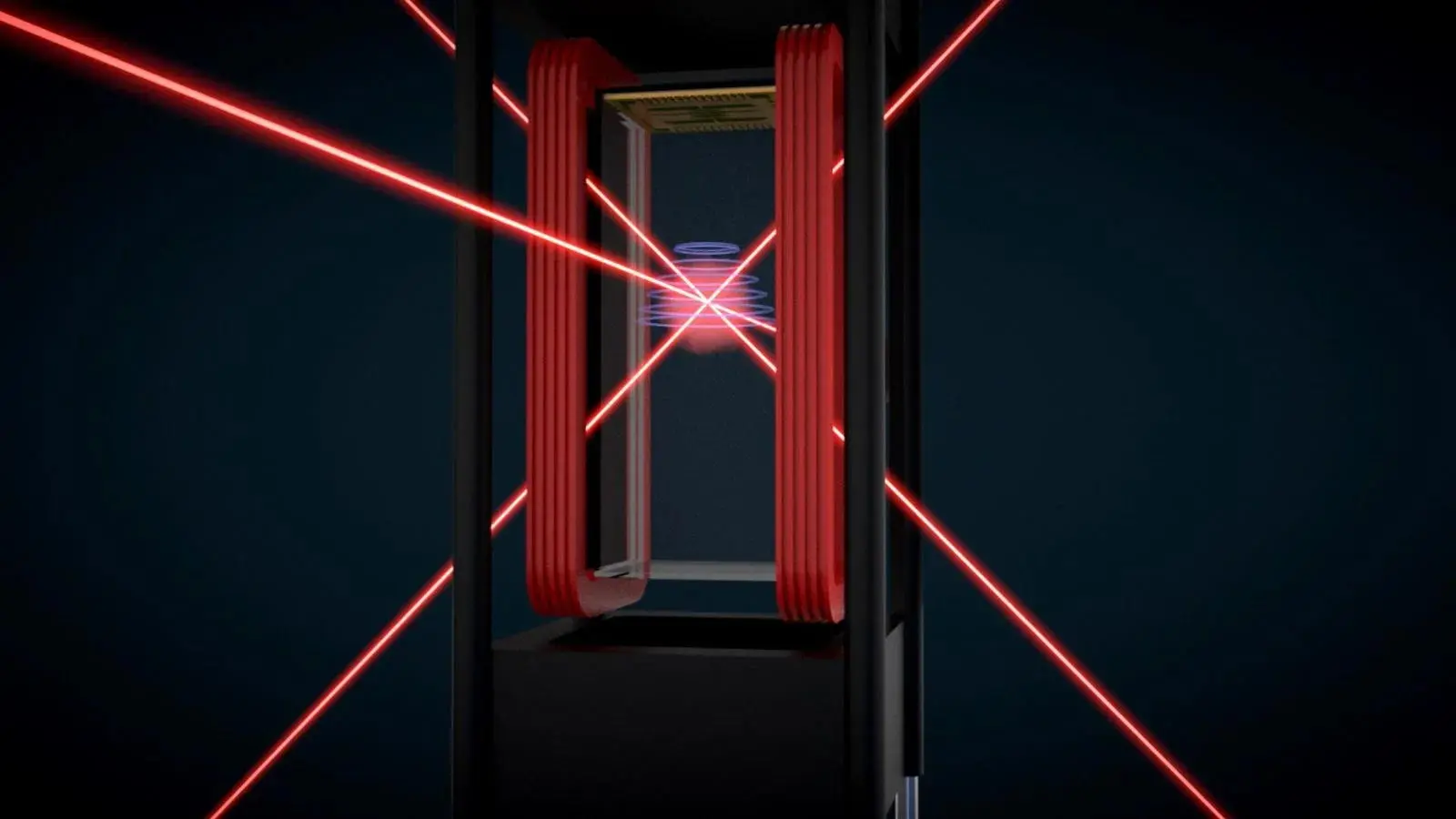
A minifridge-sized box afloat above Earth is quietly upending our ideas about matter. Inside, atoms are chilled to temperatures so low they stop acting like tiny billiard balls and start behaving like waves—big, measurable waves that reveal quantum rules we rarely see on our planet.
That box is NASA’s Cold Atom Lab, freshly upgraded and now running on the International Space Station. Astronauts installed the latest hardware this spring, and scientists have begun using the station’s microgravity to stretch quantum phenomena in time and space. The change is more than incremental. It lets researchers do experiments that simply can’t be done in ground-based labs.
How low is “ultracold”? The lab cools clouds of rubidium or potassium to temperatures just above absolute zero—below about minus 459°F (minus 237°C). The recipe sounds oddly domestic: heat a strip of metal to produce a gas, then aim lasers tuned to precise frequencies to slow the atoms until they nearly stop moving. Magnetic traps and additional cooling techniques tighten the grip. The end result is a Bose-Einstein condensate: a quantum object large enough to see with instruments, yet governed by wave-like rules that let particles overlap and act in unison.

In orbit, these ultracold clouds grow larger and can be observed for far longer than on Earth, opening a new window on quantum behavior.
Why does microgravity matter? On Earth, gravity pulls the cloud apart or drags it out of the experimental region in milliseconds. Up on the station, those matter waves can expand and interact free from that constant tug, so experiments gain duration and sensitivity. Researchers can probe subtle effects of gravity, time, and motion with a finesse that would be impractical on the ground. In other words: the space environment turns the Cold Atom Lab into a precision instrument for both basic physics and applied sensing.
This newest upgrade, the fourth since the facility’s arrival in 2018, includes a redesigned magnetic trap that lets scientists reshape the quantum gas clouds on demand and improved metal sources for generating the atomic gases. Those changes broaden the kinds of experiments teams can perform and sharpen the control needed for future spaceborne quantum instruments, like matter-wave interferometers for navigation, timing, and gravity sensing around Earth and the Moon.
The lab is compact, controlled from Earth, and supports multiple international research teams exploring fundamental physics and nascent quantum technologies. Built and operated by NASA’s Jet Propulsion Laboratory and managed by Caltech, Cold Atom Lab is funded through NASA’s Biological and Physical Sciences division. Its success in creating Bose-Einstein condensates in orbit is a milestone: it shows quantum systems can be made to work reliably beyond our planet.
So what comes next? Think of this as quantum technology entering its field season. The experiments happening now will help shape devices that navigate without GPS, sense subterranean features, or test gravity models in ways we only dreamed of a decade ago. The lab might be small, but its reach is vast—and the next surprising result could arrive any orbit.


Leave a Comment
Comments
No comments yet. Be the first.