
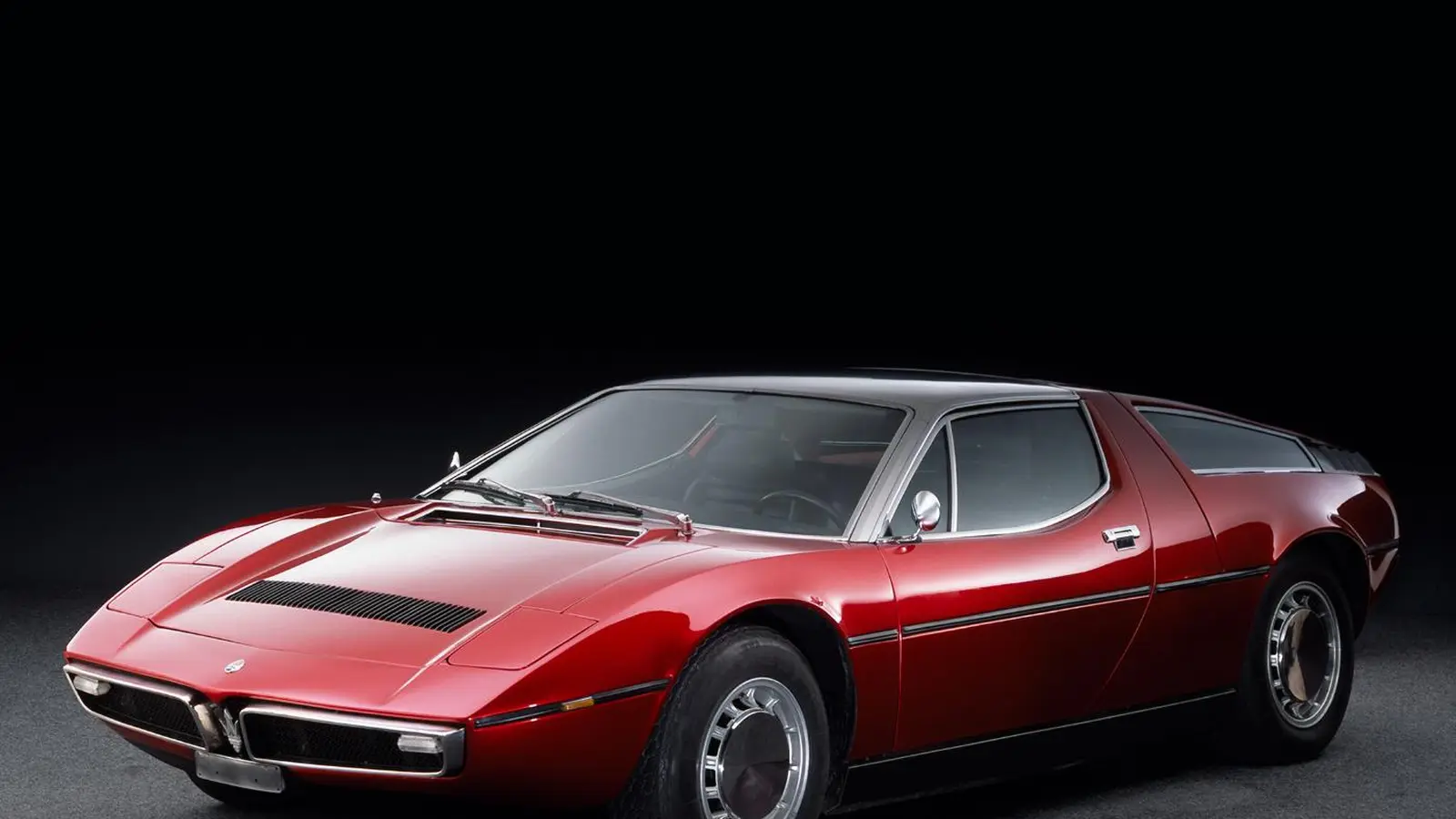
A 55-year milestone: why the Bora still matters
When the 1971 Geneva Motor Show opened its doors, the automotive world was already shifting. Headlines would soon be dominated by an oil crisis that changed buyer priorities and manufacturer strategies, but for a few dazzling weeks in Switzerland the show was simply a celebration of Italian design and engineering at its boldest. Among the crowd-pleasing debuts that year — notably Lamborghini’s LP 500 concept and the Miura SV — Maserati quietly introduced a model that would alter its trajectory: the Bora.

The Bora was Maserati’s first true modern sports car, and more importantly the first Trident-badged production car to adopt a mid-engine layout. It arrived at a unique moment: Maserati had recently been acquired by Citroën in 1968, and that influence pushed the marque into technical territory it had previously avoided. The result was a machine that married grand touring refinement with high-performance architecture.
Design by Giugiaro — beauty with purpose
The Bora looked every bit the part. Giorgetto Giugiaro, at the height of his powers, penned a clean, low-slung coupe that aged gracefully in photos and on the road. Its long, elegant profile and restrained surfaces gave it a timeless quality — a refinement that set the Bora apart from the wilder Lamborghini and Ferrari shapes of the era.
But the car’s silhouette was only the opening act. Underneath that Giugiaro skin was a significant technical leap for Maserati.

Technology leap: mid-engine, independent suspension and hydraulics
The mid-engine layout placed the 4.7-liter V8 behind the cabin in a configuration that improved balance, handling, and dynamic composure. Maserati also introduced four-wheel independent suspension to the Trident line with the Bora — a feature already present on some rival supercars but new to Maserati production models.
Citroën’s ownership left a clear engineering signature. The double-chevron’s expertise in high-pressure hydraulics was applied not to active suspension on the Bora, but in other ingenious ways: ventilated disc brakes, the movement of the entire pedal box, the driver’s seat positioning and even retractable headlights were controlled electro-hydraulically. Think of a luxury GT with the convenience of power adjustments — but executed in 1971.

The Bora’s hydraulic pedal cluster could travel forward or backward at the push of a button. The steering column adjusted for reach and rake, and seat positioning used electro-hydraulic actuation. Combined, these features gave the Bora a level of driver ergonomics and daily usability unusual in contemporary sports cars.

From prototype to production: suspension evolution
Early development cars and the Geneva concept used an innovative MacPherson-strut front suspension. In practice, this didn’t play nicely with the Bora’s wide front tires and rack-and-pinion steering, so production models reverted to a more conventional double wishbone front arrangement. Regardless, the Bora remains Maserati’s first production model with independent suspension front and rear — a milestone that modernized the marque’s dynamics.
Powertrain: racing DNA in a road car
The heart of the Bora was a 4.7-liter V8 with an aluminum block and hemispherical combustion chambers — a lineage traced back to the racing 450S. The engine was mounted longitudinally inside a combined steel monocoque and body structure, and the powertrain lived on a tubular steel subframe at the rear with a five-speed ZF manual gearbox.
Four Weber carburetors fed roughly 310 horsepower to the drive wheels — impressive figures for the era and very much in the tradition of Italian performance tuning. That said, the Webers would later become a double-edged sword: they delivered glorious throttle response and sound, but as fuel prices and consumer priorities shifted during the 1970s oil crisis, thirsty carbureted engines fell out of fashion.

Key Bora specifications at a glance:
- Engine: 4.7-liter V8 (aluminum block, hemispherical heads)
- Power: ~310 hp (Weber carburetors)
- Transmission: 5-speed ZF manual
- Layout: longitudinal mid-engine, rear-wheel drive
- Chassis: steel monocoque with tubular rear subframe
- Notable tech: four-wheel independent suspension, electro-hydraulic controls
Market context and the oil crisis effect
Timing hampered the Bora’s commercial trajectory. The early 1970s oil shock pushed buyers toward economy and fuel-efficient cars, and the era of unabashedly thirsty Italian supercars dwindled. Plans to campaign the Bora in racing series were quietly shelved as manufacturers scaled back racing ambitions and reassessed budgets.

Still, the Bora’s importance can’t be reduced to sales figures. It proved Maserati could build a sophisticated mid-engine sports car that balanced speed with usability — a different proposition from Lamborghini’s visceral creatures or Ferrari’s more track-minded offerings.
The Bora vs. its rivals
- Lamborghini: wilder styling and often more radical handling; Lamborghini was already an established mid-engine provocateur after the Miura.
- Ferrari: sometimes more performance-focused and uncompromising; Ferrari’s line-up leaned toward racing-derived technology.
- Porsche 911 (in spirit): the Bora shared the idea of an everyday-capable high-performance car — civilized, practical, and fast — similar to how many view the 911 in its segment.
Maserati carved its niche with a GT sensibility: a true performance machine that retained creature comforts and grand touring manners.
Legacy: Merak, collectability and influence on modern Maseratis
The Bora directly informed the later Merak, which adopted a 2+2 arrangement and shared the mid-engine architecture. While neither model saved Maserati from financial turbulence in the 1970s, they demonstrated the brand’s engineering credibility and helped keep the Trident relevant against the best from Sant’Agata Bolognese and Maranello.
More than five decades on, elements of the Bora’s philosophy — blending performance with everyday usability — can be seen in Maserati’s approach to flagship performance models. The company’s modern lineup frequently balances sporting capability with comfort, a blueprint that traces back to the Bora.
Collectability has followed as well. Well-preserved Boras are prized by collectors for their combination of Giugiaro styling, mid-engine rarity in Maserati history, and the visceral character of the V8 and Weber fueling system.

Why the Bora still excites enthusiasts
- It was a technical turning point for Maserati: mid-engine architecture and independent suspension.
- The use of Citroën hydraulic technology introduced features not common in sports cars of the era.
- Giorgetto Giugiaro’s design gave the car enduring good looks.
- The engine’s sound, character and mechanical purity (Weber carbs + ZF gearbox) deliver classic driving thrills.
Final thoughts
The Maserati Bora may not have dominated sales charts or stamped its name on a decade of racing victories, but its influence on the brand’s identity is undeniable. At 55 years old, the Bora stands as proof that Maserati could evolve from a maker of handsome, old-school GTs into a builder of technically advanced, mid-engine sports cars without abandoning luxury and comfort.
In short, the Bora rewired Maserati’s playbook: it showed that the Trident could compete with the wildest and the most exacting Italians — but on its own terms. For collectors, enthusiasts and anyone interested in the evolution of supercars and grand tourers, the Bora remains one of the most important Maseratis ever built.

Leave a Comment
Comments (2)
is this even true? Citroën hydraulics in a Maserati... seems wild. But did it really help handling or just add leaks, weight and drama? idk
Wow, the Bora sounds like the perfect mid 70s sleeper. Giugiaro nailed it. That hydraulic pedal? Insane. Wish GTs had that old soul, throttle + bark