
7 Minutes
Samsung’s 2026 strategy represents a fundamental pivot from iterative refinement to aggressive market segmentation. By admitting that a single chassis cannot simultaneously serve as a "mini-laptop" for power users and a "mini-TV" for content junkies, Samsung has effectively split its flagship identity. This bifurcation acknowledges a maturing demographic where the "do-it-all" compromise is no longer sufficient to justify premium pricing.
Samsung has identified two distinct user profiles driving this split:
- The Productivity Professional: Users who require an expansive, book-style canvas (the Ultra) for side-by-side multitasking, effectively mirroring a dual-smartphone workstation.
- The Content Enthusiast: Users who prioritize inner-display immersion for media consumption and gaming, favoring aspect ratio over raw productivity real estate.
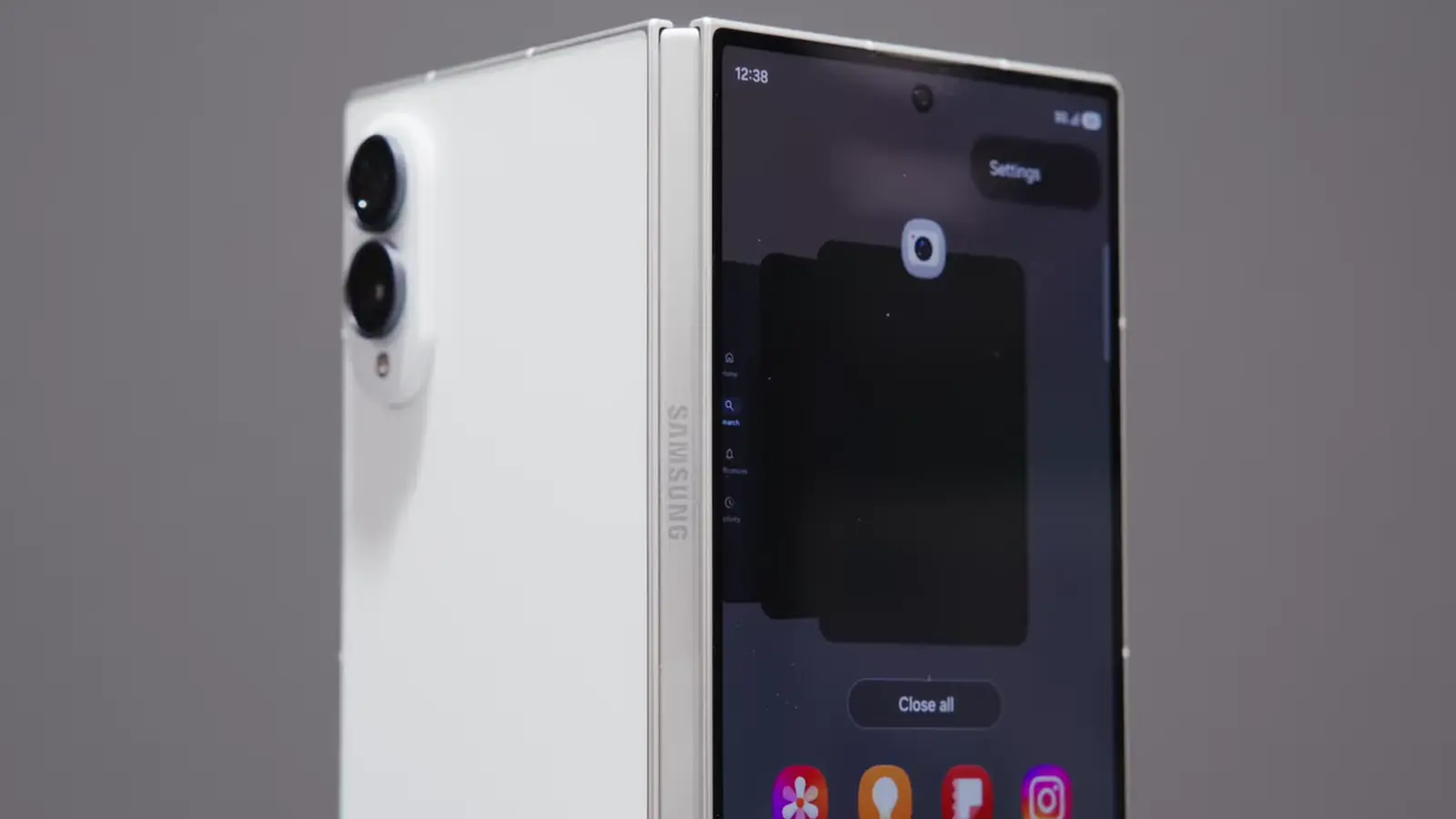
This divergence begins with the most radical design departure in years: the Galaxy Z Fold 8 "Wide Boy."
.avif)
The Galaxy Z Fold 8: Optimization for Content Consumption
The Galaxy Z Fold 8 marks a deliberate move toward media optimization with its transition to a 4:3 internal aspect ratio. This "Spongebob" shaped body allows the 7.6-inch inner display to function like a standard tablet, offering the most natural viewing experience on a foldable to date. However, as an architect of gadgets, I must note the ergonomic trade-off: the cover screen has been squashed into an almost square form factor that is fundamentally impractical for daily use. Standard apps like TikTok are poorly formatted for this width, and reaching across the display is an unnecessary stretch for the thumb.
.avif)
To mitigate this "sidegrade" feel, Samsung has boosted pixel density by 15% and applied its "goated" anti-reflective coating to the inner panel. Opening the device is also 10% easier thanks to a wider frame "crevice" and an assistive magnet system that provides a subtle pushing force during the initial unfolding motion.
Z Fold 8: The Cost of the Sidegrade
Positioned at $1,900, the Fold 8 offers significant refinements but forces users to accept notable hardware regressions to hit its price point.
| Feature | Galaxy Z Fold 8 Specification | Comparison to Previous/Ultra Models |
| Price | $1,900 | $100 less than Fold 7 launch price |
| Processor | Snapdragon 8 Elite Gen 5 | ~20% performance uplift; better ISP |
| Battery | 4,800 mAh | Upgraded (Fold 7: 4,400 mAh); 45W wired |
| Main Camera | 50 MP | Downgraded from 200 MP "Hero" sensor |
| Ultrawide | 50 MP | Upgrade from 12 MP (better macro utility) |
| Telephoto | Removed | Significant loss; no dedicated optical zoom |
| Chassis | 4.5 mm (Unfolded) | Thicker than Fold 7 (4.2 mm) and Ultra (4.1 mm) |
| Display Area | Reduced | Smaller total screen area than Z Fold 7 |
While the "Wide Boy" targets the casual consumer, the real engineering showcase is reserved for its "Ultra" sibling.
.avif)
The Galaxy Z Fold 8 Ultra: Engineering for the Pro-User
The "Ultra" moniker finally lands in the foldable category as a defensive maneuver against high-end global competition. Strategically, the Ultra serves the "mini-laptop" crowd, offering a massive 8-inch internal display—effectively providing the screen real estate of two 6.5-inch smartphones side-by-side. This is the hardware Samsung believes will keep professional users within the ecosystem as rival "bookstyle" foldables enter the market.
The Ultra's primary achievement is in material science. At 4.1mm unfolded, it is Samsung’s slimmest foldable, yet it feels more rigid than its predecessors. This is due to a titanium film placed behind the OLED—measuring less than 30% of a human hair—supported by a secondary flexible titanium plate. This "sandwich" construction not only thins the chassis but provides the structural integrity needed to finally reduce the visibility of the screen crease.
.avif)
Crucially, the Ultra (and the base Fold 8) debuts Silicon-Carbon battery technology. By moving away from traditional lithium polymer, Samsung has achieved higher energy density, cramming a 5,000 mAh cell into the Ultra’s ultra-thin frame. This shift is a pivotal moment for mobile hardware, proving that "thinner" does not have to mean "shorter-lived."
The Galaxy Z Flip 8: Erasing the Friction of the Fold
The Galaxy Z Flip 8 focuses on removing the "friction" of the folding experience, continuing the trend of making the cover screen a primary interface. However, there is a regional caveat: while most markets receive the Snapdragon chip, the UK variant is equipped with an Exynos processor, a point of contention for performance purists.
Physical refinements are evident: the device is now just 6.1mm thin when unfolded, with a frame that Samsung claims is 10% more durable. The cover screen bezels have shrunk, making way for a dedicated home screen that allows almost any task to be completed without opening the device.
.avif)
The software highlight is the "Now Brief" widget system, which offers live, mix-and-match infographics for weather, UV index, and health metrics. However, as an analyst, I find this "full accessibility" a double-edged sword. The Flip’s original appeal was its "intentionality"—the physical barrier of the fold forced a choice: Is this notification worth opening the phone and risking a doomscrolling spiral? By making everything accessible on the front, Samsung has erased the very friction that made the Flip a "digital detox" tool.
Galaxy Watch 9 & Watch Ultra 2: Resolving the Efficiency Crisis
Samsung’s 2024 wearables finally address the legacy of "micro-stutter" that has plagued WearOS. The Snapdragon Wear Elite chip provides a level of hardware-software synergy where apps now open near-instantly.
.avif)
The Watch 9 features a redesigned band with internal air pockets, resulting in a 25% weight reduction, and a 20% larger battery. But the Watch Ultra 2 is the true standout, justified by three critical pillars:
- 5,000-Nit Brightness: Currently the world's brightest smartwatch display, designed for high-glare extreme environments.
- Multi-Day Endurance: A 35% larger battery that finally delivers true multi-day performance.
- Refined Ergonomics: A 12% thinner body than the original Ultra, improving daily wearability.
.avif)
Interaction has also been streamlined: users can now activate Gemini with no wake word. The watch uses motion sensors to differentiate between checking the time and a "lift to mouth" gesture, allowing for immediate voice-to-AI interaction.
Ecosystem Intelligence: AI, Health, and the "Now" Experience
Samsung’s "Invisible AI" aims to provide utility without the need for active prompts. The health suite now includes Vitals (baselining heart rate and skin temperature to predict illness), a Heart Health Score, and a Fitness Index for peer-benchmarking.
In terms of productivity, Gemini Notebooks is a highlight, capable of converting voice recordings or notes into structured infographics and meeting summaries. On the camera side, the "Fan Cam" is remarkably effective, using automated tracking and zooming to follow a subject during recording with surprising smoothness.

However, the "Now Nudge" feature—which suggests contextual actions like opening Maps or a calendar based on incoming texts—remains the ecosystem's weak link. In my testing, while the feature works in pre-made demo environments, it remains highly inconsistent in real-world use. Half a year into its rollout, the utility remains more theoretical than practical.
Pre-empting the Competition
The 2024 lineup is a calculated move to saturate the market before Apple’s inevitable entry into the foldable space. By launching the Z Fold 8 "Wide Boy," Samsung is effectively setting the standard for the 4:3 form factor that Apple is rumored to be adopting. Samsung is in a unique position to "pre-empt" its rival because it is the very company supplying Apple with its foldable screens. Samsung already knows what the competition is building; the Fold 8 is their attempt to neutralize the novelty of Apple’s eventual announcement.
The "Ultra" carries a steep $2,100 price tag. While the 4.1mm chassis, titanium reinforcement, and silicon-carbon battery are legitimate engineering feats, they arguably represent the natural evolution of flagship hardware rather than a revolutionary leap. Whether the "Ultra" label is a true badge of status or a clever rebranding of year-on-year improvements, it ensures Samsung remains the undisputed architect of the foldable era—for now.

Leave a Comment
Comments (3)
Feels like Samsung split the identity to justify prices. Fold8 looks neat, cover screen tho, yikes.
Is the silicon-carbon battery real or marketing fluff? 5k mAh in ultra thin sounds almost sci-fi...
Wow didn't see Samsung splitting into Wide Boy and Ultra.. bold move. But losing telephoto? hmm, that stings.