
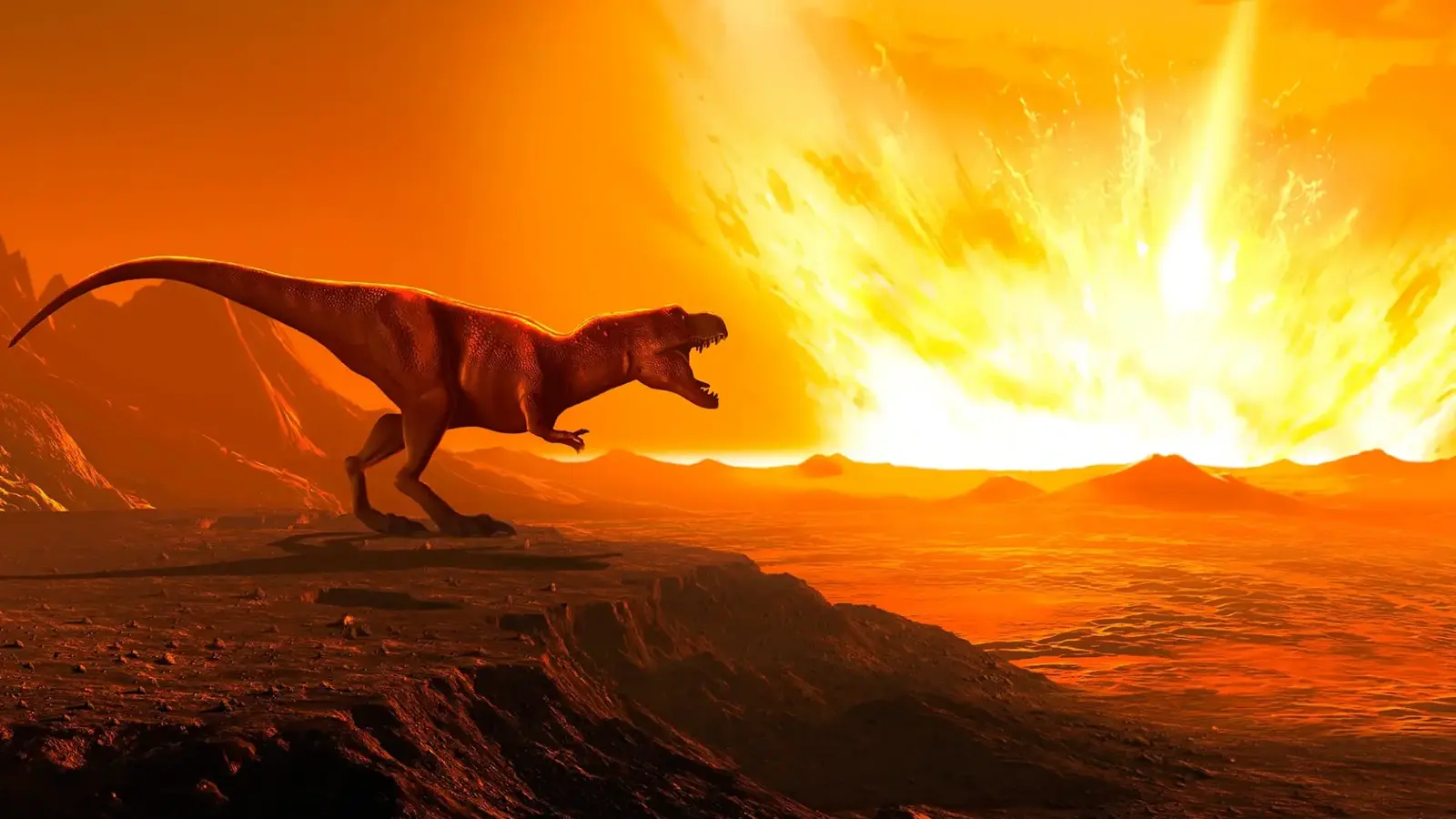
They didn’t die over millennia. They were burned alive in hours.
New modeling and recent excavations around the Chicxulub site point to a brutal, immediate killer: a vast veil of microscopic rock dust thrown into the atmosphere that trapped the impact’s heat and turned the surface into an oven. Animals caught in the open—no burrow, no shade—were exposed to an intense thermal pulse and, according to researchers, many perished within about two hours.
The story begins with a signature in stone. In 1980 Luis and Walter Alvarez linked a global layer of iridium—an element scarce in Earth’s crust but common in space—to a catastrophic extraterrestrial strike at the end of the Cretaceous. The culprit was later tied to the Chicxulub impact in the Yucatán. A roughly 10–15 kilometer-wide asteroid slammed into Earth, carving a crater roughly 150 kilometers across and unleashing energy that dwarfed human nuclear weapons.
That enormous blast did more than throw up tsunamis and belch toxic gases. It vaporized rock, sending molten and vaporized material skyward. Some of that material condensed into glassy spherules and rained back down. Until recently, scientists thought those spherules and the fires they ignited explained most of the immediate carnage. But field work in 2023 revealed an extensive layer of exceedingly fine, rock-derived dust at the impact site—dust that never coalesced into beads but remained suspended as a haze.
Brandon Johnson and colleagues ran atmospheric and radiative-transfer models that changed the picture. The plume of micron-scale particles acted like a thermal blanket. Instead of letting heat radiate away into space, the dust trapped and redirected intense infrared radiation back toward the ground. The result: an airborne lid that dramatically amplified surface heating. Models indicate animals experienced roughly 17 times the thermal flux considered lethal to humans. Even thick-skinned dinosaurs would have suffered catastrophic burns.

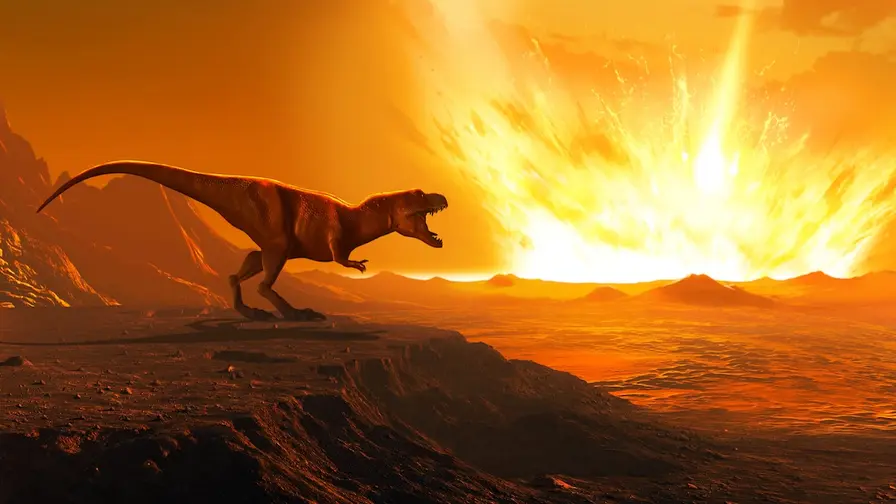
The dust trapped heat and turned the planet’s surface into a roaring oven.
The consequences were twofold and rapid. First came the blistering thermal pulse—radiant heat so intense that grasses, conifers and lichens could ignite and forests could burst into flame. Then, over months to years, the same fine particles blotting sunlight produced a prolonged global dimming—an impact-triggered “winter” that choked photosynthesis and starved survivors. If any creatures escaped the initial incineration, many later succumbed to famine and to chronic exposure to inhaled particulates.
That last point matters. The dust was not only an infrared blanket; it was toxic, respirable material. Particles on the order of 2.5 microns can penetrate lungs and enter the bloodstream—just like modern PM2.5 from wildfires. Purdue researchers note that even organisms that survived the heat could later suffer respiratory collapse or long-term organ damage from breathing the fallout. But the models imply the thermal wave moved faster and killed more quickly than the slow, grinding effects of inhalation and starvation.
The dust-centric scenario also reframes debates about what did—or didn’t—drive the end-Cretaceous extinction. Some geologists have argued that massive volcanism, like the Deccan Traps eruptions, played the leading role, with the asteroid delivering a final blow. The new work makes a persuasive case that the impact and its dust cloud alone could have caused a near-immediate global die-off, and that volcanic effects, while important on longer timescales, need not be the primary trigger of the rapid mortality seen in the fossil record.
What emerges is not a single cause but a brutal sequence: impact, radiant inferno, global wildfires, an atmospheric blackout and then ecological collapse. The research appears in Journal of Geophysical Research: Biogeosciences and ties field evidence from spherules and dust layers to physics-based models of radiation and particle behavior. It’s a portrait of extinction written in glass beads and fine dust—an extinction in which the sky itself became a killer.
We still dig for more clues. Every grain of ancient dust recovered at Chicxulub helps refine the timing, intensity and mechanics of that terrible episode—and with each sample the image of Earth’s most famous mass extinction grows clearer.


Leave a Comment
Comments
No comments yet. Be the first.