
Imagine eavesdropping on the Moon and finding a frozen reservoir. Strange, right? Yet that is precisely the trick a team of geophysicists is proposing: listen to the way the ground vibrates and you may find water where telescopes and radar come up short.
Researchers from the University of Maryland, Lawrence Berkeley National Laboratory and the University of Hawaii argue that seismic waves — the same ripples we use to study earthquakes on Earth — carry telltale signatures when they pass through icy lunar soil. The key is stiffness. Ice makes regolith firmer. That changes how vibrations travel: they speed up, reflect more, and sometimes bounce back like an acoustic echo from a hidden wall.
How did they reach this conclusion? By layering three very different lines of evidence until they converged on the same pattern. In a rock lab, a researcher crushed volcanic rock from Arizona into dust that mimics lunar soil, then froze it and tracked where ice settled inside the tiny pore spaces with X-rays. In parallel, thermal models mapped the South Pole’s cold traps — craters that have been shaded for billions of years and are prime candidates to preserve frost. Finally, computer simulations sent mock moonquakes through virtual layers of icy ground to watch how seismic traces would change.
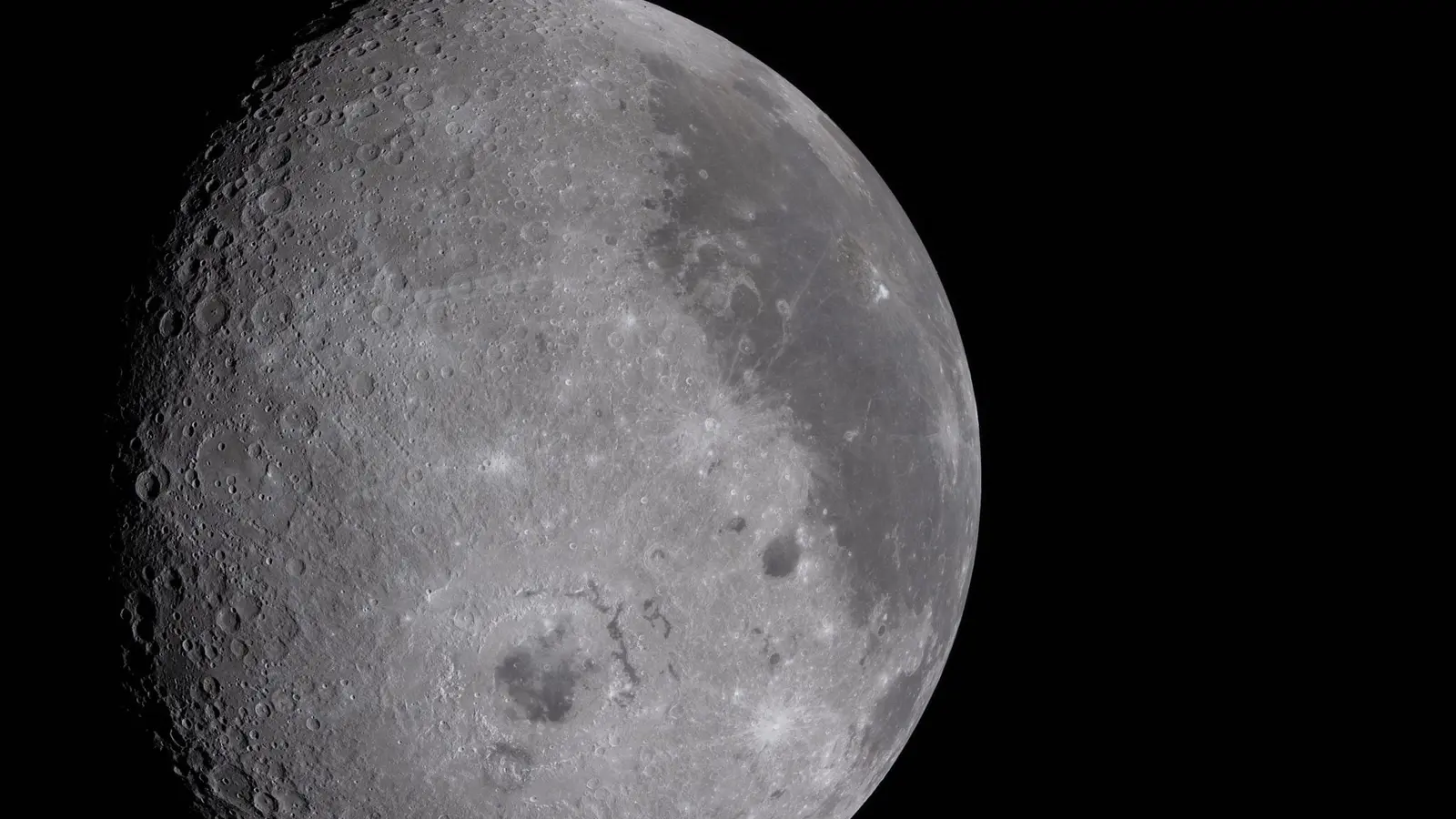
An image of the moon’s Hayn Crater captured by NASA’s Lunar Reconnaissance Orbiter spacecraft. Water ice may be hidden deep inside similar lunar craters.
Across experiments, models and simulations the result was consistent: seismic waves move noticeably faster through ice-rich deposits, and interfaces between dry and frozen layers produce strong reflections. In plain language: if you put a sensitive seismometer in the right place, you could not only detect buried ice but also estimate how thick or continuous a deposit is.

Seismic signals could reveal ice two to three times deeper than orbital sensors can probe.
Why does this matter? Because the most useful water on the Moon may be locked away beneath a skin of dry dust and completely invisible to instruments in orbit. For future explorers, that buried ice is more than a scientific curiosity. Melted and purified, it becomes drinking water. Split into hydrogen and oxygen, it becomes rocket fuel and breathable air — reducing the need to haul heavy supplies from Earth and making sustained exploration far more practical.
There is another, quieter payoff: time capsules. Permanently shadowed craters act like deep freeze boxes for volatile molecules. Ice trapped there could carry chemical fingerprints of the early solar system, including clues about how water arrived on the inner planets. Unlocking those records would rewrite parts of the Moon’s role in Earth’s watery beginnings.
Practical tests may arrive sooner than you think. China’s Chang'e-7 mission, planned to land near Shackleton Crater, is expected to carry a seismometer capable of hunting for the predicted signals. NASA’s Artemis program, aiming for crewed sorties to the South Pole by 2028, will carry instruments such as the Lunar Environmental Monitoring Station designed to listen for lunar quakes. The combination of ground truth from landers and refined seismic predictions could confirm whether the echoes match the models.
So where does that leave us? A new observational strategy is on the table: pair targeted seismometers with thermal maps to pinpoint likely deposits, then let the Moon’s own tremors — natural or induced — reveal what lies hidden beneath. It’s an old technique applied in a new arena, and if it works, it turns the lunar surface into both archive and pantry for explorers and scientists alike.
Listening, it turns out, might be the simplest way to find what eyesight cannot: frozen water quietly waiting in the Moon’s dark crevices.
.avif "Chinese Scientists Pioneer Technology to Extract Oxygen, Water, and Rocket Fuel from Lunar Soil")

Leave a Comment
Comments (2)
Cool idea, but are moonquakes common enough? If signals are faint, won't lander noise screw things up… if that’s real then
wait, we can literally listen for buried water? Mind blown. If seismometers map ice layers it’d flip lunar missions, but calibration, noise… and how deep can it really see?