

Not every mirror tells the truth. Some are designed to lie.
Researchers at UCLA have built what they call a "lying mirror" — a passive optical surface that refuses to mirror whatever stands before it and instead reflects a chosen, preprogrammed image. Think of it as a trick of light etched into the surface itself: no electricity, no projection system, no internal screen. The device receives incoming light and shuffles it into an entirely different outgoing wavefront.
How does that happen? The team used deep-learning algorithms to compute microscopic patterns on the mirror’s surface that steer incoming light toward a target image. Once fabricated, the metasurface behaves like an optical translator: feed it sunlight, room light, or a flashlight (within the conditions tested), and it emits the design it was trained to produce — a duck, a handbag, an eight, even a panda face — regardless of the actual incoming scene.
Some of the demonstrations were uncanny. Photographs of clothing were turned into what looked like a handbag. Various handwritten digits were coerced into the same numeral: eight. Simple line drawings became a panda’s visage. Most striking was the mirror’s resilience: when presented with inputs it had never seen during training, it still managed to produce its target image with surprising clarity.
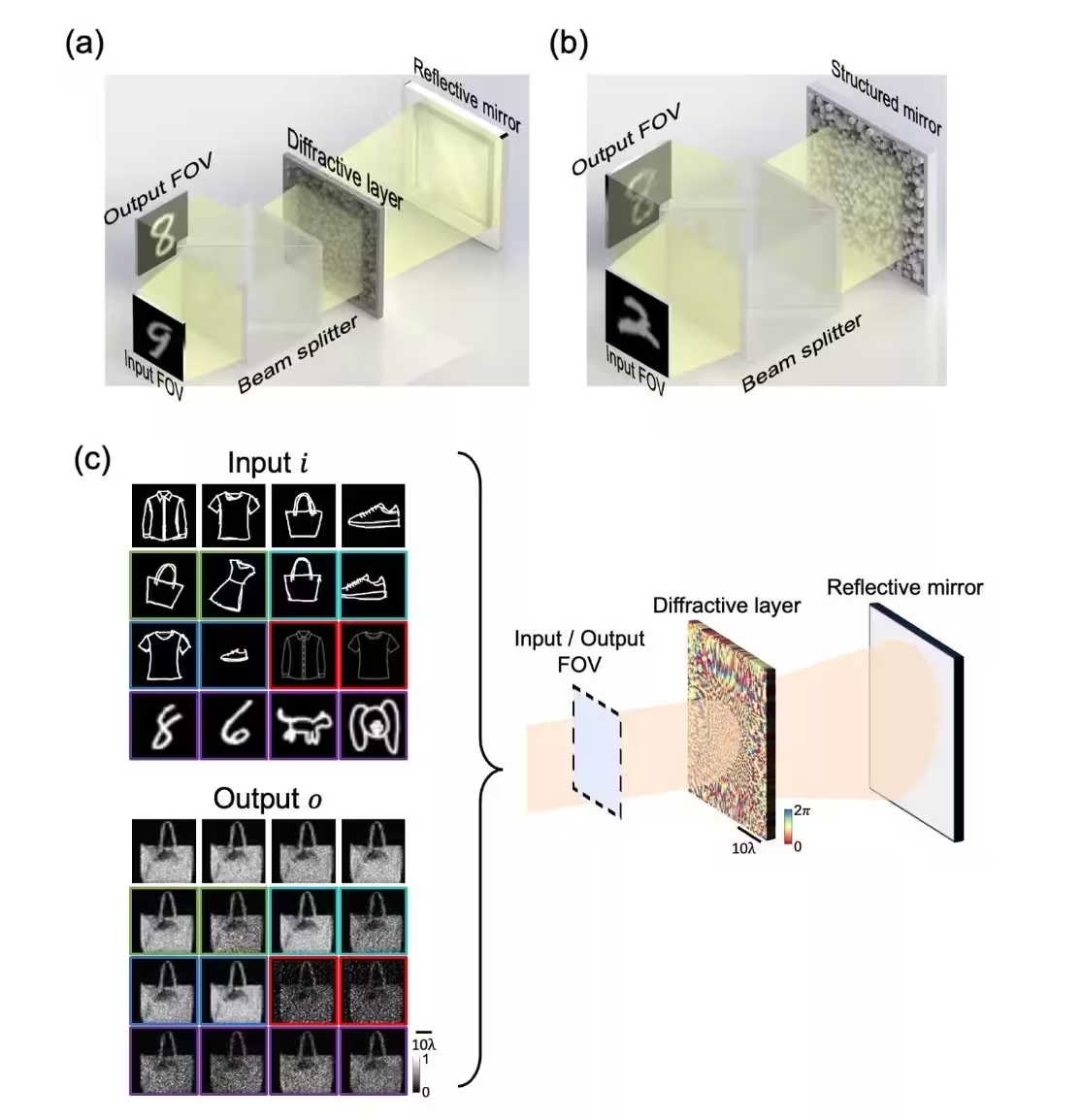
It’s worth underscoring one crucial point: this is a passive device. Conventional image-making systems — projectors, displays, holograms — need power, processing, or a light source matched to the image. The lying mirror encodes that transformation directly into its nanostructure, acting like a sculpted optical filter that redistributes incoming photons into a deceptive pattern.
Real-world use, however, remains a work in progress. Laboratory lighting is controllable; ambient daylight and mixed indoor illumination are not. Different wavelengths and light distributions pose a challenge. To operate reliably outdoors or under varied lighting, the developers say the approach will need multilayer or broadband designs that can manage multiple spectral components and angles simultaneously.

The practical ideas are immediate and wide-ranging. Imagine masking a piece of sensitive equipment by placing a surface in front of it that reflects a harmless, ordinary object to casual observers. That’s visual camouflage reimagined, without relying on screens or active systems. Beyond security and military applications, the same effect could be used in immersive entertainment and theatrical design — visual misdirection baked into the hardware.
The work, published in Nature Communications, opens a new chapter in passive light shaping: surfaces that don't simply redirect light according to geometry, but that rewrite what observers perceive. The next question is not whether we can fool a mirror, but where such illusions will appear next.

Leave a Comment
Comments
No comments yet. Be the first.