
4 Minutes
Imagine running datacenter-scale AI from a desktop. It sounds like a thought experiment, until you walk past AMD's booth at IFA and see a machine that dares to make it real.
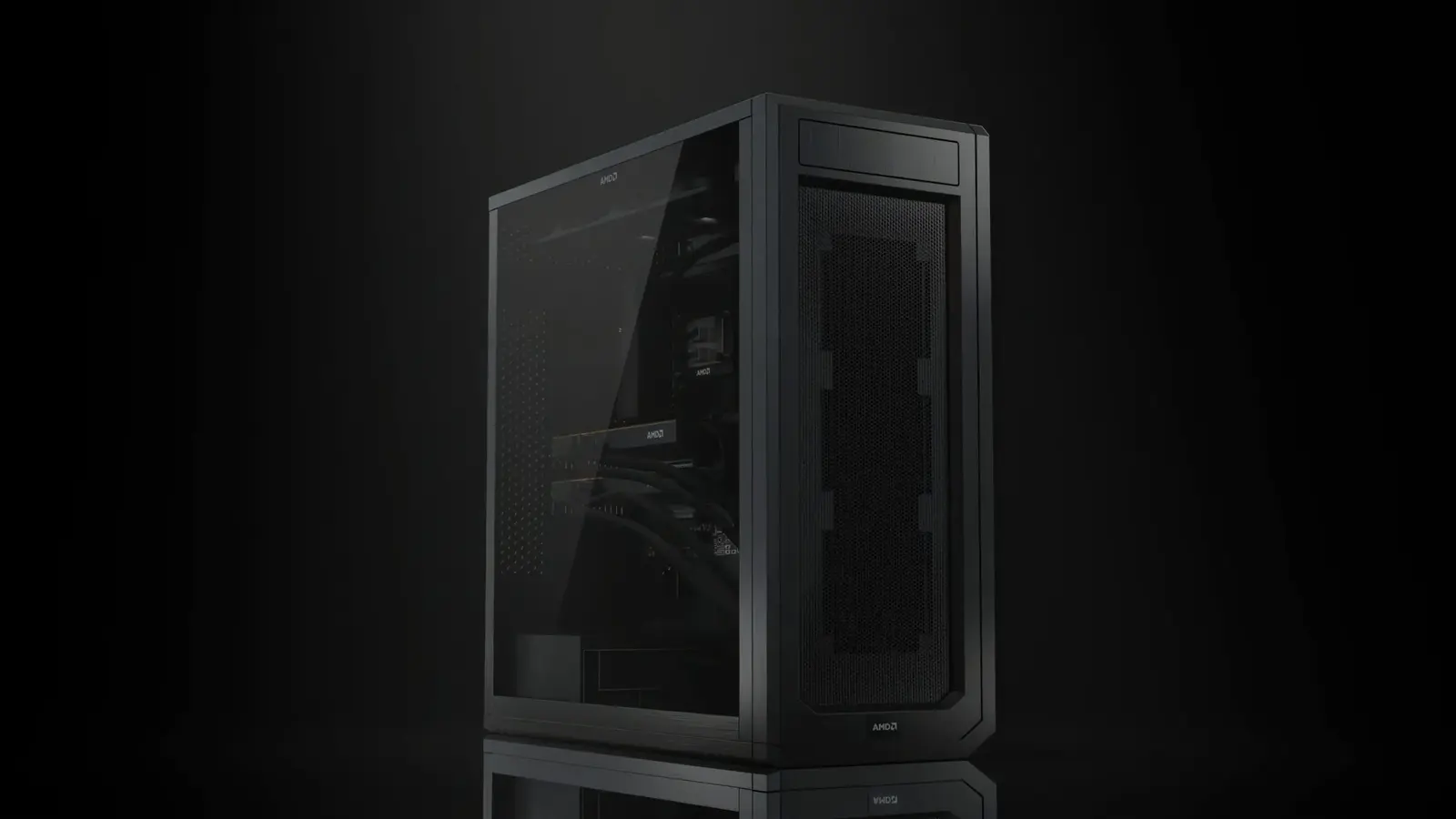
AMD pulled back the curtain on Threadripper Halo Station, a workstation that stitches together the company’s highest-end PRO components into what AMD calls the "Ultimate Personal AI Workstation." The goal is simple and audacious at once: bring massive model training, fine-tuning and inference into a single desktop chassis so developers and studios can cut reliance on expensive cloud compute.
.avif)
At the heart of the Halo Station sits a Threadripper PRO 9995WX—one of AMD’s fastest Threadripper CPUs. Think many cores. Think high clocks. This chip can reach up to 5.4 GHz and packs into a package that is optimized for throughput and heavy multitasking. But raw CPU horsepower is only part of the story.
For AI workloads, GPUs do the heavy lifting. AMD pairs the Threadripper with workstation-grade Instinct accelerators—MI350P cards equipped with HBM3e. A typical configuration ships with two of these cards, and the chassis can accept up to four, letting memory scale to a staggering 576 GB of HBM3e. Combined GPU memory bandwidth is quoted in the multi-terabyte-per-second range, while the system’s DDR5 RDIMM support reaches up to 2 TB, bringing total system memory to roughly 2.6 TB when both pools are combined.

- CPU: Threadripper PRO 9995WX — up to 96 Zen 5 cores / 192 threads, clocks to 5.4 GHz, ~384 MB cache
- GPU: Up to 4× AMD Instinct MI350P accelerators, each with 144 GB HBM3e (up to 576 GB total)
- System memory: Up to 2 TB DDR5 RDIMM (total system memory ≈ 2.6 TB)
- Chassis & cooling: Liquid cooling in a standard E-ATX Halo-styled case
- Target availability: Planned for 2027
There are trade-offs to parse. NVIDIA’s DGX Station remains a direct competitor and retains advantages in certain architectures and upgrade paths—NVIDIA supports AIC expansion cards and offers large single-chip HBM capacities on some accelerators. AMD’s argument is different: scale-out with multiple Instinct cards, mix in enormous CPU thread counts and the flexibility to swap parts with commodity components when needs evolve.


Why does that matter? Because not every team wants to rent compute by the hour. Training or running trillion-parameter models locally can shave recurring costs dramatically and remove bandwidth and privacy hurdles associated with cloud providers. In plain terms: pay once, run many. AMD explicitly positions Halo Station as a bridge for teams that need datacenter-class throughput without the datacenter footprint.
At IFA AMD didn’t stop at one box. The company also showcased the Ryzen AI MAX 400 lineup—laptops and mini‑PCs optimized for local AI tasks. These devices aim to put capable inferencing and on-device development into portable form factors, and partners including HP, Lenovo, Acer and others already previewed machines that will ship on the platform.
AMD layered software and ecosystem play over the hardware. Ryzen AI Halo systems will ship ready for Microsoft’s Project Zenith, bundling tools like Visual Studio Code, WSL, GitHub Copilot CLI and PowerShell to ease local model development. AMD also announced a collaboration with SUSE to help teams migrate applications from local development on Ryzen AI Halo into scaled, production-grade environments—one less friction point for enterprises.
Benchmarks shown at the event were eye-catching. A Ryzen AI MAX+ prototype with integrated memory reportedly executed GLM-5.3 Flash (≈320 billion parameters) at around 58 tokens per second locally. That’s practical throughput for many real-world use cases and, importantly, a cost argument: heavy reliance on hosted LLMs can quickly tally hundreds of euros per multi-million token workload. Local silicon changes that calculus.

AMD is trying to reframe how and where AI gets built—moving work from remote racks back to the desk without turning performance or expandability into a compromise.
Not everything is settled. Pricing for the Threadripper Halo Station hasn’t been announced. The DGX Station has historically carried a near-six-figure price tag, and industry watchers expect AMD to position Halo Station competitively in that neighborhood—either to match or undercut NVIDIA, depending on market strategy.
There’s also a practical upside to AMD’s parts strategy: many components in Halo Station are sourced from mainstream server and workstation ecosystems, which makes maintenance and future upgrades less proprietary and more modular. That appeals to labs and studios that plan hardware roadmaps years in advance.

In short, AMD’s pitch is engineering pragmatism combined with ambition: give developers familiar tools, let them run massive models locally, and hand them hardware that can be serviced and scaled without vendor lock-in. If the market responds, 2027 could be the year desktop AI stops being a niche and starts to feel like the sensible choice for serious teams.

Leave a Comment
Comments
No comments yet. Be the first.