
China's largest automaker BYD has filed a patent for a battery cabin that immerses cell modules directly in an electrically insulating fluid while keeping electrical equipment in a separate dry chamber. The filing describes a two‑compartment enclosure and focuses on the engineering challenge of routing electrical connections across the boundary between the wet lower chamber and the dry upper chamber.
Design, cooling approach and engineering tradeoffs
Most contemporary battery packs use indirect liquid cooling. In that approach a coolant flows through aluminum cold plates placed next to battery modules, so heat must pass through the cell case and interface materials before reaching the coolant. Immersion cooling changes that path by putting modules directly into a dielectric fluid, an electrically insulating liquid that transfers heat from the wetted surfaces of the modules straight into the surrounding fluid. That shortens the thermal path but complicates pack architecture because the fluid must be contained and electrical components that are not designed to operate in liquid must remain isolated.
The BYD patent contrasts this immersion approach with some of the company and industry production architectures. BYD's MC Cube system integrates blade cells in a cell‑to‑system layout, while MC Cube‑T is a variant that explicitly uses liquid cooling. CATL's EnerOne and EnerC energy storage products use liquid cooling with cold plates outside the modules, and CATL's Qilin passenger vehicle battery arranges a liquid cooling plate as a multifunction midlayer between adjacent cells. Those designs keep the coolant in defined channels or layers that do not fully surround the modules, whereas BYD's invention describes the modules occupying the liquid‑filled lower chamber itself and the power electronics placed in an isolated dry upper chamber.
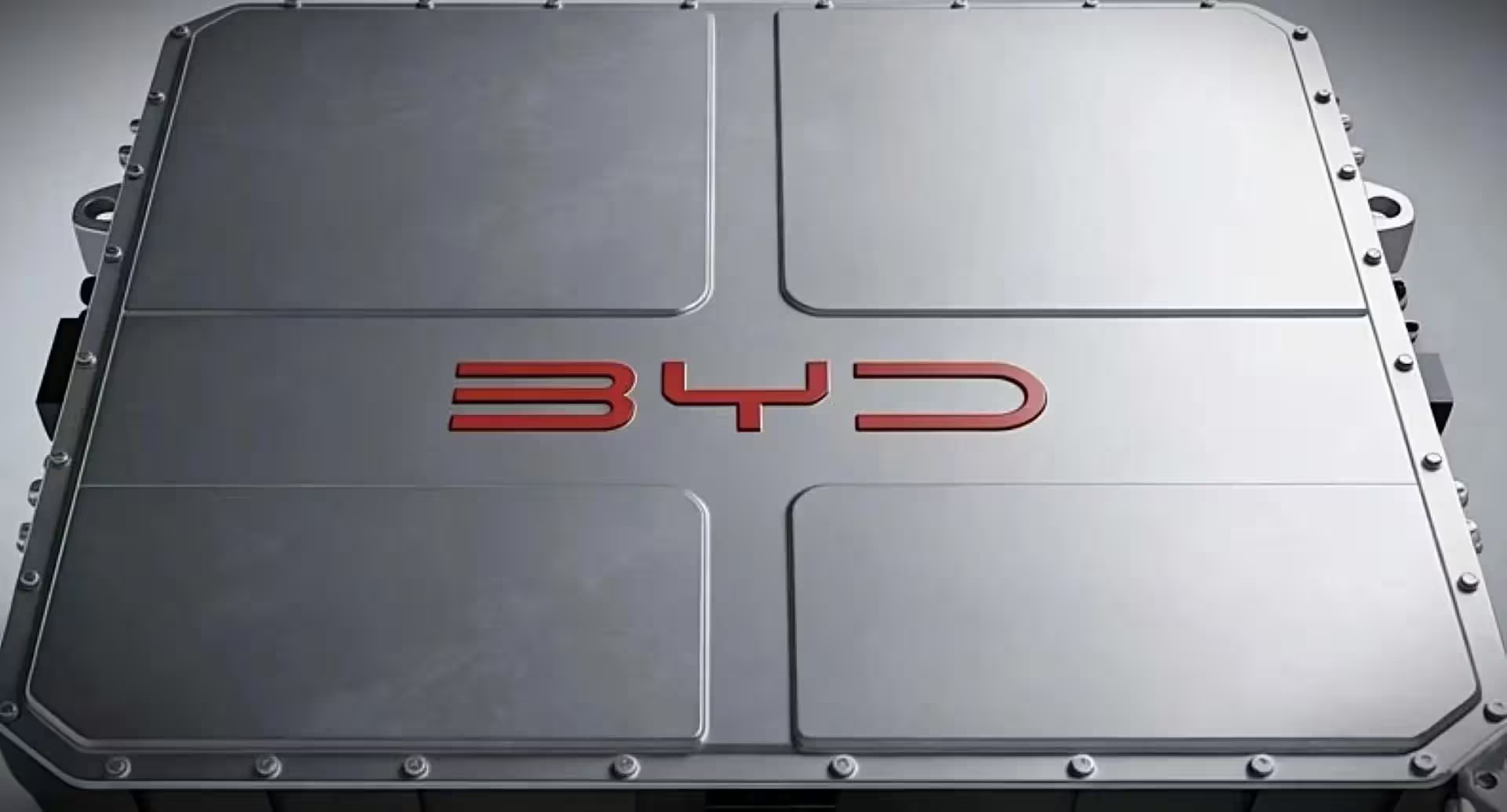
The patent document, CN 122868832 A, divides the cabin into two distinct compartments: an upper dry chamber for electrical equipment and a lower liquid chamber that contains the cell modules immersed in the dielectric fluid. Rather than routing wires and signal lines through the floor or sidewalls of the wet chamber, the design guides electrical connections upward through the top region of the liquid chamber so they enter the dry compartment above the main fluid volume. The filing explains that this placement matters because hydrostatic pressure increases with immersion depth; seals located higher in the enclosure experience lower hydrostatic pressure than seals at greater depth.
By steering connector interfaces into a higher, drier zone, the design aims to keep electrical equipment physically outside the liquid while preserving direct electrical links to the immersed modules. In other words, the patent relies not only on the dielectric and cooling properties of the fluid but also on the pack's physical layout to maintain liquid‑resistant electrical interfaces.
The document explicitly covers battery enclosures and energy storage equipment; it does not identify a specific application for passenger vehicles. The filing lists dielectric fluids, including hydrocarbon‑ or ester‑based formulations, and distinguishes those from conventional liquid coolants used in indirect cold‑plate systems.


Leave a Comment
Comments
No comments yet. Be the first.