

Ethereum reclaims ground after sharp sell-off
Ethereum (ETH) recovered roughly 4% on October 16, climbing back to about $2,462 after an intraday low near $2,325. The bounce followed a volatile session sparked by stronger-than-expected U.S. inflation readings that briefly pressured risk assets, including major cryptocurrencies and tech stocks. Traders and on-chain analysts are now parsing exchange reserves, open interest and network metrics to judge whether ETH can sustain momentum and challenge the $2,550 resistance zone.
At press time CoinGecko recorded ETH around $2,460, with a market capitalization near $300.6 billion and 24-hour trading volume of approximately $14.38 billion. Over the previous 24 hours ETH traded between $2,324.97 and $2,463.31, recovering a significant portion of Thursday’s losses.
Quick takeaways
- ETH rose about 4% in 24 hours after rebounding from a low near $2,325.
- CryptoQuant data shows Binance’s tracked ETH reserves fell by ~430,000 ETH between Aug. 25 and Oct. 16, 2026.
- Analysts identify $2,500–$2,550 as key resistance; a weekly close above $2,550 would strengthen the bull case.
- Binance ETH open interest has declined about 4.7% over 30 days, signaling reduced leverage.
- BitMine reported holdings above six million ETH — ~4.9% of circulating supply.

Context: macro shocks and liquidation flows
The rebound came after U.S. CPI and PPI data surprised to the upside, reviving concerns about higher-for-longer interest rates. The inflation prints triggered rapid deleveraging in crypto derivatives markets: one notable episode saw roughly $106 million in long liquidations on Binance within an hour, according to earlier reporting. CryptoQuant described the event as one of Binance’s largest hourly Ethereum long liquidations in six months.
Forced liquidations amplified the slide as margin positions closed automatically. That mechanical selling drove ETH briefly below $2,350 before buyers stepped in around $2,320–$2,325, setting the stage for the current recovery.
Technical picture: resistance, support and indicators
Crypto analysts now point to a resistance band between $2,500 and $2,550. If ETH can clear and hold above $2,550 on a weekly close, many traders would interpret that as confirmation that the bottom is forming and a move toward $3,000 becomes more plausible.
However, daily momentum remains mixed. The Moving Average Convergence Divergence (MACD) remained negative in the latest readings, suggesting sellers have not fully ceded control. At press time the MACD line was around -35.5 with a signal line near -8.6 and a histogram near -26.9, indicating a lack of a bullish crossover.

The Relative Strength Index (RSI) held near 41.9, below its moving average of 46.6 and under the neutral 50 threshold — again showing the market has not yet swung fully back to buyers.
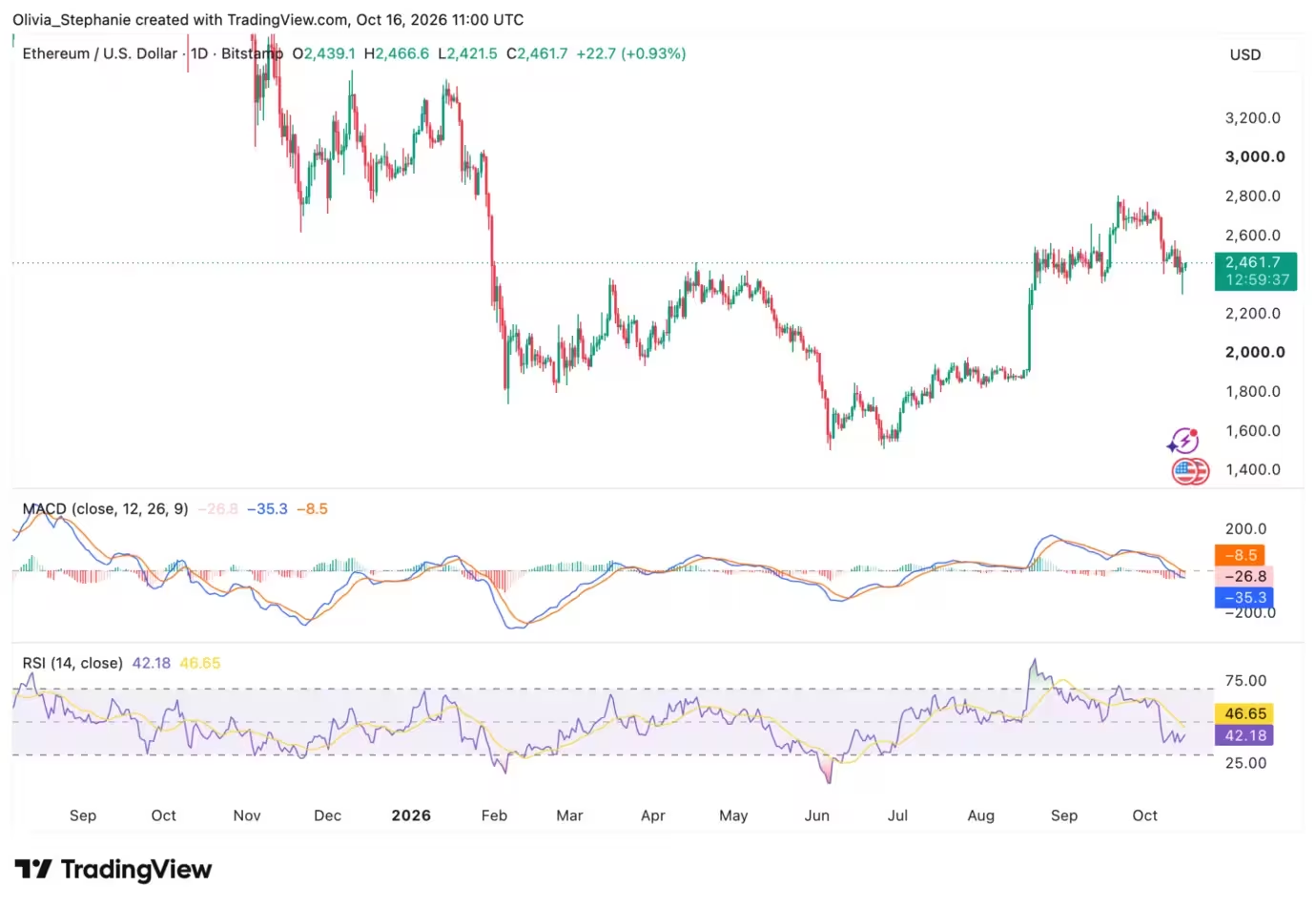
Ethereum (ETH) price chart
Key technical levels to watch
- Immediate support: ~$2,420 — holding this level would be important to prevent a deeper pullback.
- First major downside area: ~$2,400; a sustained break could expose $2,300–$2,200.
- Near-term resistance: $2,500; higher resistance cluster: $2,550. A weekly close above $2,550 would be a meaningful confirmation.
- Stretch targets if bullish momentum returns: $2,600 and then $2,750–$2,800, with upside to $3,000 on a confirmed turn.
What traders and analysts are saying
Crypto trader Alex Marzell highlighted that selling pressure eased near $2,324 after the PPI-driven flush, then ETH rallied about 6% in nine hours. Marzell emphasized that as long as $2,420 holds, dips continued to attract buyers and $2,500 would be the next notable objective.
$2,324. That's where the PPI flush on $ETH ran out of sellers, $4 above the $2,320 I said had to hold yesterday. From there it ran 6% in nine hours.
Crypto analyst Ted Pillows similarly pointed to the $2,350 support zone and flagged that resistance is light until $2,550. Pillows said a weekly close above that level would indicate the bottom is likely in, while failure to hold could leave room for one more shakeout.
On-chain flows: exchange reserves and spot volume
On-chain data paints a mixed picture. CryptoQuant analyst Amr Taha documented an 11% drop in Binance’s tracked Ethereum reserves between Aug. 25 and Oct. 16 — a decline of about 430,000 ETH (valued at roughly $1.05 billion using a reference price of $2,437.30). Binance’s tracked balance fell from approximately 3.90 million ETH to 3.47 million ETH over that period.

But lower exchange reserves do not automatically equate to accumulation by retail or institutional buyers. Withdrawn ETH can move into cold wallets, custody providers, other exchanges or DeFi smart contracts. Still, reduced exchange balances are often interpreted as a potential bullish signal when accompanied by net outflows to staking or long-term storage.
Taha also noted a substantial softening of spot trading activity across centralized exchanges: seven-day average ETH spot volume declined from $6.73 billion on Aug. 25 to approximately $3.125 billion by Oct. 15 — a drop near 53.6%. Volume outside Binance fell from $4.98 billion to $2.30 billion, while Binance’s average declined from $1.75 billion to about $825 million. The decline highlights a broader drop in trading engagement, which can limit the depth of any rally.
Liquidation exposure
CryptoQuant’s liquidation heatmap identified roughly $546 million in short-position liquidation clusters above the market and roughly $187 million in long clusters below it — implying estimated short-side liquidation risk was about 2.9x the long-side exposure at specific price points. These figures represent potential exposure at defined levels, not trades already executed.
Derivatives, leverage and demand signals
Data from CryptoQuant contributors suggests leverage in the ETH derivatives market has eased. CryptoOnchain reported Binance ETH open interest fell about 4.7% over the past 30 days to near $6.1 billion, while long liquidations rose 47% during the same period. Funding rates across derivative markets remained close to zero, indicating a neutral cost to carry positions.
Lower open interest and increased long liquidations point to reduced leverage and some erosion of overly bullish positioning. That reduction can be healthy for the market, decreasing the risk of cascade liquidations in future volatility, but it also signals that fresh leveraged buying pressure is weaker.
CryptoOnchain also flagged weaker buying demand on exchanges. Binance USDT reserves slipped roughly 2.3%, with net stablecoin flows on the platform about negative $175 million — evidence that liquidity for new spot buys has not fully returned. The Coinbase Premium indicator sampled by the analyst sat at -0.11 during the observation window, suggesting relatively weak demand on Coinbase compared with the benchmark market used by the metric.
Network activity and staking

On-chain usage metrics were similarly subdued: transaction counts were down about 4% and burned transaction fees dropped 58% over the measured period, pointing to lower transaction-driven fee demand. At the same time, staking remained elevated — CryptoOnchain reported a staking rate of 36.1%, placing it at the 98.6th historical percentile. High staking rates reduce circulating supply and can support price under certain conditions, though they also reduce immediate liquidity available to buy or sell.
The analyst concluded the on-chain picture was neutral overall. He noted that a meaningful return of USDT liquidity to Binance and a positive shift in Coinbase Premium would be constructive signs for a sustained ETH recovery.
Corporate accumulation: BitMine holdings
Corporate balance sheets are also shaping supply dynamics. BitMine Immersion Technologies, led by Fundstrat co-founder Tom Lee, reported holding 6,028,946 ETH after an Oct. 12 purchase of 12,532 tokens. That stake represents roughly 4.9% of Ethereum’s circulating supply, according to the company’s treasury figures. BitMine has publicly stated a target of accumulating about 5% of the total supply and has staked a large portion of its holdings.
As of Oct. 4, BitMine reported 5,067,309 ETH staked. During an Oct. 7 investor presentation, Tom Lee said BitMine was nearing its 5% objective after around 15 months of accumulation and might stop adding ETH once the target is reached. If corporations continue to shift capital into long-term ETH treasuries and staking, it could reduce sell-side pressure and aid higher price floors.
Outlook: scenarios and catalysts
Near-term outcomes for ETH will likely hinge on a handful of variables:
- Macro forces: Further upside surprises in inflation or hawkish commentary from central banks could re-ignite selling across crypto and equities. Conversely, softer macro beats would help risk appetite.
- Technical confirmation: A weekly close above $2,550 would be a strong positive technical signal. Failure to hold $2,420/$2,400 increases the risk of retesting $2,300–$2,200.
- Exchange liquidity and stablecoin flows: Renewed inflows of USDT/USDC to exchanges — especially Coinbase and Binance — would signal return of buying power.
- Derivative positioning: Further reductions in open interest and deleveraging reduce tail risk, but also limit fuel for rapid rallies driven by leverage.
- Corporate and staking demand: Continued accumulation by firms like BitMine and high staking rates remove liquid supply and can support higher price floors over time.
Bottom line
Ethereum’s 4% rebound signals buyers remain present after the inflation-driven sell-off, but technical indicators and trading volumes do not yet confirm a sustained trend reversal. Clearing and holding $2,550 on a weekly basis would materially improve the odds of a durable recovery and open the door toward $3,000. Absent that confirmation, the market remains vulnerable to another leg down toward $2,300–$2,200 if macro conditions or liquidity metrics deteriorate.

Traders should monitor exchange reserves, stablecoin flows, open interest and key technical levels while keeping an eye on macro developments that can sway risk-on sentiment. For longer-term investors, staking activity and corporate accumulation offer structural narratives that could support ETH over time, even amid short-term volatility.

Leave a Comment
Comments
No comments yet. Be the first.