

BTC Falls Under $81,000 as Macro Data Sparks Crypto Selloff
Bitcoin slipped beneath the $81,000 mark on October 15, extending a short-term correction after hotter-than-expected U.S. inflation figures and broad risk-off pressure across Asian equities. The move erased more than 3% of BTC's value in 24 hours and coincided with roughly $483 million in combined Bitcoin and Ethereum futures liquidations, according to CoinGlass. Crypto traders and institutional investors adjusted exposure as policymakers and market participants parsed implications for future interest-rate policy.
Market snapshot: prices, volume and capitalization
During Thursday's Asian session, CoinGecko recorded Bitcoin trading near $80,664, down about 3.2% over 24 hours and down 2.5% over the last seven days. Daily trading volume for BTC hovered around $40.4 billion while total market capitalization sat near $1.62 trillion. Ether experienced greater downside and heavier forced liquidations among derivatives traders, reflecting the event-driven volatility across top cryptocurrencies.
US inflation print re-ignites rate concerns
The U.S. Bureau of Labor Statistics reported a 3.7% year-over-year increase in consumer prices for September, above August's 3.4% reading. Monthly CPI rose 0.6%, while core CPI (excluding food and energy) increased 0.3% for the month and reached 2.6% year-over-year — slightly above economists' median expectations. Energy costs were a notable contributor: gasoline alone surged about 9.1% in September and the broader energy index jumped roughly 5.2% on the month, jointly accounting for a substantial portion of the monthly headline move.

Higher-than-forecast inflation intensifies market speculation that the Federal Reserve could maintain restrictive policy settings longer or even consider additional rate hikes. Rising interest-rate expectations typically reduce the present value of future cash flows and can weigh on risk assets, including equities and cryptocurrencies. While CPI prints do not mechanically determine Bitcoin’s short-term path, they influence investor positioning across asset classes and margin-dependent derivatives markets.
Futures liquidations escalate volatility
Derivatives data showed significant forced closures as leveraged long positions were wiped out. CoinGlass reported around $483 million in Bitcoin and Ethereum liquidations over the prior 24 hours. Ethereum accounted for the lion’s share, with roughly $286 million in liquidations versus about $197 million for Bitcoin. These totals reflect the notional value of closed positions rather than direct losses to individual traders.
How liquidations amplify market moves

A liquidation happens when margin requirements are breached and exchanges automatically close positions to prevent a negative account balance. In a falling market, mass liquidation of long positions can accelerate downward price pressure as exchanges sell collateral or traders exit, creating feedback loops that intensify volatility. Notably, ether’s futures exposure — estimated near $30 billion in open interest — produced outsized liquidation totals relative to its smaller derivatives market compared with Bitcoin’s approximate $52 billion futures open interest.
During the sharp move, Ether dropped roughly 6.4% toward $2,356 while Bitcoin fell around 3.2% toward $81,000. Other major tokens also suffered: Solana declined about 5.5% with its futures market reporting roughly $31 million in liquidations; Zcash plunged nearly 13% with almost $19 million in forced closures; XRP and Dogecoin slid close to 5% and 6%, respectively. Earlier analyst warnings had highlighted the risk of a leverage-driven shakeout if U.S. CPI surprised to the upside, and the fresh data triggered that scenario.
Asian equities tumble, reinforcing risk-off tone
Crypto’s weakness came alongside a notable selloff in Asian stock markets. South Korea’s Kospi plunged approximately 8% during morning trading, driven in part by steep declines in semiconductor heavyweight shares such as Samsung Electronics and SK Hynix, each falling more than 9%. Japan’s Nikkei 225 also declined about 5%, with tech sectors among the worst hit.
The ripple extended from U.S. markets, where Wall Street saw broad losses the prior session: the Nasdaq Composite closed down 1.88%, the S&P 500 fell 1.11% and the Dow slipped marginally. Technology stocks were particularly sensitive to changing rate expectations. With both equity and crypto markets moving lower, traders reassessed portfolios that had leaned on momentum and leverage.
Technical outlook: key BTC levels and indicators
On-chain and chart-based analysts flagged an important structural level just above $80,000. Crypto analyst Crypto Patel pointed to $80,108 as critical support after Bitcoin fell from roughly $87,360 to about $80,200 — a 7.5% swing he described as a confirmed downside move. Patel warned that a clean break and a confirmed high-timeframe candle close beneath that level could open the path to a broader $70K–$65K zone.
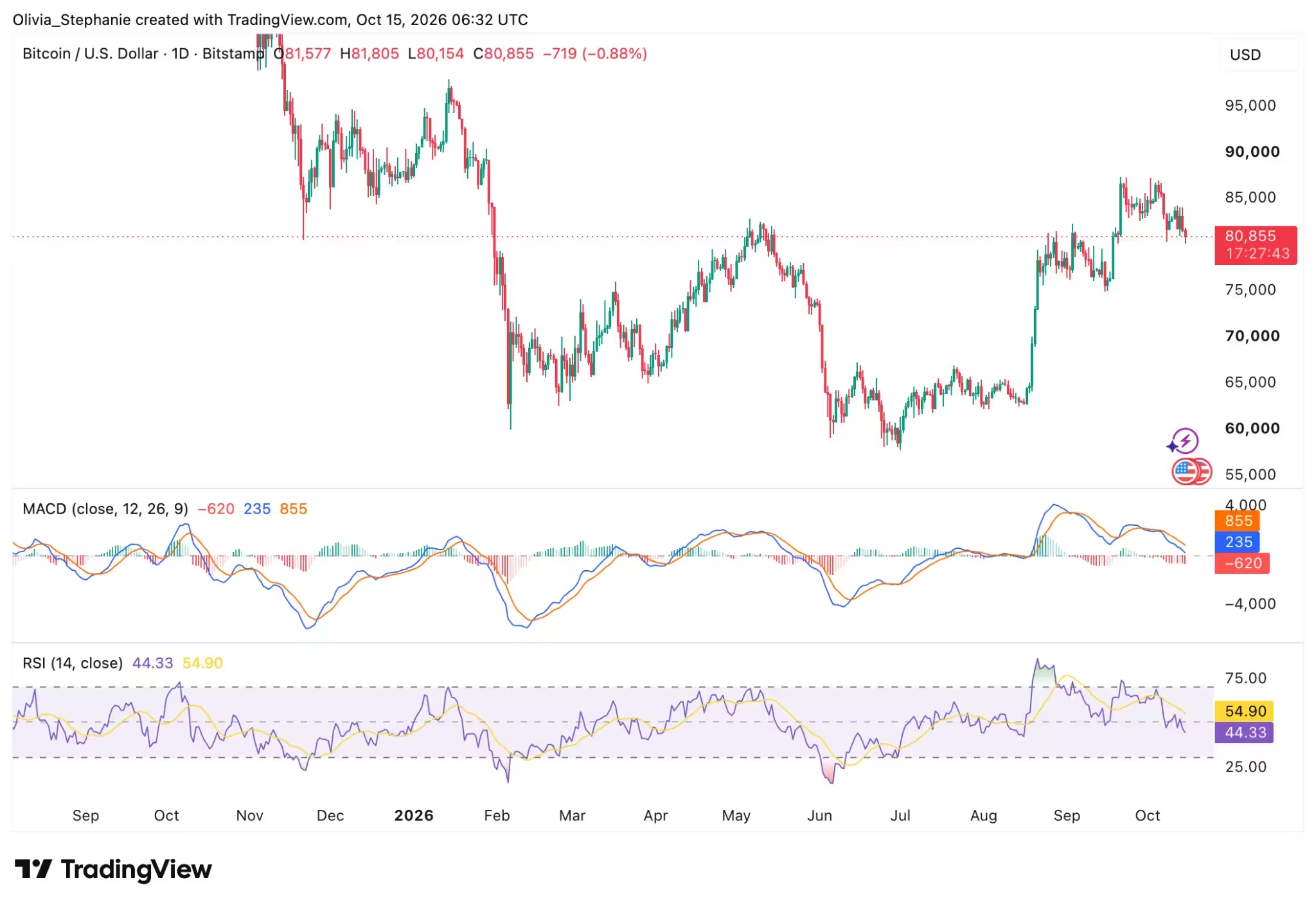
Bitcoin (BTC) price chart
Momentum indicators and immediate levels
On the daily chart, the Moving Average Convergence Divergence (MACD) remained below its signal line and showed a negative histogram reading near -629, signaling weak short-term momentum. The Relative Strength Index (RSI) measured about 43.92, below the neutral 50 mark and its moving average of 54.87 but not yet oversold (below 30). Traders identified $80,000 as the immediate focal point: a sustained breach could expose additional support bands, while a renewed push above $83,000–$85,000 would reflect a restoration of short-term bullish momentum.

Analysts who mapped out downside scenarios mentioned intermediate levels such as $75,000 and $70,000 as potential stopping points, with more extreme downside targets around $57,000 in highly stressed deleveraging conditions. These projections represent technical possibilities and should be treated as conditional, not inevitable price trajectories.
Market commentary and analyst views
Crypto Lens, another market commentator, said the broader crypto market lost more than $140 billion in value during the selloff and flagged a sequence of lower potential Bitcoin targets. Such commentary often varies by methodology: some analysts aggregate spot and derivatives losses or include unrealized losses across leveraged positions, which can generate differences from exchange-reported liquidation tallies.
A snapshot of social sentiment reflected warnings about a potential renewed leverage purge if inflation measures continued to surprise. Traders managing futures and perpetual swaps paid particular attention to funding rates, open interest, and exchange-level liquidations to gauge whether the move could accelerate into a larger deleveraging event.
What traders and investors should watch next
Key variables that will likely determine near-term crypto market direction include upcoming macroeconomic data, Federal Reserve commentary, and technical behavior around the $80,000 area. If inflation momentum cools in subsequent releases or central bank commentary leans toward policy easing expectations, risk assets including Bitcoin could stabilize and reclaim higher ranges. Conversely, persistent inflation could keep real yields elevated and limit upside for high-beta assets.
On the crypto-specific front, monitoring derivatives metrics (open interest and funding rates), exchange flows, and liquidation clusters can provide early warning signs of renewed stress. For spot-focused investors, watching support bands around $80,000 and $75,000 and resistance around $83,000–$85,000 will be important for trade and risk management decisions.
Risk management for volatile markets
Given the role of leverage in amplifying moves, market participants are advised to reassess position sizing, margin utilization and stop levels. Diversifying execution across spot and hedged derivatives, maintaining adequate collateral buffers, and avoiding extreme concentration in illiquid positions are standard risk controls that can reduce the potential for forced liquidations during fast moves.
Conclusion: cautious trading amid macro uncertainty
Bitcoin’s drop below $81,000 on October 15 underscores how macroeconomic surprises — particularly U.S. inflation data — can rapidly reshape sentiment across crypto and equity markets. With roughly $483 million in combined BTC and ETH futures liquidations and growing concerns over interest-rate trajectories, traders face a two-way market where technical breakdowns can trigger accelerated downside while policy or data-driven relief could spark a recovery toward prior resistance zones.

For investors tracking Bitcoin and ether, the coming days should clarify whether $80,000 holds as a pivot or if deeper corrections toward the $70K–$65K area become more probable. Meanwhile, monitoring derivatives activity, funding rate dynamics and central bank commentary will remain essential.

Leave a Comment
Comments
No comments yet. Be the first.