

Bitcoin edges toward $84,000 as markets await U.S. inflation
Bitcoin (BTC) traded close to $83,538 on October 14 after briefly touching roughly $83,900 during Asian sessions, as traders digested fresh commentary from the Federal Reserve ahead of the U.S. Consumer Price Index (CPI) release. With on-chain activity increasing among older coin holders and macro cues dominating risk assets, market participants are watching whether U.S. inflation figures could spark a decisive move for BTC.
Key price levels and market snapshot
CoinGecko tracked Bitcoin near $83,500 with an approximate 24-hour reported trading volume of $982 billion and a market capitalization around $1.68 trillion. The digital asset was effectively flat for the previous 24 hours, while technicians highlighted $84,000 as the immediate resistance to monitor. On the upside, conditional targets were discussed by analysts if BTC could sustain momentum above that threshold.
Technical outlook: resistance at $84K and a conditional path to $93K
Technical analysts remain focused on the $84,000 mark. Ali Martinez, among others, flagged a four-hour chart structure that mirrors earlier recovery patterns where a move above the 50-period moving average catalyzed a larger rebound. In that prior scenario, the 200-period simple moving average acted as support while a close above the 50-period average confirmed the trajectory higher. Martinez suggested that a confirmed four-hour close above approximately $84,000 could clear the way toward a conditional target near $93,000 — but emphasized that such a projection depends on Bitcoin clearing resistance and maintaining upward momentum.
Daan Crypto Trades also pointed to the $83,000 region as a pivotal level on both daily and weekly timeframes. He noted that BTC formed a higher low prior to the recent bounce, and that much of the visible liquidity remained stacked above current prices. In his view, a softer CPI print could prompt price action toward those liquidity pockets.
Short-term indicators show faded momentum
Momentum indicators on daily charts suggest the recent advance has lost some steam. The MACD readings indicated a bearish histogram and a MACD line below the signal line, signaling weakening buying pressure even though both lines remain above zero. The Relative Strength Index (RSI) sits near neutral territory, reflecting neither overbought nor oversold conditions and highlighting the market’s current indecision.
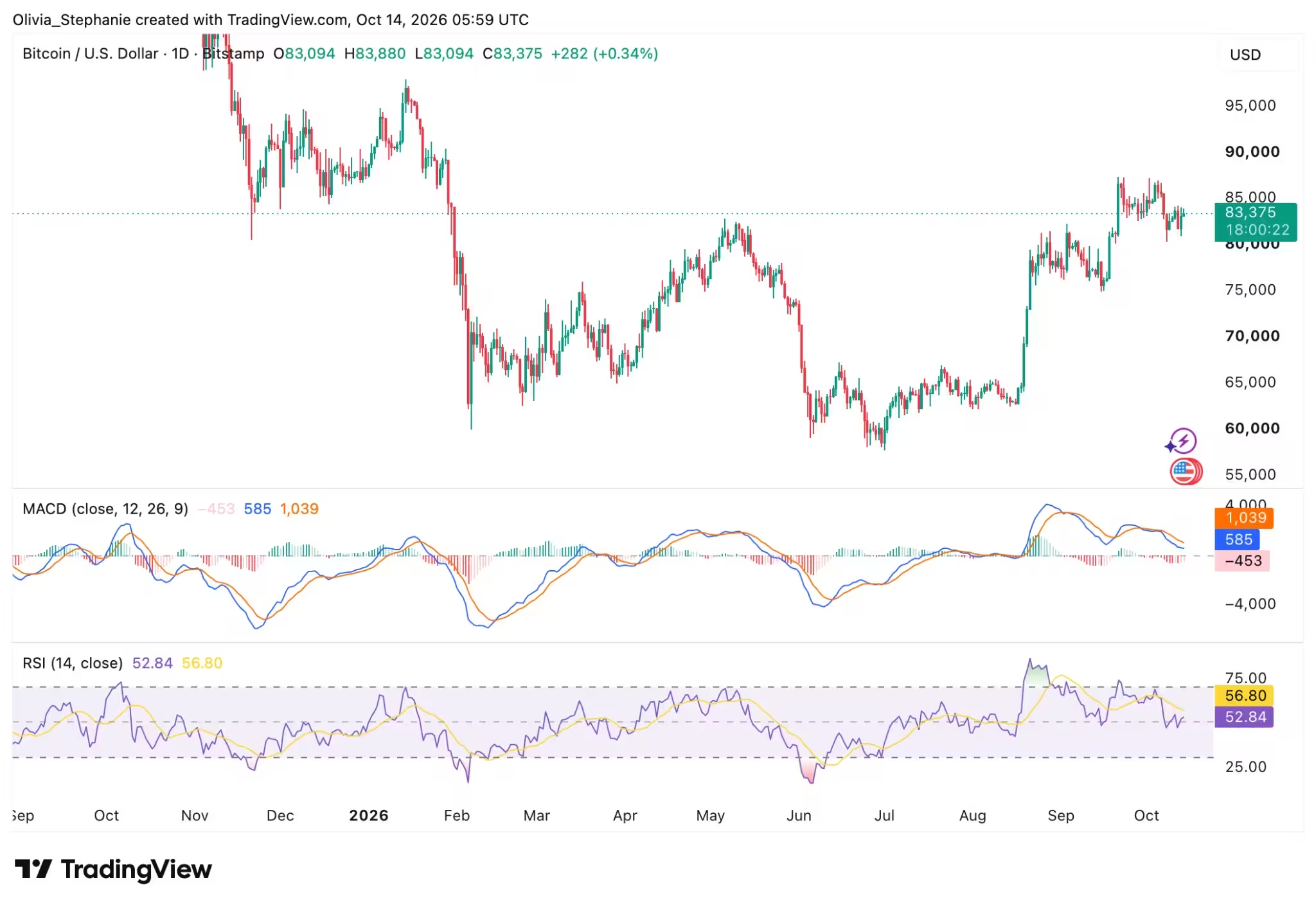
Bitcoin (BTC) price chart
Overall, the chart suggests immediate support around $81,000–$82,000 and resistance closer to $86,000–$88,000. A sustainable break above $86,000 would shift focus toward the next range around $88,000–$90,000, whereas a drop below $81,000 could expose lower support between $78,000 and $80,000.

Fed commentary and macro context: how interest-rate signals move crypto
New York Federal Reserve President John Williams added another layer of macro uncertainty when he indicated that an additional rate increase could be appropriate before the end of 2026, while suggesting that 2027 might not demand further hikes. These remarks followed the Fed’s September decision to raise its policy rate by 25 basis points to a 3.75%–4.00% range.
Williams characterized inflation as a continuing concern but said price pressures could ease as energy markets stabilize and some tariff effects fade. His comments triggered a modest pullback in the U.S. dollar and Treasury yields, which in turn reduced some market expectations for aggressive further tightening — at least temporarily. However, he was clear that incoming economic data could alter that outlook.
Macro headlines matter for crypto because interest-rate expectations influence dollar strength, risk appetite, and flows into speculative assets like Bitcoin. Softer-than-expected inflation could embolden risk-taking and lift BTC, while hotter CPI prints would likely reinforce hawkish Fed expectations and pressure risk assets.
Upcoming data: CPI and Producer Price Index
The U.S. Consumer Price Index for September was due on October 14 at 8:30 a.m. Eastern Time, with Producer Price Index (PPI) figures scheduled for the following day. The Bureau of Labor Statistics had reported annual inflation at 3.4% in August, with a monthly increase of 0.4% — making September’s reading a high-impact input ahead of the Fed’s next policy discussion.
Both CPI and PPI offer fresh information on price pressures facing consumers and businesses, but their immediate effects on Bitcoin will depend on market expectations, liquidity, and how institutional and retail participants interpret the data in the context of interest-rate paths.
On-chain signals: older coins begin to move
Blockchain analytics are adding nuance to the price conversation. CryptoQuant observed increased movement among coins that had been dormant for one to three years and those held for more than three years. Activity in these age bands picked up in late September as Bitcoin recovered from the mid-$70,000s into the mid-$80,000s, mirroring earlier bursts of movement seen in January–February and again between late July and mid-August.
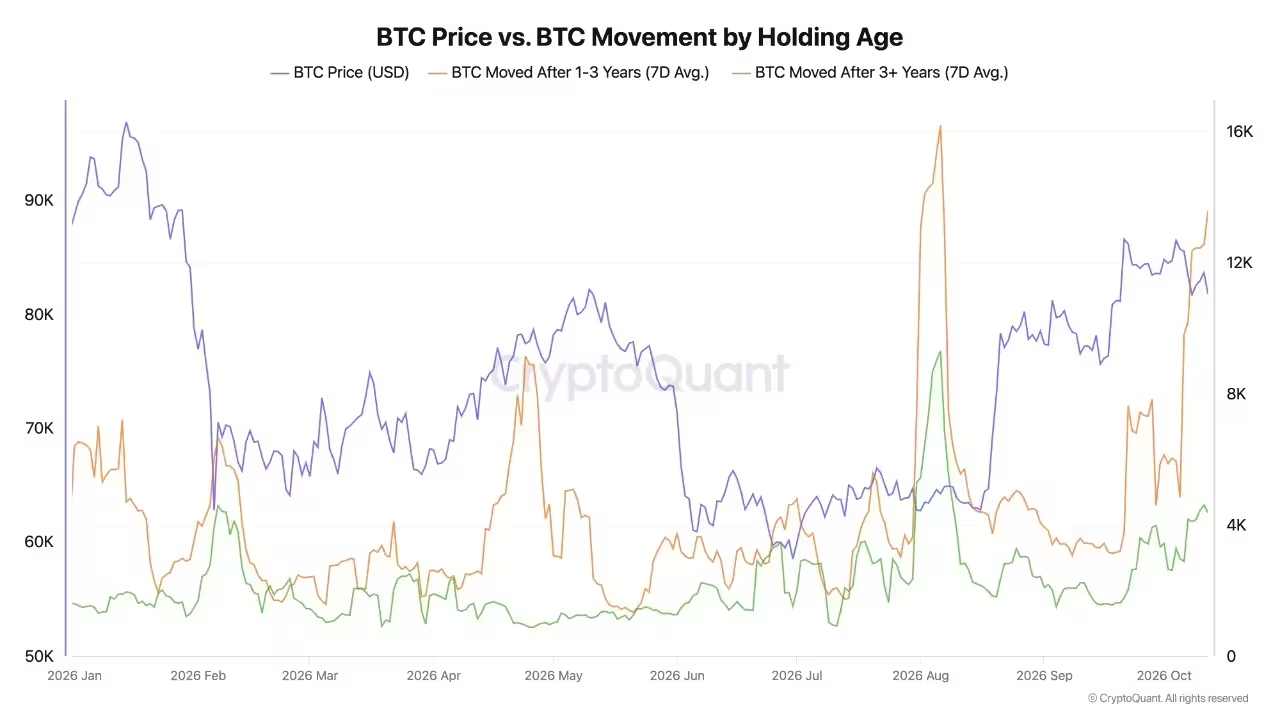
Analysts cautioned that elevated transfers of old coins do not equate directly to selling. Wallet-to-wallet transfers, custodial reshuffles, or internal consolidations by the same owner can all register as greater on-chain activity without indicating spot-market supply pressure. Additionally, heightened transfers may reflect security responses from long-term holders rather than intent to exit positions.
Ledger hardware compromise prompts defensive moves

Part of the uptick in long-term coin transfers may be explained by security concerns after Ledger confirmed discovery of an unauthorized hardware implant in a device sold through a Southeast Asian reseller. The compromised component allegedly could capture recovery phrases shown during device setup and transmit them via a cellular link.
Ledger advised potentially affected customers to initialize new devices and adopt fresh recovery phrases, warning that restoring an exposed recovery phrase to a new device would not secure funds if the phrase had already been compromised. As a result, some long-term holders appear to be moving holdings into new wallets with new seed phrases — a pattern that could temporarily raise on-chain movement metrics without signaling wholesale sell-offs.
CryptoQuant has noted that seven-day moving averages for older-coin activity are likely to rise while affected users migrate funds to secure environments. The analytics provider did not quantify how much of the recent activity is tied directly to Ledger-related migrations.
Market implications and trading considerations
For traders and investors, the immediate question is whether a U.S. inflation print will act as a catalyst to push Bitcoin through $84,000 and possibly toward the higher target bands identified by technicians. Key considerations include:
- Inflation surprise risk: A weaker-than-expected CPI could ease rate-hike fears and lift BTC, while stronger-than-expected data would likely trigger repricing toward tighter policy expectations.
- Liquidity and order blocks: Much of the visible liquidity sits above current prices; therefore, sharp moves could be amplified if market participants chase breakouts or if stop-loss clusters are triggered.
- On-chain flows vs. market sales: Increased movement by long-dormant coins does not automatically mean selling pressure; custodial changes and security-driven migrations can temporarily increase supply-side signals without translating to spot market dumps.
- Technical confirmation: Traders looking for confirmation should watch for a sustained four-hour close above $84,000 and subsequent support retests, alongside improving momentum readings such as a MACD recovery above its signal line.
Short-term scenarios to monitor
Bull case: CPI prints softer than consensus, dollar weakens, BTC clears $84,000 on strong volume, and momentum indicators turn bullish — opening a potential run toward $88,000–$93,000 in an orderly fashion.
Base case: CPI in line with expectations, price remains in a range between $81,000 and $86,000 as participants wait for clearer macro direction; on-chain activity continues but does not force a breakout.
Bear case: CPI surprises to the upside, Fed-hike odds rise, BTC fails to hold near-term support around $81,000, and selling pressure pushes prices toward the $78,000–$80,000 zone.
Conclusion: data-driven risk management critical for crypto traders
As Bitcoin hovers near $84,000, the path ahead will likely be shaped by the upcoming U.S. inflation releases and ongoing Fed commentary. Traders should combine technical signals with macro triggers and on-chain evidence when assessing risk and sizing positions. Meanwhile, security developments such as the Ledger incident underscore the need for cautious custody practices among long-term holders.
Whether U.S. inflation acts as the decisive spark for a sustained Bitcoin rally remains uncertain. What is clear is that a mix of technical resistance, concentrated liquidity, central-bank signaling, and evolving on-chain behavior will determine the next meaningful directional move for BTC.


Leave a Comment
Comments
No comments yet. Be the first.