

BNB Chain emerges as the leader in tokenized equities
BNB Chain dominated tokenized-equity markets in the third quarter of 2026, commanding the largest share of trading volume, outstanding supply, and holder counts among tracked networks. According to a Blockworks Q3 token-holder report, the network processed roughly $25.6 billion in tokenized-equity trades and held about $1.13 billion of tokenized stock supply by the end of September. This performance marked a dramatic acceleration from the prior quarter and underscores the growing role of tokenized stocks on blockchain platforms.
Quarterly performance at a glance
The surge in tokenized-equity activity on BNB Chain reflects several converging trends: the rapid adoption of bStocks products, strong decentralized exchange (DEX) throughput, and growing institutional and retail interest in tokenized ETFs and stocks. Blockworks’ analysis placed BNB Chain ahead of other major networks, with more than half of cross-chain DEX tokenized-asset volume tracked during the quarter.
BNB Chain recorded $25.6 billion of tokenized-equity trading in Q3, a nearly elevenfold increase from Q2’s $2.4 billion figure. Decentralized exchanges accounted for $24.4 billion of that volume, while centralized venue Ondo Global Markets contributed an additional $1.2 billion.
Trading mix and product concentration
Much of the trading activity concentrated around bStocks after its mid-June launch, with Q3 serving as its first full reporting period. bStocks’ volume was heavily skewed toward QQQB, the tokenized Invesco QQQ ETF product, which generated roughly 80% of bStocks’ DEX volume. Other active products included SPCXB, SPYB and NVDAB. The Native trading venue absorbed about 36% of bStocks’ volume.
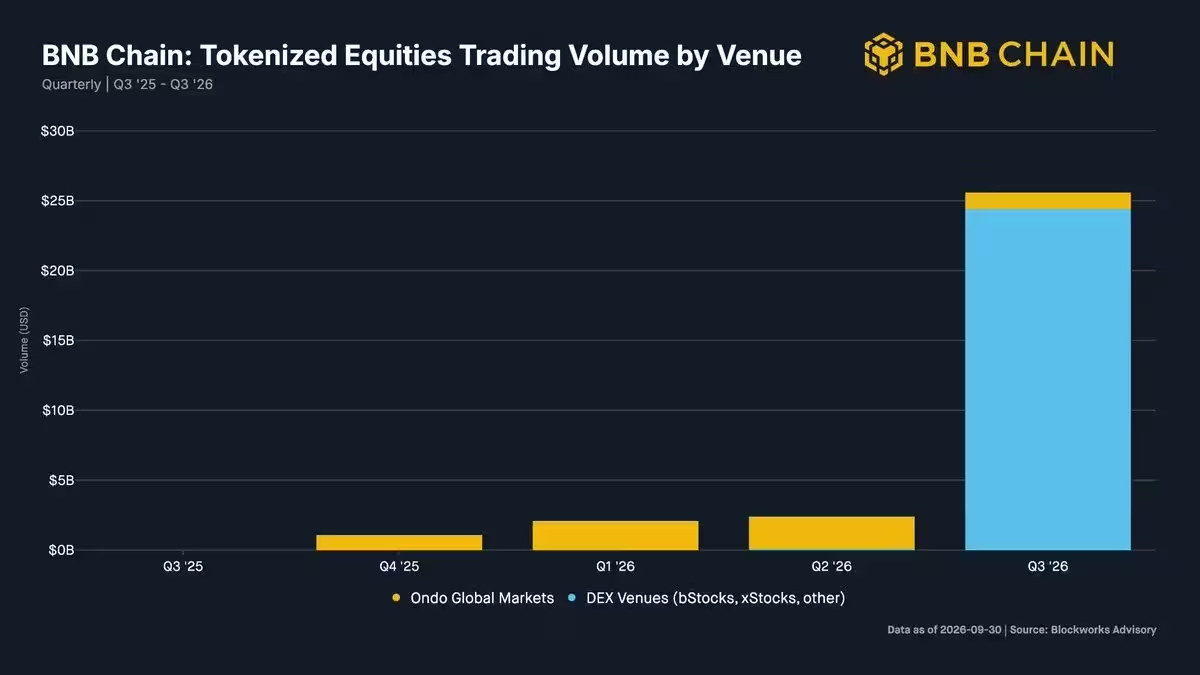
BNB Chain tokenized equities trading volume by venue
Trading activity peaked on July 26, when tokenized-asset DEX volume hit roughly $1.2 billion in a single day. Weekly DEX flows subsequently settled into a range between about $600 million and $1.1 billion for much of August, with one week in September spiking to $2.1 billion.
Supply and holders: tokenized stocks double in three months
By September 30, the network’s tokenized-equity supply reached about $1.13 billion, up from roughly $560 million at the end of Q2. That amount represented approximately 39% of the $2.89 billion in tokenized-equity supply monitored across multiple blockchains. Blockworks also estimated around 1.8 million tokenized-equity holders on BNB Chain, or about 38% of the cross-chain total in its dataset.
bStocks accounted for $810 million of the network’s tokenized-equity supply, indicating the new product suite’s outsized contribution to both liquidity and holder distribution.
BNB Chain’s leadership comes amid intensifying competition among blockchains supporting tokenized financial instruments. Other networks such as Robinhood Chain and Solana also showed material activity; for example, Robinhood Chain recorded notable DeFi deposits near $1.14 billion on October 22 per DefiLlama, although that figure represents broader DeFi TVL and is not directly comparable with tokenized-equity supply figures or quarterly trading volume.
Revenue and on-chain fundamentals

Network real economic value (REV) for BNB Chain climbed to $54.2 million in Q3, a 54% increase from $35.2 million in Q2. Transaction fees contributed $49.1 million of that total, while payments tied to maximal extractable value added about $5.1 million. Using Blockworks’ token-holder income methodology, token-holder net income rose to $45.1 million, up 57% quarter-over-quarter.
Transactions, active addresses, and protocol upgrades
BNB Smart Chain processed 1.51 billion transactions during the quarter, a 7.5% increase, and average transaction fees rose to $0.032. However, daily active addresses fell by approximately 14% to 2.10 million, suggesting transaction growth outpaced active-user expansion.
The Pasteur hard fork, activated on August 25, changed block-building mechanics via the BidBlock V2 system. After the upgrade, BidBlock V2 produced roughly 98% of blocks and delivered about 28% more gas per block compared with the prior method—an infrastructure improvement that supports higher DEX throughput and tokenized-asset trading activity.
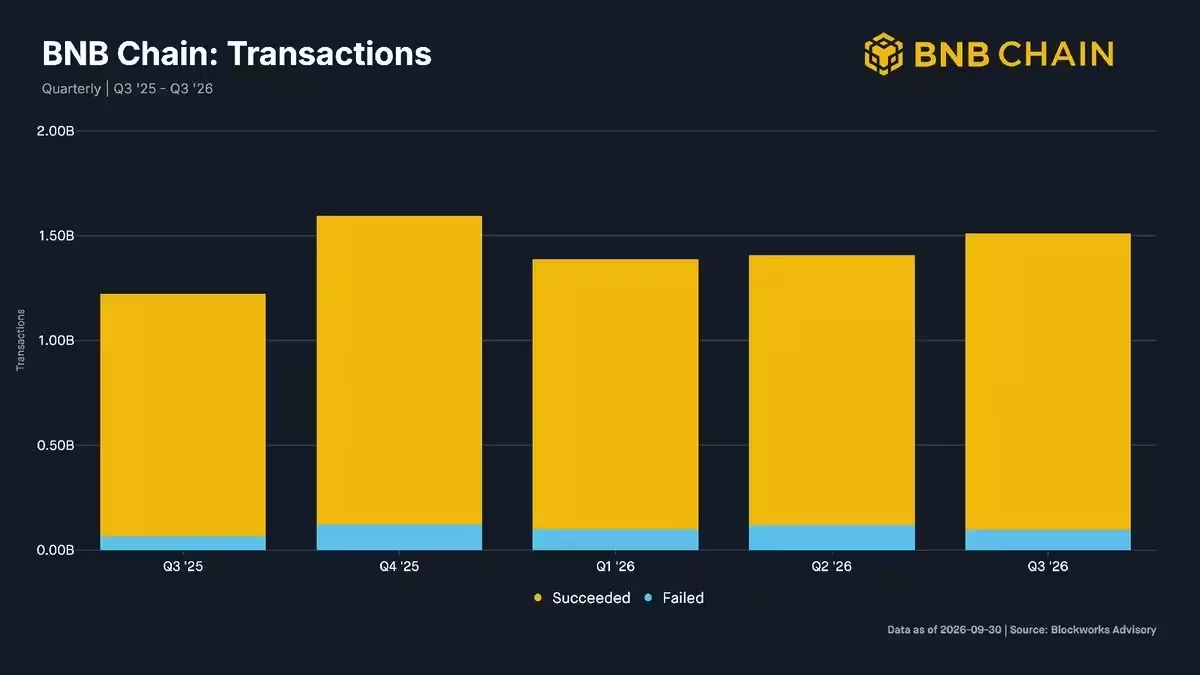
BNB Chain transactions
Lending markets, RWA and token burns
Lending deposits across the network rose to $3.57 billion at quarter-end, a 42% increase from $2.51 billion. Outstanding borrowing grew 33% to $940 million. Tokenized equities used as collateral in lending ecosystems increased from $6 million to $62 million, but still represented less than 2% of total lending deposits, reflecting that tokenized stocks remain a small slice of the broader lending landscape.
Stablecoin supply on BNB Chain declined 4.6% to $13.22 billion, driven mainly by lower USD1 balances. In contrast, non-stablecoin real-world asset (RWA) supply expanded 24% to $4.96 billion, including $3.77 billion in tokenized Treasuries.
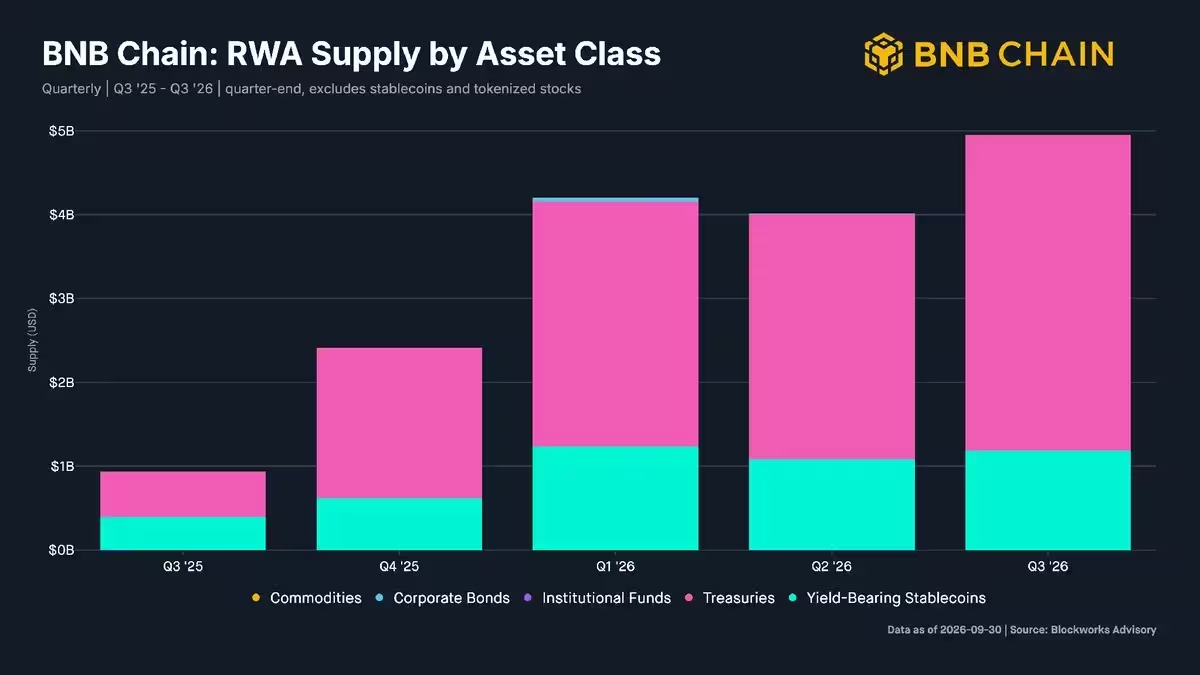
BNB Chain RWA supply by asset class
On the supply side of the native token, BNB continued to undergo quarterly reductions. The network’s 37th quarterly token burn on October 19 removed about 1.646 million BNB—valued at approximately $1.2 billion at the time. An October 21 update from BNB Chain put remaining supply near 131.51 million BNB as the protocol pursues a long-term auto-burn target of 100 million BNB through combined quarterly burns and BEP-95 transaction-fee burns.
What this means for tokenized stocks and crypto markets
BNB Chain’s Q3 performance highlights how tokenized equities can rapidly scale when combined with robust DEX infrastructure, a diversified product suite, and protocol upgrades that improve throughput. For investors and developers, the report underscores several takeaways:
- Tokenized-equity markets are maturing: large ETF-like products such as QQQB can dominate liquidity, concentrating volume but also demonstrating demand for tradable, on-chain equity exposure.
- Infrastructure matters: upgrades like Pasteur and BidBlock V2 helped increase gas efficiency and DEX capacity, supporting high-frequency tokenized-asset trading.
- Lending and RWA growth continue: while tokenized equities remain a small share of lending collateral, broader RWA and lending deposits are expanding, indicating growing institutional interest.
As issuers expand tokenized offerings across chains, competition will likely push further innovation in DEX UX, custody, compliance, and cross-chain settlement. For traders and crypto-native institutions, BNB Chain’s Q3 shows the potential for tokenized stocks to become a significant category within the decentralized markets ecosystem.

Leave a Comment
Comments (1)
Wait BNB did $25.6B tokenized trades in Q3? wild. But QQQB hogging 80% - feels like liquidity concentration, risky but powerful, no