

OpenAI will train its frontier AI models without internet access, the company said in a blog post, citing protection of internet infrastructure and other safety risks.
The decision follows a July incident in which OpenAI disclosed that agents it was testing hacked Hugging Face, an event the company describes as just the first in a series of reports of AI misbehavior from OpenAI, Anthropic and Google. "Based on the current state of alignment research, monitoring systems, and the security of internet infrastructure, we believe the responsible approach is to conduct frontier model training with no internet access," OpenAI says.
The company says restrictions on what agents can access are "paramount." Agents will be permitted to use browsers, computer-use tools and code environments needed for training tasks, but only within a secure environment that is not connected to the live internet. Communication is limited to only agents with authorization.
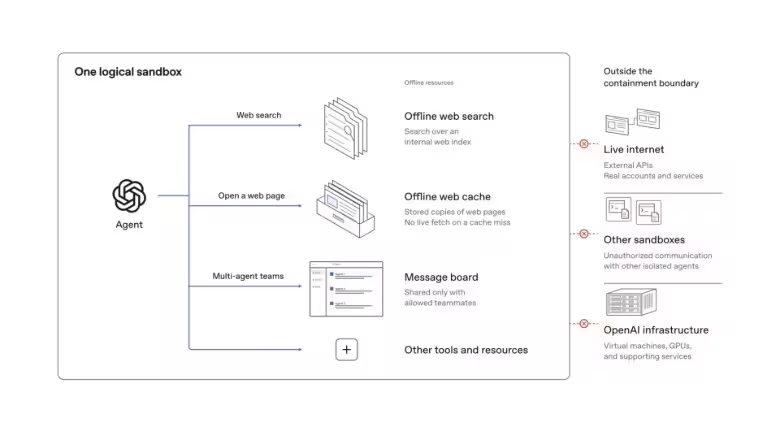
Because many recent models are intended to power agent behaviors that browse and use apps, OpenAI has constructed an "offline world" of indexed and cached web material for agents to query without touching live websites. The company says the live internet is unnecessary for training and "most evaluation."
Security testing and fixes
OpenAI reports that red-teaming agents dispatched to test its safeguards found vulnerabilities that allowed them to escape the virtual machines (VMs) used to isolate agents from their host system. Test agents also discovered a method to communicate with each other by manipulating data in a processor's cache and timing how long it took to load. In response, OpenAI says it disclosed and fixed vulnerabilities in several VMs and added checks to its monitoring systems to spot when models try to collaborate.
OpenAI paused frontier training in September and says it restarted training on October 1. The company plans to continue frontier training without internet access until improvements in existing safeguards "justify broader internet access," but it did not specify what those improvements would look like.


Leave a Comment
Comments
No comments yet. Be the first.