
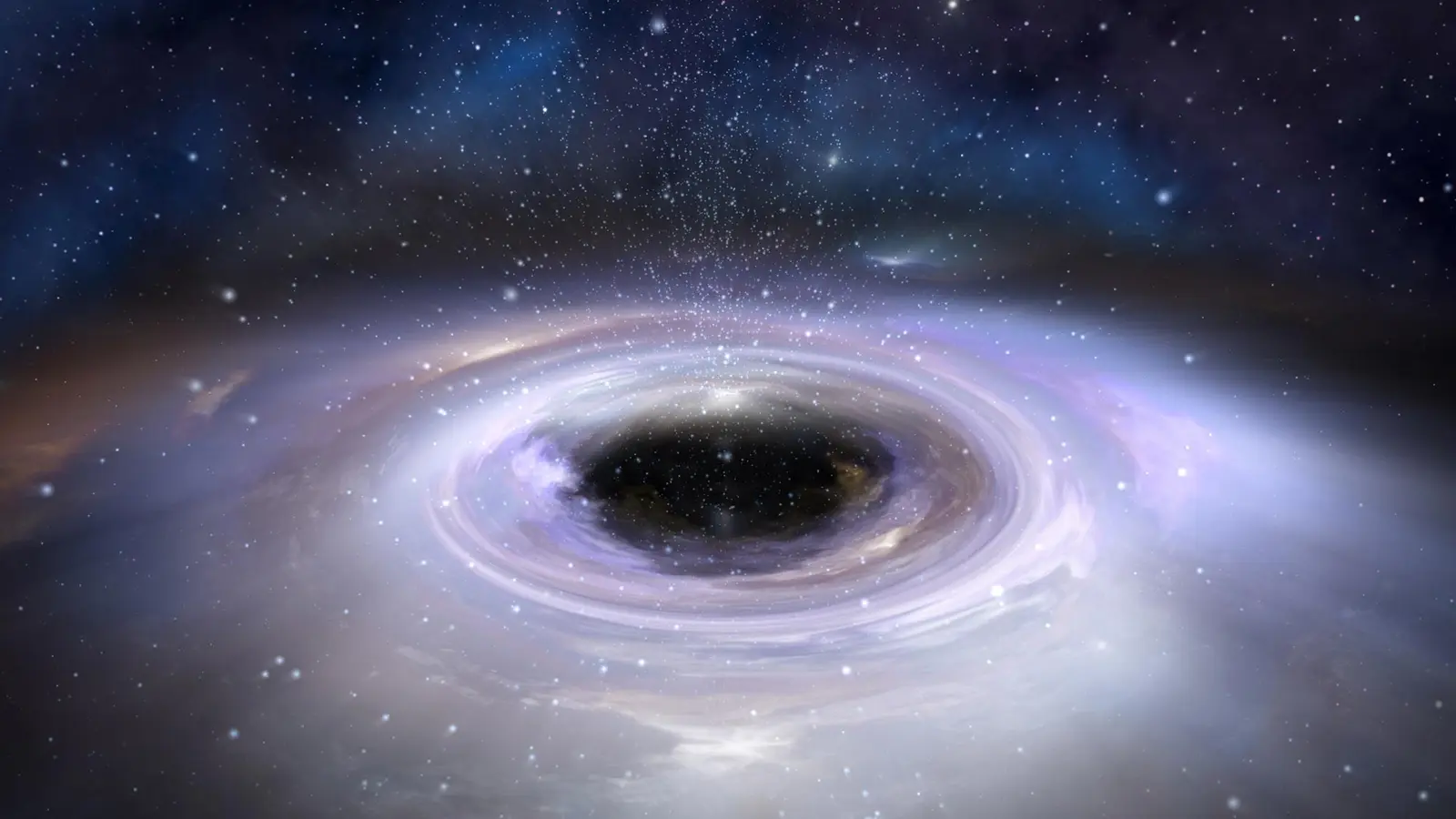
Imagine a star simply vanishing. No fireworks. No bright remnant marking its death. Just a quiet collapse into darkness. That eerie possibility—massive stars turning into black holes without a supernova—has moved from speculation toward evidence, thanks to a new analysis of gravitational-wave detections.
Scientists combed through signals from the LIGO–Virgo–KAGRA network, focusing on 257 confirmed black hole mergers collected over roughly a decade. The data revealed a striking feature: a heavy clustering of black holes around 10 times the Sun’s mass. They appear again and again. But between about 12 and 16 solar masses there is a surprising dearth. A gap. A hole in the distribution where theory had not clearly predicted one.
Why does that matter? Because mass is a fingerprint of formation. How a black hole forms—whether in a violent supernova that kicks and spins its progeny, or in a silent implosion that preserves different angular momentum—leaves telltale traces in both mass and spin. The analysis found that those roughly 10-solar-mass objects also show a narrower spread of spin values compared with the broader population, hinting they share a common origin.
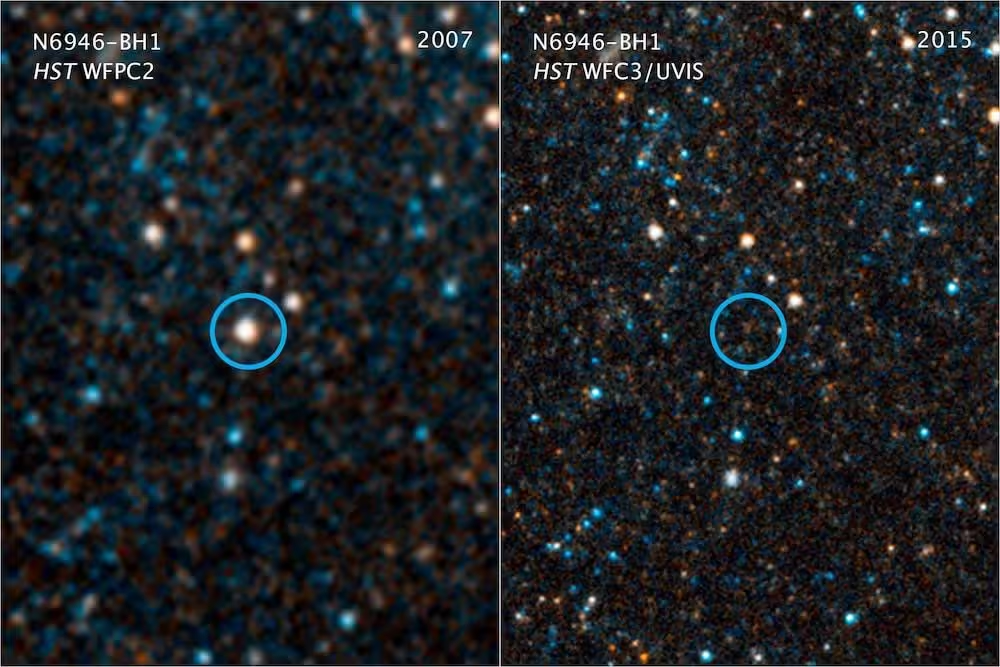
These pictures taken by NASA’s Hubble Space Telescope in 2007 and 2015 show an example of a star thought to have died via a failed supernova. A giant star N6946-BH1 is seen before and after it vanished out of sight, likely after imploding to form a black hole.
Could these be the products of failed supernovae—stars whose cores collapse directly into black holes without blowing off their outer layers? Observational hints already exist. Hubble images of the giant star N6946-BH1 showed it bright and present, then gone in later observations, consistent with a quiet implosion rather than an explosion. Now gravitational waves offer a statistical route to the same story, revealing formation channels hidden from electromagnetic telescopes.
The study, led by Katerina Chatziioannou of Caltech with Isaac Legred as lead author, compares models that include a subpopulation formed by failed supernovae to models that do not. The failed-supernova model reproduces the peak at ~10 solar masses and the relative shortage in the 12–16 solar-mass range. It’s not a smoking gun. But it lines up with theoretical expectations that certain internal stellar physics—how the core reorganizes, how neutrino-driven processes proceed, how mass loss and convection play out—can steer a star toward a quiet collapse.
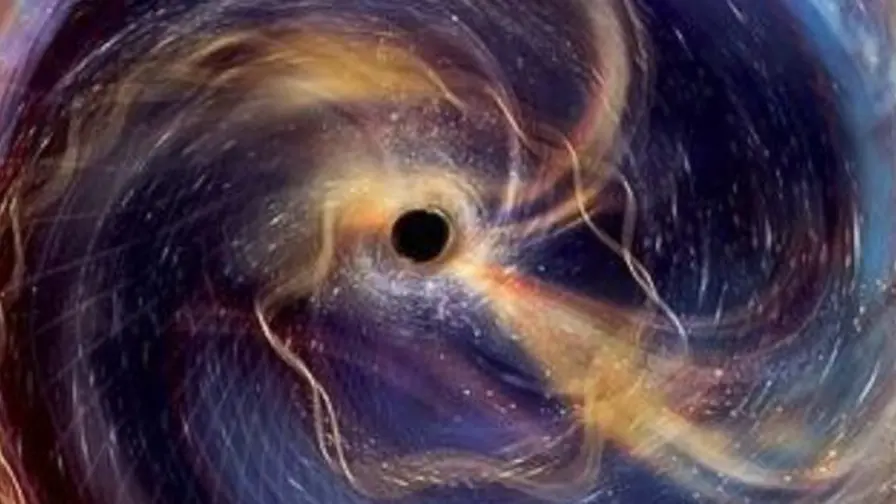
Gravitational waves give us parameters we can measure: masses, spins, and merger rates. They aren’t photons, but they carry fingerprints. Read a population of events in aggregate and patterns emerge. Read them carefully and you can begin to distinguish different birth stories. That is precisely what this team did, connecting population-level statistics from the LIGO–Virgo–KAGRA catalog to underlying stellar physics.
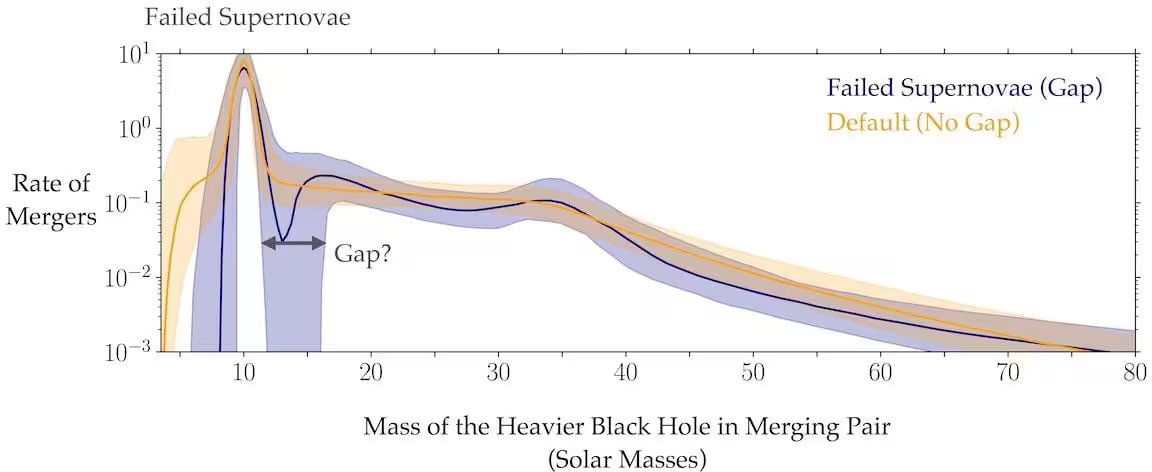
This chart shows the rates of mergers between black hole pairs (y-axis) plotted against the mass of the heavier black hole in the pair (x-axis), as inferred from gravitational-wave data. It compares two models—both show a peak at 10 solar masses—but they differ in whether they have a gap in masses between 12 and 16 solar masses (blue line) or not (yellow line). The blue model is a prediction for a population of black holes that formed via failed supernovae—the rate is of mergers is much lower between 12 and 16 solar masses, implying that merging black holes are not efficiently formed in that mass range. The LIGO-Virgo-KAGRA gravitational-wave data favor the failed supernovae model.
There are broader implications. If many binary black holes formed from failed supernovae, that changes expectations for companion-star evolution, natal kicks, and where merging systems are found inside galaxies. It also helps explain why some mass ranges are common while others are rare—an outcome of stellar interior processes as much as binary dynamics.
Still, caution is warranted. The gravitational-wave network has now observed hundreds of black hole mergers, but interpreting population structure relies on models and assumptions. Alternative formation channels—dynamical encounters in dense star clusters, hierarchical mergers, or exotic stellar pathways—could also produce similar signatures in mass and spin. Follow-up observations, refined models of stellar collapse, and more gravitational-wave data will sharpen the picture.
What’s clear is this: the universe keeps its secrets in quiet ways as well as loud ones, and listening to spacetime itself is revealing a hidden chapter of stellar death.
The research appears in Physical Review D and was carried out by researchers affiliated with Caltech, the University of Illinois Urbana-Champaign, and collaborators across the LIGO–Virgo–KAGRA consortium—an interdisciplinary effort that turns subtle ripples into bold astrophysical insight.

So the next time you picture a star’s final act, consider silence as well as spectacle. The cosmos writes its stories in many tongues; gravitational waves are teaching us to translate them.

Leave a Comment
Comments (1)
Wow, silent star deaths? That's haunting... 10-solar-mass pileup and a 12-16 gap, hmm. If true this really reshuffles supernova lore. Mind blown