
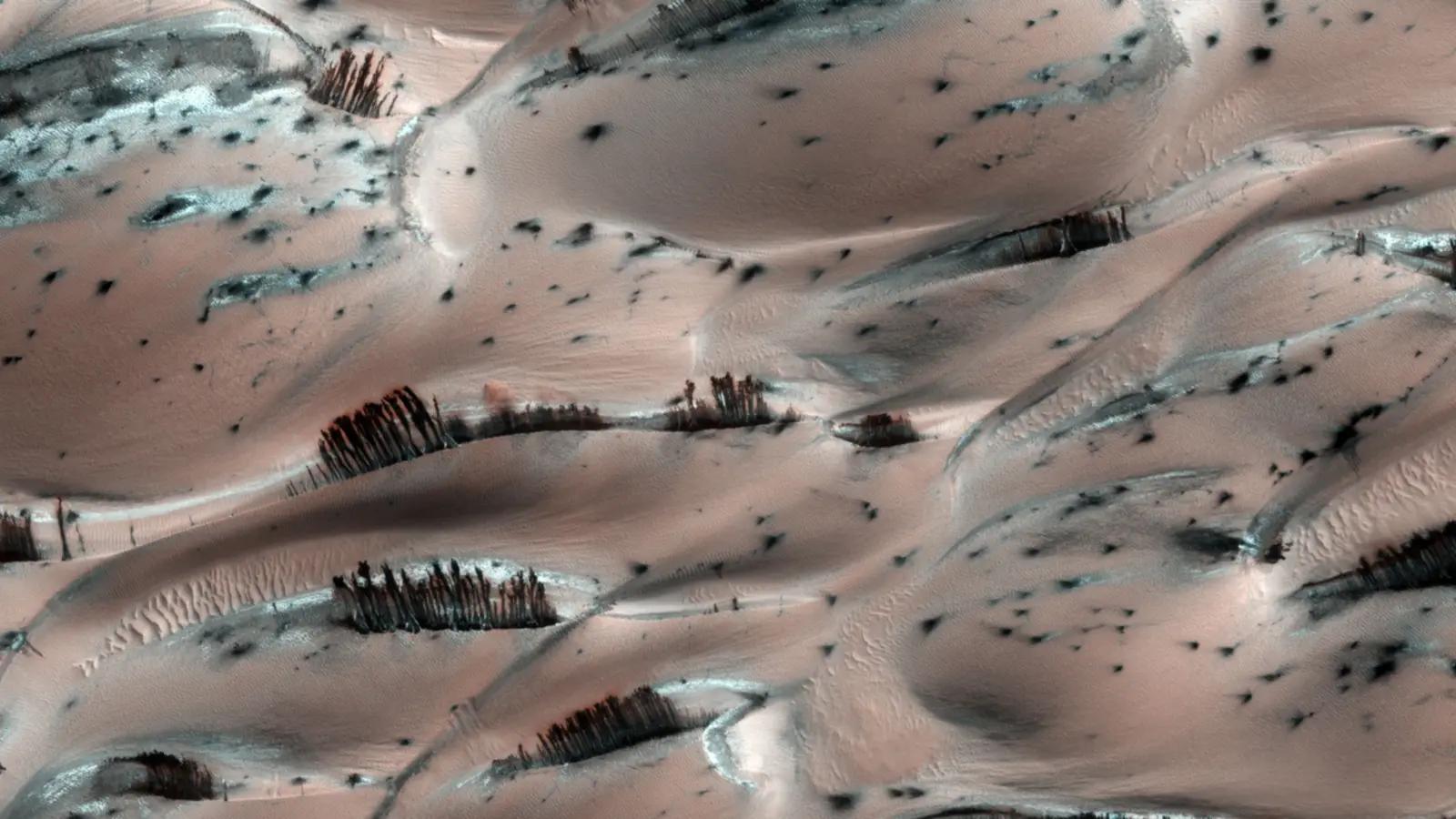
Look long enough at a strange HiRISE photo and your brain fills in a story: thin trunks, ragged crowns, a frozen wood rising from a pale polar plain. The image, taken by NASA's Mars Reconnaissance Orbiter in 2008, can trick the eye. It tempts you with a forest that cannot exist.
Flip the frame upside down and the illusion collapses. What once read as branches and trunks becomes dark streaks running down dune faces — sand, not saplings. That inversion is a useful reminder: perspective matters, especially on a planet that writes its seasons in dry ice.
Mars keeps its cold differently than Earth. A large share of the Red Planet's polar frost is solid carbon dioxide — dry ice — not water. During the long, bitter winter the dunes wear a coat of translucent CO2 ice. When spring sunlight returns, the ice doesn’t melt; it sublimes, turning straight to gas. Heat sneaks through the clear layer, warming the ground beneath, and pockets of pressurized CO2 form between ice and sand.
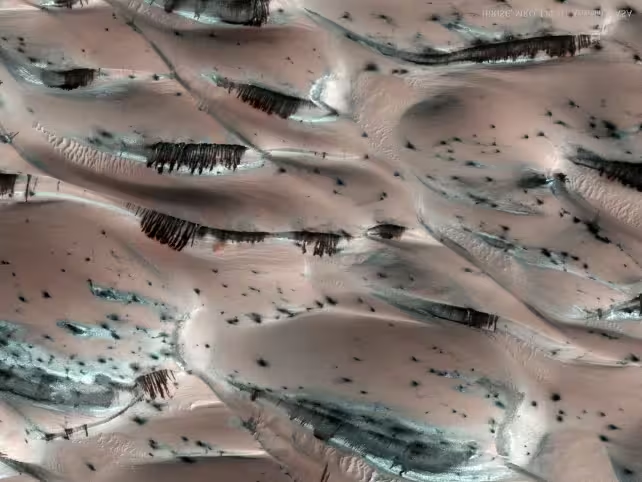
Turned upside down, the image of the Martian forest reveals an entirely different landscape.
Those trapped gases find a way out. They burst through the brittle surface, blasting sand and dust into brief, fan-shaped plumes. The released material cascades down steep slopes, carving narrow dark streaks and new alcoves into the dunes. In the 2008 HiRISE shot, the camera actually caught a small dust cloud kicked up by one such collapse — a rare freeze-frame of a seasonal avalanche in motion.
Planetary scientist Candice Hansen-Koharcheck and colleagues followed these shifts in a 2011 study. By comparing HiRISE sequences across Martian years they documented dunes that sprouted fresh gullies, hollows, and deposits. In measured cases, the base of some slopes shifted forward by 2.2 to 4.7 meters in a single Martian year — tangible change in what looks like a lifeless landscape.
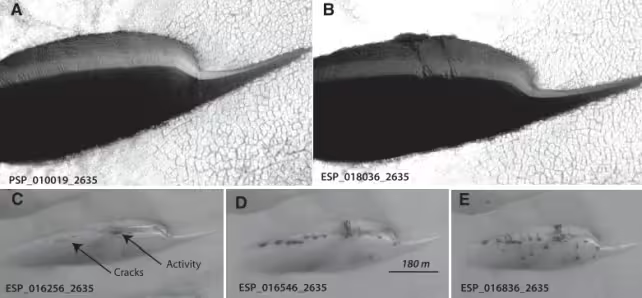
A sequence of HiRISE observations reveals how seasonal carbon dioxide ice drives sand down the slopes of a Martian dune, leaving dark streaks and reshaping the landscape.
Wind does the rest of the cosmetic work. Summer strips away the CO2 veneer and, with it, the stark dark streaks. Surface winds smooth the slopes again, hiding the scars until the next freeze. Then winter returns, the dunes re-clothe in dry ice, and spring will once more stage its brief, theatrical eruptions.
So those ghostly “trees” are not biology at all but the signature of an alien weather system: sunlight, translucent dry ice, trapped gas, and flowing sand. It's a reminder that Mars has its own grammar of erosion and movement, one that can mock familiar shapes and make the planet feel simultaneously static and shockingly alive.
We stare at these shifting patterns and learn the language of a world that keeps changing its face — one false forest at a time.


Leave a Comment
Comments
No comments yet. Be the first.