
What happens when researchers finally find a way to flick off a switch that cancer has jammed on? In a small but striking early trial, an experimental RAS inhibitor added to standard chemotherapy produced deep, durable tumor responses in people with metastatic pancreatic cancer—an outcome that felt improbable until now.
Pancreatic cancer is ruthless. Most patients are diagnosed after the disease has already spread, and standard first-line chemotherapy rarely buys more than months. Researchers at Memorial Sloan Kettering and collaborators tested daraxonrasib, a drug that targets the active RAS protein (the biochemical “ON” state that drives cell division), paired with gemcitabine and nab-paclitaxel to see whether blocking that signal could amplify chemotherapy’s effect.
Sixty-one patients enrolled in the phase I/II RMC-GI-102 study received daraxonrasib 200 mg by mouth every day alongside intravenous gemcitabine (1,000 mg/m²) and nab-paclitaxel (125 mg/m²) on days 1 and 15 of each cycle. The results—presented by Dr. Wungki Park at the 38th EORTC-NCI-AACR Symposium on November 19, 2026, in Barcelona—were more than encouraging.
Tumors shrank or vanished in 60.7% of patients, including complete responses in 8.2%, and disease was controlled in 90.2% of participants. With a median follow-up of 18.3 months (range 13.1–23.7), the combination produced a median progression-free survival of 12.8 months—nearly double the typical interval before cancers start growing again on chemotherapy alone.
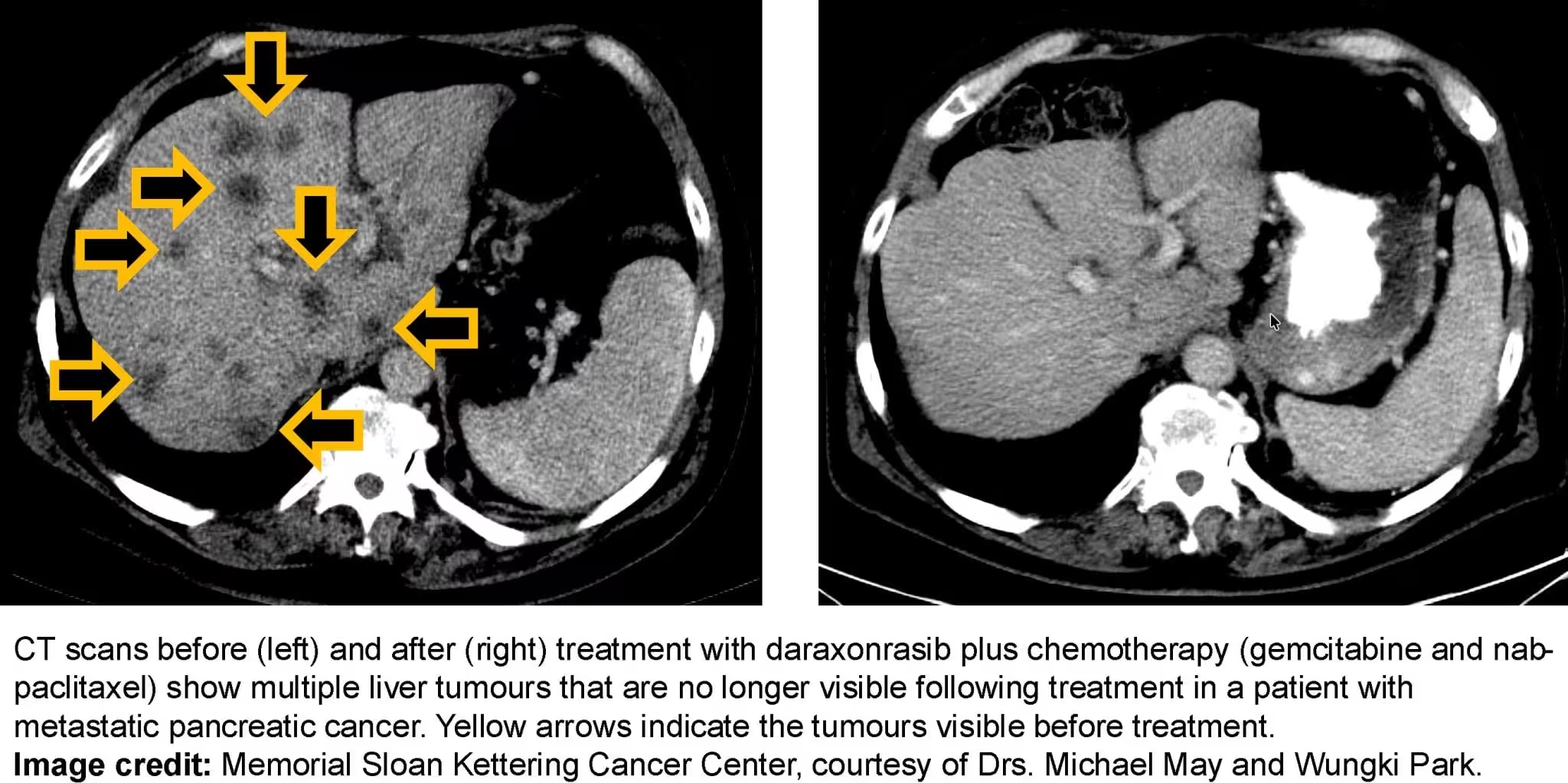
CT scans before (left) and after (right) treatment with daraxonrasib plus chemotherapy (gemcitabine and nab-paclitaxel) show multiple liver tumors that are no longer visible following treatment in a patient.
To put that in context: standard regimens normally produce measurable tumor shrinkage in roughly 23%–42% of patients and most tumors resume growth after about five to six months. Median overall survival with conventional chemotherapy generally falls in the 8–11 month range. Here, the 12-month overall survival rate was 76.6%, a signal that patients may be getting more sustained benefit when RAS signaling is interrupted.
Why target RAS? Mutations in the RAS gene occur in more than 90% of pancreatic tumors. Those mutations lock the protein into an active state, relentlessly driving cell division. For decades RAS was considered “undruggable.” Daraxonrasib is among the newer agents designed to directly inhibit the active RAS conformation—essentially trying to flip a stuck switch back toward off.
The safety profile was manageable. The most common side effects were rash, diarrhea, fatigue and lowered blood counts related to chemotherapy. Standard interventions handled most complications, and only about 5% of patients stopped treatment because of daraxonrasib-related side effects.
Excitement is tempered by caution. RMC-GI-102 was an early-phase, non-randomized study, so these encouraging outcomes don’t yet prove longer survival compared with chemotherapy alone. That question is the focus of the global Phase III RASolute-303 trial, which is testing daraxonrasib both by itself and in combination with gemcitabine and nab-paclitaxel against standard chemotherapy.
Experts not involved in the trial noted the broader implications. RAS mutations drive cancers beyond the pancreas—lung, colorectal, biliary tract, appendiceal and some gynecological tumors—so the strategy of combining a RAS inhibitor with established chemotherapy could be tested across several disease types. If those studies echo these early findings, the ripple effects for targeted therapy could be substantial.
For now, the data read like a brief detour away from the steady slide pancreatic cancer patients have faced for years: deeper tumor regressions, longer disease control, and a tolerable safety profile. The real test will be whether those early gains survive the scrutiny of randomized trials and translate into longer lives—and sooner rather than later, that question will be answered on a much larger stage.

Leave a Comment
Comments
No comments yet. Be the first.