
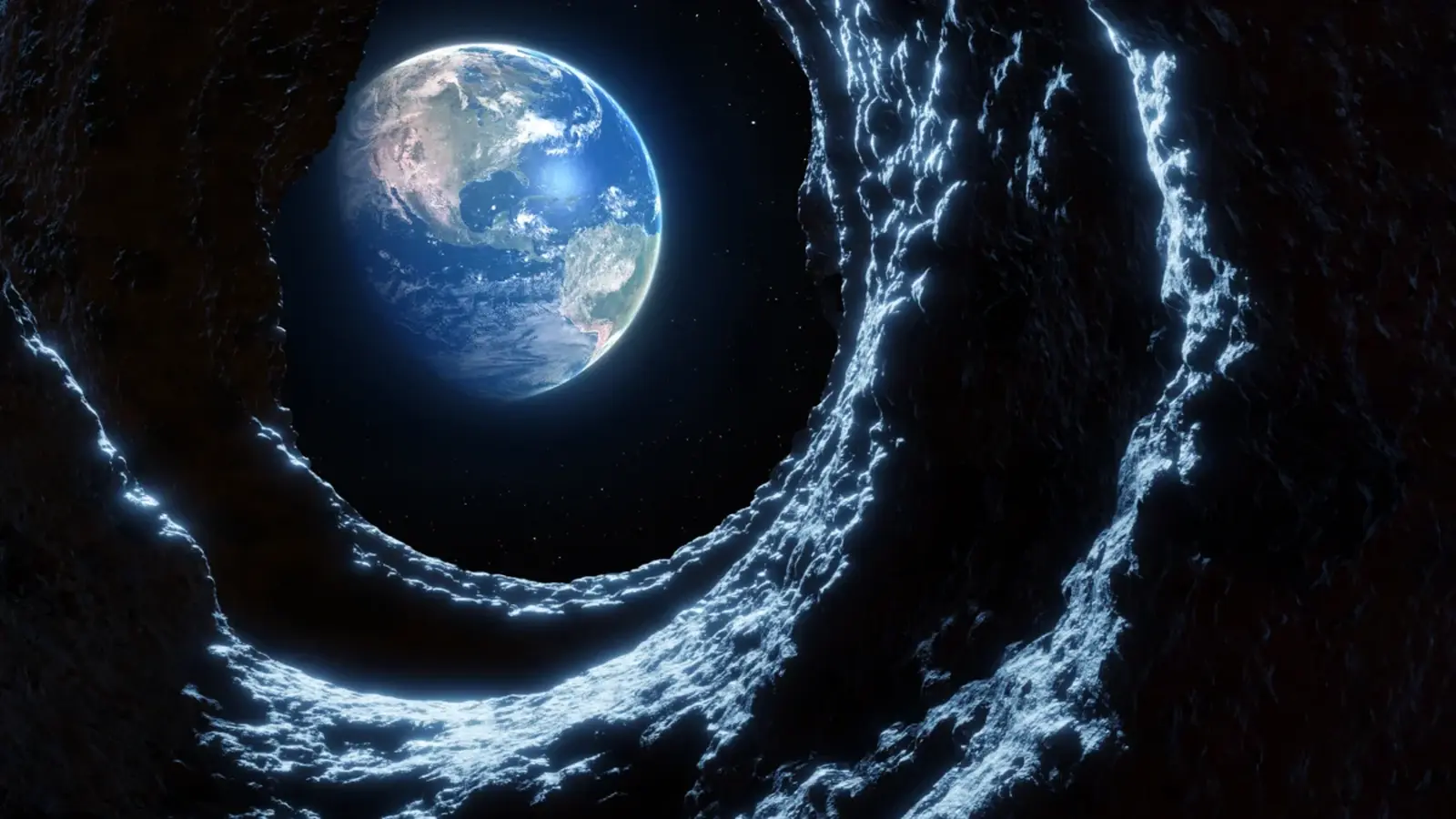
Beneath the Moon's familiar, cratered face there may be vast, silent passages—dark hollows carved long ago by molten rock. The idea sounds like science fiction, but new gravity data make the case harder to ignore.
Between 2011 and 2012 NASA's twin GRAIL spacecraft mapped tiny ripples in lunar gravity. Those ripples have been interrogated before; they whispered hints of kilometer-scale voids. When a higher-resolution gravity model was released in May 2025, two planetary geoscientists at the University of Illinois Chicago went back to listen more closely.
Juan Losarcos and Andrew Dombard compared the new gravity map to what we would expect from emptied rock. A hollow beneath the surface carries less mass than solid stone, and that mass deficit shows up as a subtle dip—a gravity fingerprint. After accounting for surface topography and matching patterns with numerical simulations, they flagged four promising candidates.
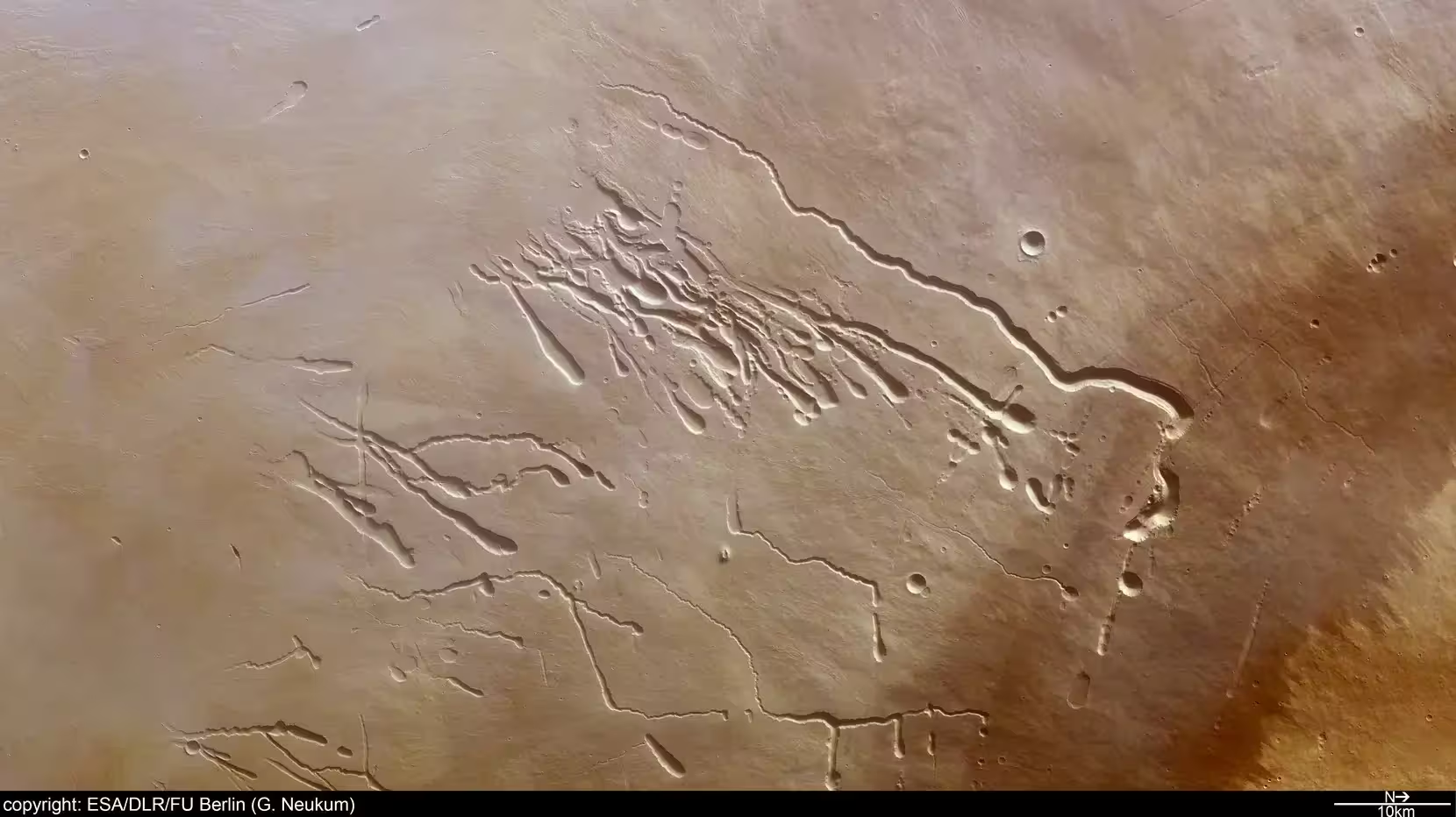
Suspected collapsed lava tubes on the flank of Pavonis Mons, a giant volcano on Mars.
Where? The signals cluster near familiar lunar landmarks: the sinuous rille Vallis Schröteri, Rima Mairan, and two sites adjacent to Wollaston crater. Each anomaly fits a cavity buried roughly 100 meters beneath the surface and spanning under two kilometers across—dimensions that, crucially, look physically plausible.
That caveat matters. Earlier studies suggested voids up to nine kilometers wide, which would likely have collapsed under their own weight. These newer estimates are more modest. They also point to a different origin story than the simple picture of a roof forming over a great river of lava.
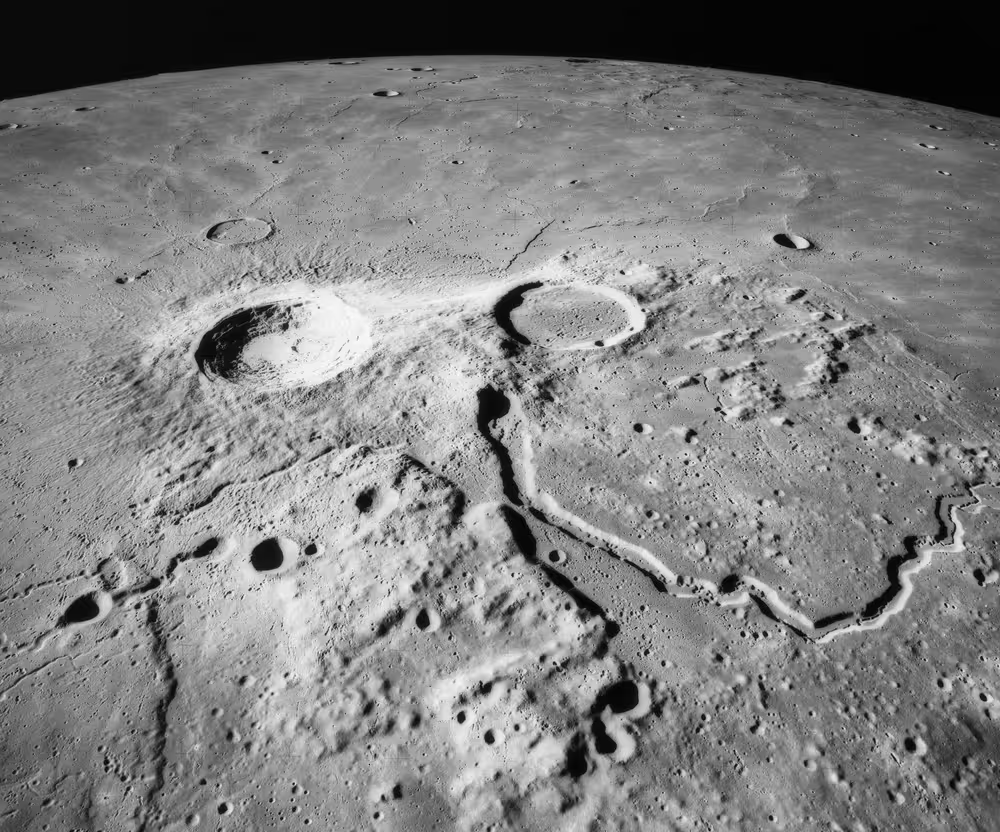
Vallis Schröteri, the Moon's largest sinuous rille, photographed from lunar orbit during the Apollo 15 mission in 1971.
Think smaller. Imagine narrow underground channels that, over time, were eaten outward as hot lava melted and scoured the surrounding rock. Not a cocoon built over a surface river, but a tunnel bored and widened from within—slow, relentless enlargement rather than an instant roofing job.
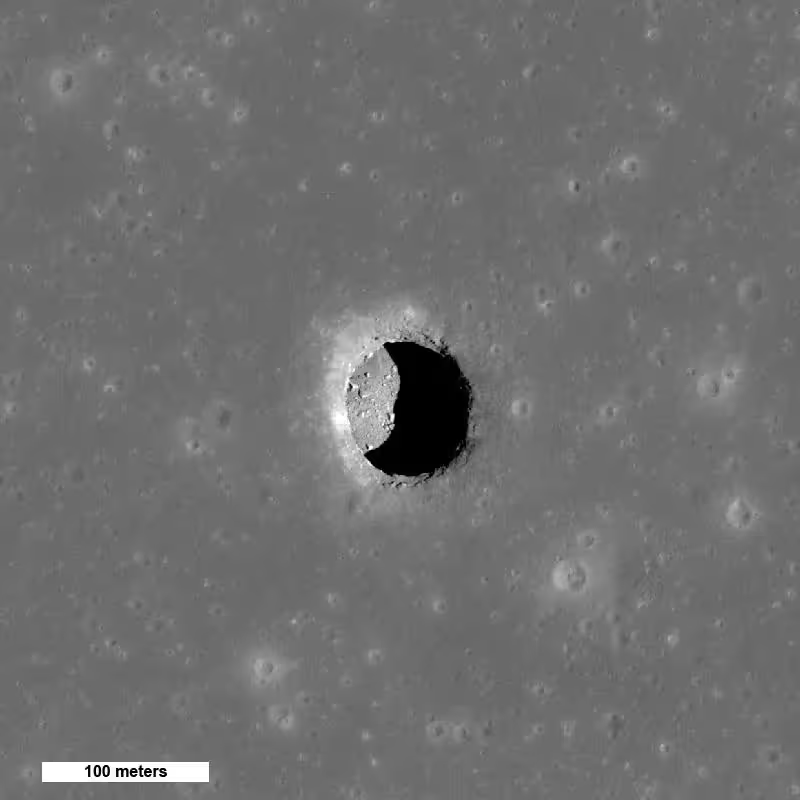
A pit that could be a lava tube skylight in Mare Tranquillitatis.
How confident can we be? Gravity alone is a blunt scalpel. Variations in rock density unrelated to empty space could produce similar signatures. And intact tubes without collapsed skylights leave few surface clues. The research team compared gravity dips with visible geology to strengthen their case, but they still call these features candidates rather than confirmed caves.
Confirmation will require follow-up: ground-penetrating radar, targeted orbital imaging, perhaps seismic studies or future lander investigations. If radar finds a clean void, that would change how we think about both lunar volcanism and practical planning for return missions.
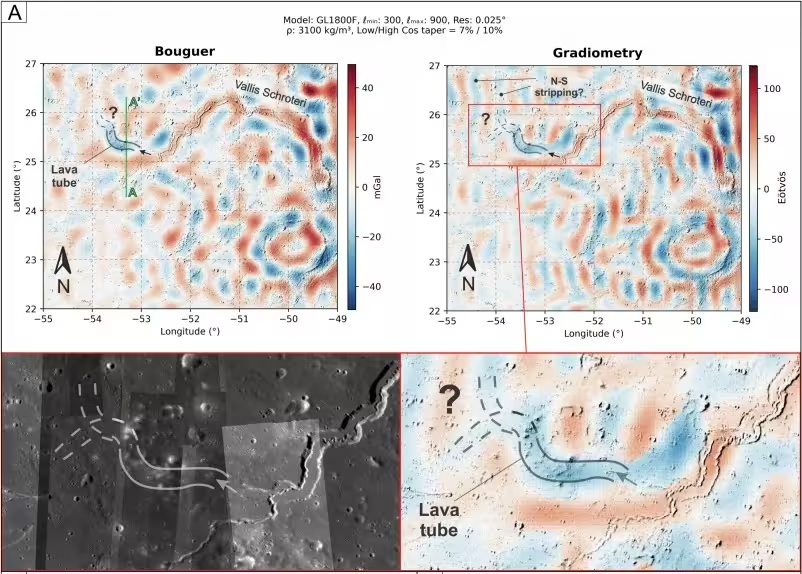
Maps of gravitational variations in the Vallis Schröteri region, with blue indicating weaker gravity or negative gravity gradients, and red indicating positive anomalies.
Why care? These tunnels are not just geological curiosities. A stable, sheltered void could protect instruments or astronauts from radiation and the Moon's brutal temperature swings. And untouched interiors might contain pristine records of volcanic and thermal evolution—time capsules sealed for billions of years.
The work was published in Icarus and it nudges open a door to subterranean exploration. The Moon still has secrets down below, and gravity has just handed us a few new maps of where to start digging.

Leave a Comment
Comments
No comments yet. Be the first.