

Imagine playing a low piano note and finding out, to your surprise, that several keys across the keyboard are trembling at once. That counterintuitive image is now a reality inside the inner ear.
For decades, the cochlea—the spiral tube tucked deep in our skulls—has been taught and understood as a tidy frequency map: place, then pitch. High notes on one end. Low notes on the other. It was a tidy, elegant explanation, one that Georg von Békésy helped establish and that informed everything from textbooks to cochlear implant design. But new measurements in guinea pigs suggest the ear has been hiding a trick.
Using optical coherence tomography, an imaging method borrowed from ophthalmology and refined with advanced signal processing, researchers peered into the living cochlea and tracked the tiniest of motions across its membrane. What they found surprised them: when the ear hears low-frequency tones, widely separated regions of the cochlea can vibrate almost in unison. The motion isn't localized to a single spot, as the traditional 'place code' would predict. Instead, distant patches march together, often synchronized.
That doesn't throw out the frequency map entirely. The cochlea still shows location-dependent responses for many sounds. But for low pitches—those that carry the rumble of voices and the fundamental tones that give speech its shape—there appears to be an extra layer of representation. Think of it as a melody played across several strings rather than plucked at a single fret.
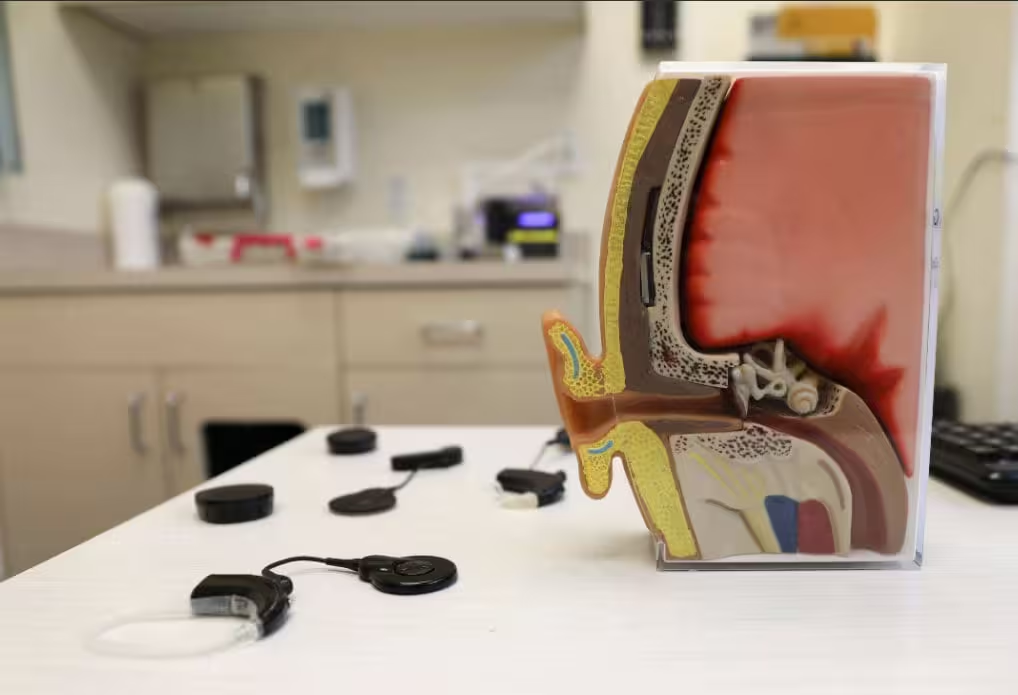
New research suggests the coil-like membrane of the inner ear known as the cochlea is capable of discerning low frequencies almost simultaneously across distant regions. At least in respect to low frequencies, the discovery challenges a canonical understanding of hearing dating to the 1960s.
Why does this matter? Because low-frequency information is central to how we parse speech in noisy rooms and how the brain groups sounds into meaningful streams. People with hearing loss frequently struggle most when background noise is present. Current cochlear implants take the place-code idea to heart: they stimulate electrodes at locations corresponding to frequency bands. If the natural cochlea sometimes encodes low tones as coordinated motion across multiple sites, then a single-site stimulation strategy may miss important patterns the brain expects.
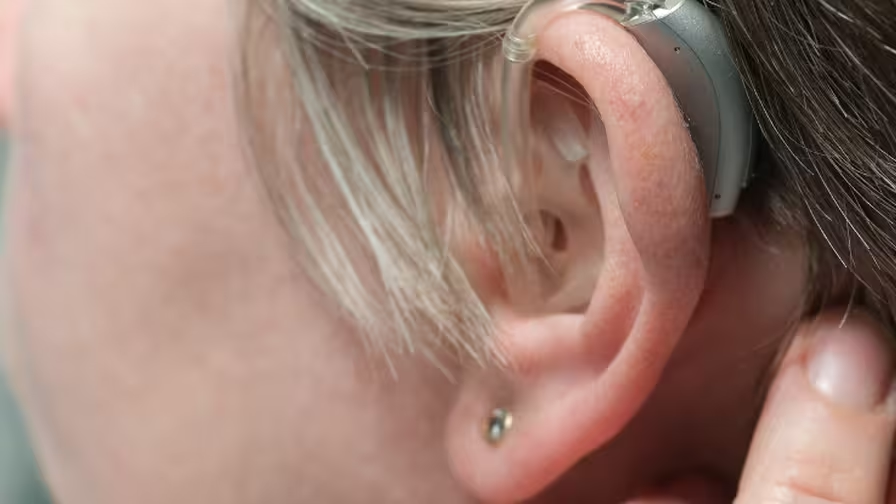
"When you bring in low-frequency background noise, it’s a very challenging environment for people with hearing loss," says George Burwood, the lead author and a research instructor at Oregon Health & Science University. "The place code paradigm limits interpretation of how mammals evolved to detect complex signals, especially speech."
In practical terms, implant engineers might need to rethink how they reproduce the cochlea's native signals. Electrical stimulation could aim to recreate coordinated activation patterns, not just fire electrodes in one location at a time. That would be a tougher engineering problem, but one with the potential to improve speech perception in real-world settings.
There’s also a deeper neuroscientific puzzle. If a low-frequency tone sets off synchronous motion in multiple cochlear regions, how does the brain tell which frequencies are present? The evidence hints that the auditory system uses cues beyond mere place: timing relationships, phase differences, and perhaps the combination of mechanical and neural responses. "The brain appears to have mechanisms that are able to differentiate frequencies without having a map or place code," notes Larry Trussell, director of the Oregon Hearing Research Center.
Technically, this discovery leaned on a marriage of sensitive imaging and clever signal processing. Optical coherence tomography, co-invented in part by physician-scientist David Huang, allowed researchers to detect sub-nanometer motions inside a fragile, fluid-filled organ. By cutting through background noise and registering activity at multiple sites simultaneously, the team revealed movement patterns that earlier methods simply couldn't resolve.
The takeaway: low-frequency hearing may be represented across the cochlea in coordinated ways, not solely by single locations, and that realization could reshape how we restore hearing with implants.
We are left with more questions than answers—and that’s a good place to be. What waveform patterns should implant electrodes reproduce? How do these multi-site vibrations translate into neural codes downstream? Will clinical trials that embrace more complex stimulation schemes yield better speech understanding in noisy environments? The next few years of lab and clinical work will be telling.
For now, the cochlea has reminded us that biology often favours nuance over neat diagrams. Who knew a humble low note could still surprise us?


Leave a Comment
Comments (1)
wow, the cochlea doing synchronized tremors?? mind blown. Low tones dancing across the membrane, who knew biology kept secrets. curious how implants adapt