

Imagine a clock with teeth too large for a human life to see: it ticks once every 405,000 years. Outwardly, Earth’s weather seems chaotic — sudden storms, brutal gales, deluges that reshape coasts in hours. But buried beneath that chaos, geologists have found a slow, patient heartbeat preserved in stone.
In the sedimentary layers of China’s Sichuan Basin, rocks laid down in a half-billion-year-old tropical sea record repeated pulses of storm debris. These layers, called tempestites, are the geological fingerprints of storms: sand and silt ripped from the seafloor by waves and currents, carried away and redeposited as distinct beds that can survive for hundreds of millions of years.
Shuyuan Shi and colleagues used cyclostratigraphy — searching for repeating patterns in sedimentary strata — alongside chemical markers to stitch together about 24 million years of the Cambrian record. The result was surprising: 59 regular pulses, each roughly 405,000 years long. And when the researchers mapped where tempestites clustered, a clear pattern emerged. Storm deposits thickened and multiplied during the rising and peak phases of each cycle, while the opposite phases left thin, isolated traces.
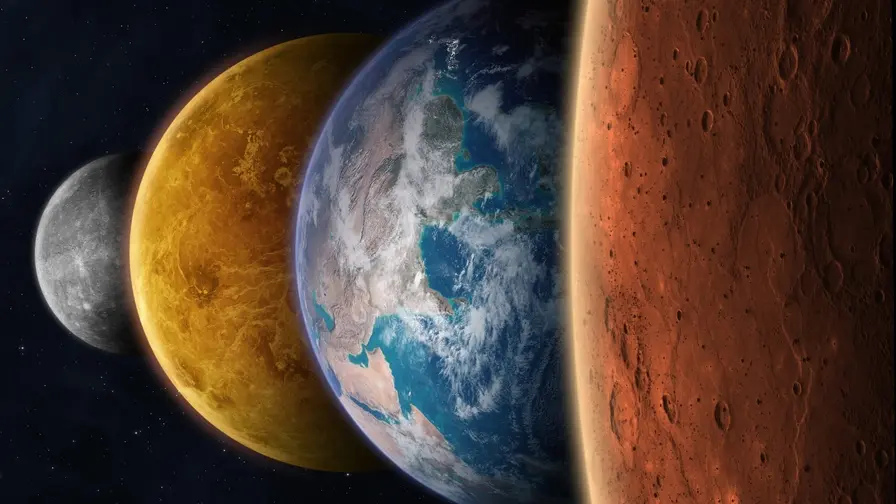
Why would storms obey such a slow metronome? The prime suspect is one of the Milankovitch cycles, the orbital nudges that Earth receives from its planetary neighbors. Earth’s orbit is not a perfect circle; its eccentricity — the degree of elliptical stretch — waxes and wanes under gravitational tugs. One of those eccentricity cycles takes about 405,000 years, driven especially by Venus and Jupiter.

These eccentricity swings don’t change the total sunlight Earth gets each year so much as they scramble how sunlight is apportioned across seasons. That matters when orbital precession — the slow wobble of Earth’s axis — is in play. Together, eccentricity and precession modulate seasonal heating, and Shi’s team argue that, in a warm Cambrian world, those modulations could periodically supercharge tropical ocean heating. More heat. More energy exchange between ocean and air. Stronger storms. It’s a simple chain of cause and effect, but stretched across geological time.
There are caveats. Sedimentary records are patient but selective. Sea level shifts, changing sediment supply, and local conditions of preservation can all bias the apparent frequency and intensity of tempestites. The researchers are careful: the correlation is compelling, not conclusive. Still, the match between the 405,000-year sedimentary rhythm and a known orbital beat is hard to ignore.
So what does this mean for modern climate or for storms today? Direct extrapolation is risky. Earth’s climate system today is not the Cambrian climate; continents sit in different configurations, sea levels and atmospheric compositions have shifted, and human-driven warming is a new forcing. The 405,000-year rhythm may not translate into predictable modern storm cycles. But the finding does expand the toolbox for deep-time climate reconstruction: tempestites may be more than random storm graves. They can be archives, recording the interplay of planetary mechanics, ocean heat, and atmospheric violence.
There’s something quietly poetic in the idea that storms, the most furious and short-lived of weather events, can be paced by the stately motions of planets. A tempest’s fury lasts hours or days; the clock that sets their long-term ebb and flow belongs to the Solar System itself. If future work tightens the link, those ancient storm beds will offer another way to read Earth’s distant climate script — one written not in ink but in sand and silt.
The study appears in Palaeogeography, Palaeoclimatology, Palaeoecology and was led by Shuyuan Shi of the Research Institute of Petroleum Exploration and Development.

Leave a Comment
Comments
No comments yet. Be the first.