
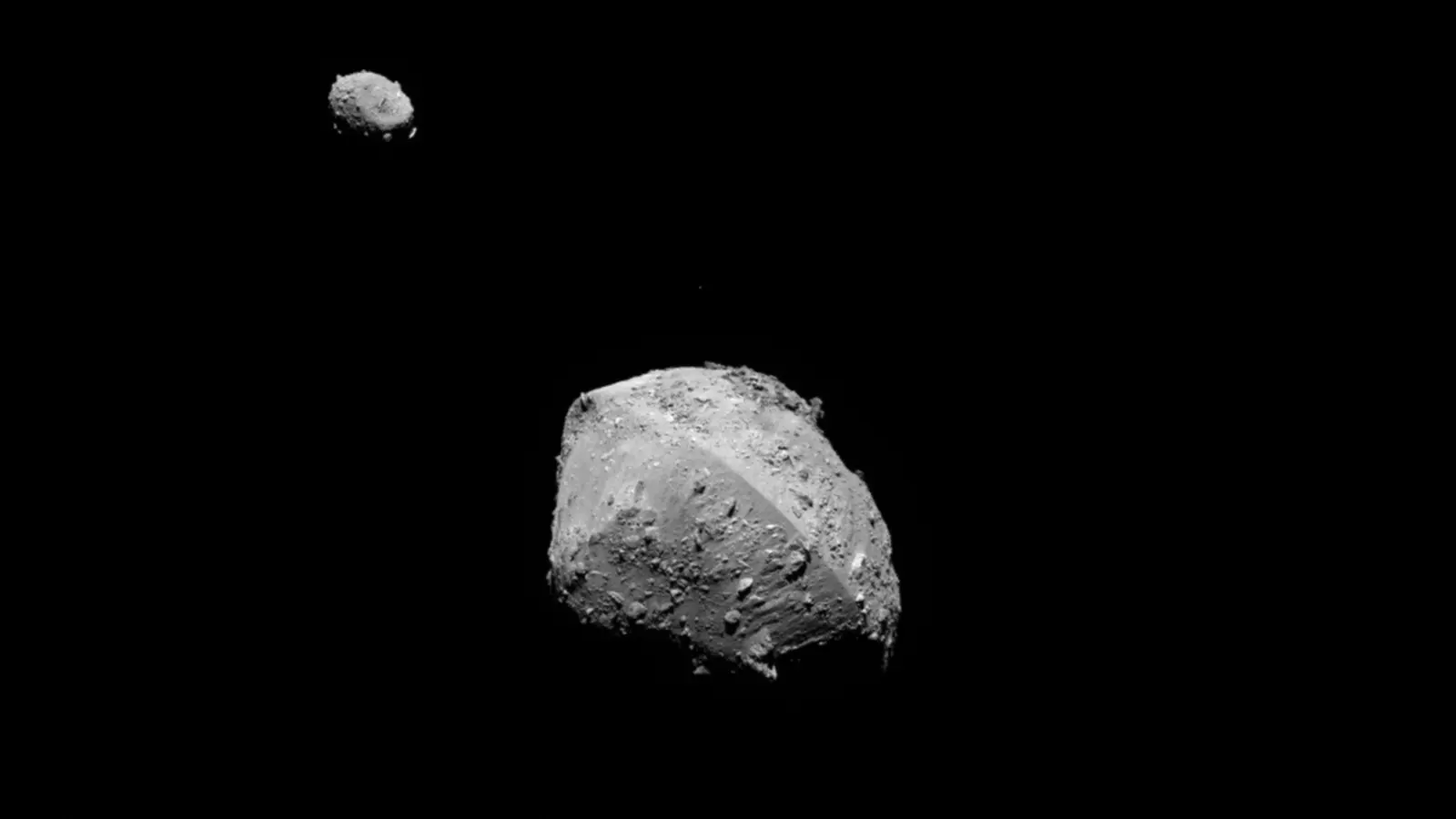
A sports-stadium-sized wound runs across Dimorphos, a reminder that humanity just tested a defense we once only imagined. The strike wasn't cinematic in the way asteroid impacts in movies are—no planet-shattering explosions—but when NASA's DART spacecraft deliberately plowed into the small moonlet orbiting Didymos, it changed something fundamental about how we might protect Earth.
The target was elegant in its simplicity: a binary asteroid system where a 151-meter rock called Dimorphos orbits a much larger 730-meter companion, Didymos. Smack the smaller body and any shift in its orbit is measurable from Earth. On 26 September 2022 DART hit its mark after a ten-month cruise. The result exceeded expectations: instead of shaving 73 seconds off Dimorphos's orbital period—the mission's minimum success criterion—DART shortened it by about 33 minutes, a seismic change in orbital mechanics for a human-made intervention.
Close-up evidence of what that blow did has been slow to arrive. A tiny Italian cubesat, LICIACube, photographed the immediate aftermath but was blinded by a vast plume of ejecta. The true scene lay hidden under clouds of rock and dust—until the European Space Agency's Hera mission reached the pair.
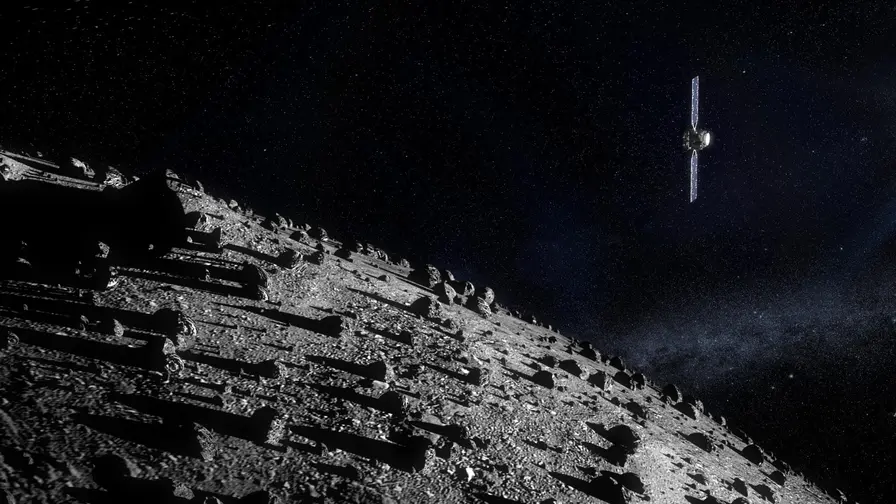
Launched in October 2024 and arriving at Didymos-Dimorphos on 4 November 2026, Hera carries cameras, thermal imagers and other instruments built to answer a single stubborn question: did DART make a crater, or simply rearrange a loosely bound rubble pile? The images Hera has returned are startling because they answer with both a yes and a no.
An animation of the asteroid pair captured by Hera's thermal infrared imager (TIRI). Warmer regions are redder and brighter, while cooler ones are bluer and darker.
The side of Dimorphos struck by DART is flattened. Where once a rounded surface faced Didymos now sits a depression so large it spans much of the asteroid's width. Think of a stadium-sized cavity carved out of a rock barely longer than a city block. Yet elsewhere the landscape preserves familiar features. Scientists can pick out boulders photographed by DART before impact, implying that parts of the surface remained stubbornly in place even as adjacent regions were excavated and shifted.
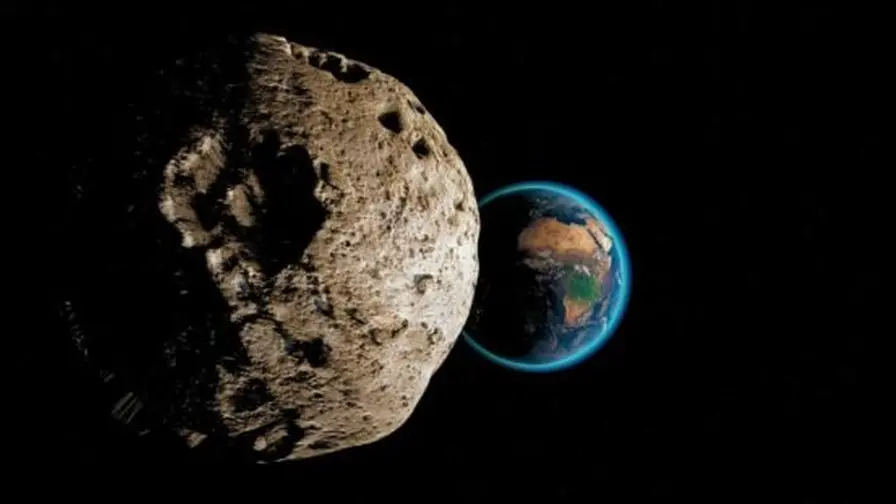
That paradox points to the complex nature of rubble-pile asteroids—aggregates of rocks and dust held together by weakness, not solidity. Their response to a kinetic impact depends on internal structure, cohesion, and the way momentum transfers through countless contact points. Some models had suggested DART might not leave a distinct bowl at all, instead prompting a wholesale slumping and reassembly of material. Hera shows a hybrid outcome: a clear crater and a reshaped body that still carries photographic echoes of its former self.
More surprises followed. Dimorphos no longer keeps the same face toward Didymos. Once tidally locked like our Moon, the small body now tumbles irregularly. The impact injected rotational energy, and the pair's dynamical dance has become more chaotic. Around them swirls a growing population of meter-scale boulders—hundreds flagged in long-exposure images. Some of these were suspected as early as 2023, when Hubble spotted about 37 companion rocks. Hera finds a far larger entourage. Determining whether these fragments are fresh excavations from the DART strike or long-standing debris will help reconstruct the immediate aftermath of the collision.
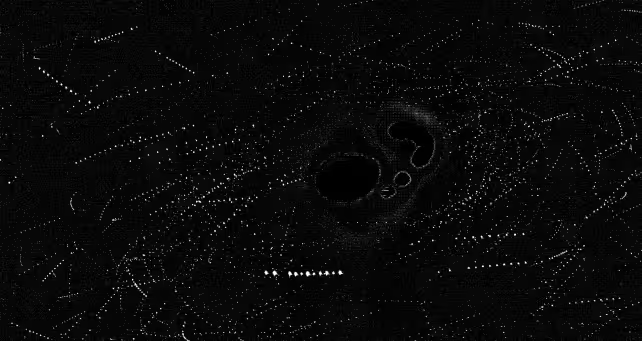
A composite of 11 long-exposure images revealing the swarm of boulders around the asteroid. (ESA)
Hera is still getting closer. At the time of these observations it was tens of kilometers away; later it will drop to around 13 kilometers for sharp images. In January the mission will release two cubesats—Juventas to probe the asteroid's interior with the first radar exploration of its kind, and Milani to characterize the near-asteroid environment. Combining remote imagery, interior sounding and in-situ particle counts will let scientists pin down Dimorphos's mass and structure, and crucially, how efficiently DART's momentum transfer altered its trajectory.
The scientific stakes extend beyond curiosity. Sixty-six million years ago an impact reshaped life on Earth. Today we have demonstrated that an impact can be a solution, not merely a danger. DART proved orbital deflection is possible; Hera is teaching us what that hit looks like up close and how rubble-pile worlds respond. If we ever have to deflect a threatening rock, this is the apprenticeship that matters.
There is more to learn. Hera's upcoming close work promises details that could turn a first test into reliable planetary defense doctrine. For now, the scar on Dimorphos stands as both a warning and a promise: we can nudge destiny, but the rules of the road are written in rubble and gravity—and we are only beginning to read them.

Leave a Comment
Comments (1)
Wow, that crater looks unreal. Stadium-sized on a pebble! Proud? yeah, and nervous too.. we actually nudged destiny, weird feeling.