
Ethereum stalls near $2,950 while whales quietly accumulate
Ethereum (ETH) is trading in the $2,930–$2,950 corridor as of January 25, 2026, consolidating after a pullback from January highs above $3,400. Although market chatter has focused on the $3,000 rejection, on-chain metrics tell a more resilient story: accumulation by large holders, steady network activity, and improving staking dynamics suggest that the price weakness is driven more by ETF flow and short-term rotation than by a breakdown in Ethereum fundamentals.
ETF outflows pressured price, not protocol health
Short-term downward pressure was amplified by spot ETH ETF outflows exceeding $600 million between January 20–23, including a notable $250 million one-day withdrawal from a major manager. Those liquidations cooled momentum and kept ETH beneath the $3,000 level. However, flow analysis indicates profit-taking and rotation rather than wholesale institutional abandonment.
Whales and leverage dynamics
On-chain tracking reveals that large addresses accumulated roughly $1 billion in ETH during the pullback, suggesting confidence among whales. At the same time, funding rates and derivatives’ open interest have reset from prior crowded-long conditions, indicating that forced deleveraging is being cleansed from the market. Put simply: leverage is being flushed, not conviction.
On-chain activity remains robust
Under the surface, Ethereum’s network usage is healthy. Daily active addresses have risen toward 1.3 million and transaction volumes have remained between 1.9 million and 2.2 million per day. These metrics point to continued demand for transfers, DeFi interactions, and smart contract usage even while price consolidates.
Staking, validators, and supply tightening
Validator metrics reinforce the bullish fundamental picture. Exit queues are near zero, entry queues are rebuilding, and staking participation continues to grow — a combination that reduces circulating supply pressure. Low gas fees and improved efficiency from recent upgrades have also supported sustained DeFi and dApp engagement, strengthening the case that price weakness today coexists with firm network fundamentals.
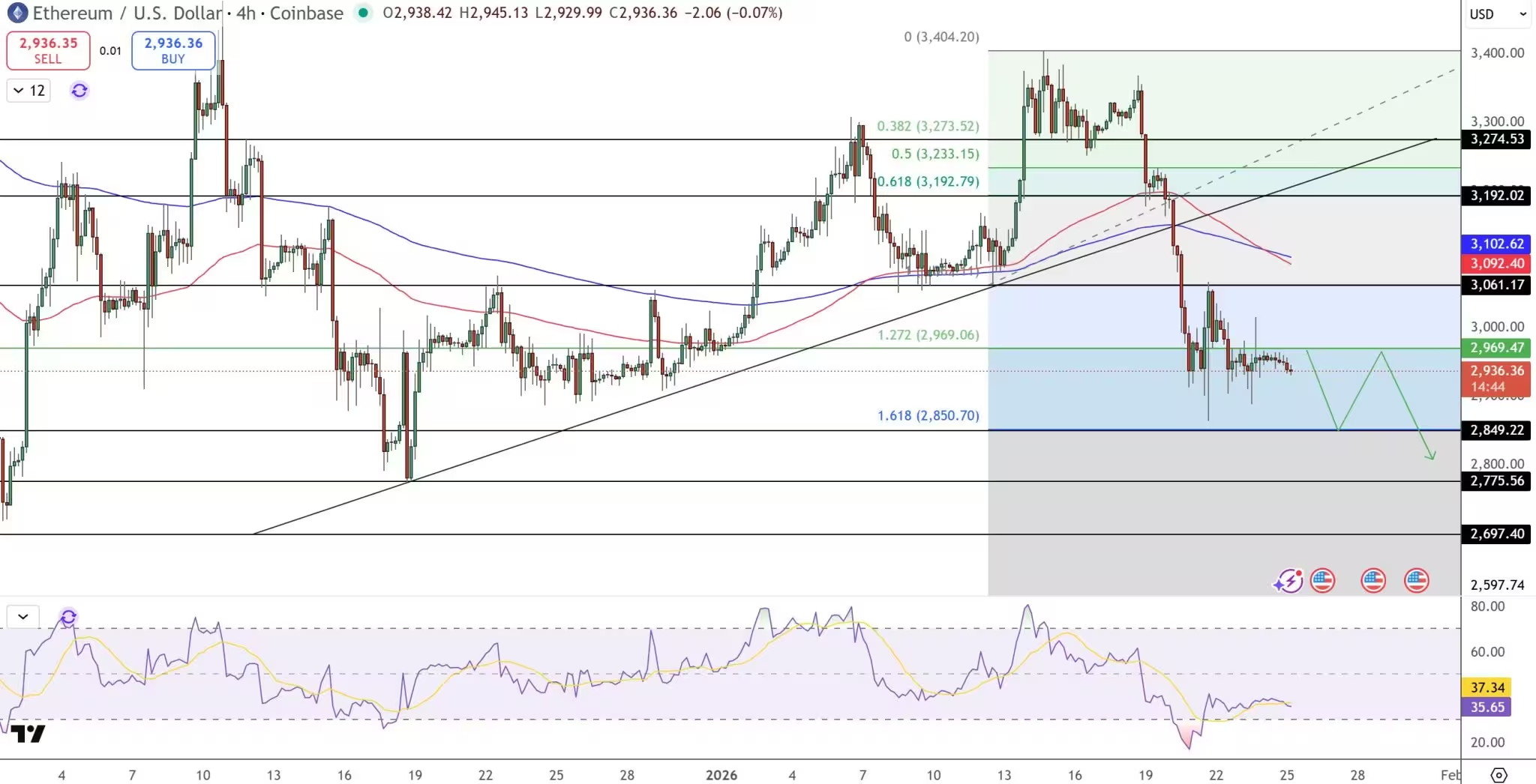
Ethereum Price Chart

Geopolitical noise has limited impact on ETH momentum
Rising geopolitical tensions, including clashes between the U.S. and Iran, have created intermittent risk-off windows for global markets. Despite these macro uncertainties, ETH has continued to show resilience. Investors appear to view Ethereum’s long-term upgrades and security priorities — including work on post-quantum readiness by the Ethereum Foundation — as supportive for adoption and institutional confidence.
Technical outlook: compression beneath $3,000
From a technical perspective, ETH is compressing around $2,850–$2,950, a zone that aligns with prior demand and Fibonacci confluence. The RSI sits subdued in the 35–40 range, signaling caution but not capitulation. A decisive push above $3,060 would reopen upside targets in the $3,190–$3,400 band, while a break below $2,800 could expose deeper retracement toward $2,700.
Practical trade setup for traders
For those planning entries around current ranges, a tactical approach could be to accumulate near $2,850–$2,900 with targets toward $3,190–$3,400 and invalidation on a clean close below $2,700. Keep position sizing conservative given elevated macro risk and the potential for ETF-driven volatility.
Why 2026 roadmap matters for long-term ETH
Ethereum’s development roadmap for 2026 strengthens the long-term bullish case. Upcoming network milestones, including the Glamsterdam upgrade and subsequent Hegota phase, prioritize scalability, efficiency, and sustainability. Progress on blob infrastructure and accelerating Layer-2 adoption will further improve throughput and lower costs, attracting more DeFi activity and smart contract deployments. With millions of new contracts and growing dApp activity entering the year, many analysts see 2026 as a possible breakout window for ETH if macro conditions stabilize.
Bitcoin Hyper: bridging BTC security with Solana speed
Separately, the Bitcoin Hyper ($HYPER) project is positioning itself as a bridge between Bitcoin’s security and Solana-like transaction speed. By enabling fast, low-cost smart contracts and decentralized apps anchored to Bitcoin’s security model, Bitcoin Hyper aims to unlock new BTC-based application demand. The project’s audited framework and an active presale—already surpassing $30.9 million—have drawn attention from traders and developers seeking BTC-native smart contract utility.
Bottom line for investors
Ethereum’s recent rejection at $3,000 looks dramatic on price charts, but on-chain indicators paint a different picture: accumulation by whales, healthy user activity, rising staking participation, and technical upgrades all point to resilient fundamentals. Traders should watch ETF flow and derivatives metrics for short-term triggers while keeping an eye on roadmap-driven adoption as the key long-term catalyst for ETH.

Disclaimer: Cryptocurrency is a high-risk asset class. This article is for informational purposes only and does not constitute investment advice. You could lose all of your capital.

Leave a Comment
Comments (2)
wow whales accumulating + staking up, low fees, this is the kind of slow grind i like. adding a little, not FOMO. could pop if macro cools 🚀
Is this even true? Whales buying while ETFs bleed out sounds like rotation not capitulation, but show the wallet flows pls. Curious, skeptical tho.