
5 Minutes
When the Moon creaks, it does so in more places than we imagined. New mapping shows that the dark basalt plains — the maria that draw telescope lenses and future habitat plans alike — are threaded with tiny ridges caused by recent tectonic stress. These wrinkles are not relics of some ancient cooling episode; many formed tens of millions of years ago, geologically young and potentially still active.
Researchers led by geologist Cole Nypaver assembled the first near-global inventory of small mare ridges (SMRs) across the Moon’s maria using high-resolution imagery from NASA’s Lunar Reconnaissance Orbiter (LRO). The team identified 1,114 previously undocumented SMR segments on the near side; combined with prior surveys, the global count now stands at 2,634 segments stretching across both hemispheres. That number transforms a patchy picture into a unified portrait of a shrinking, wrinkling Moon.
What the ridges reveal about lunar tectonics
On Earth we have plates. The Moon does not. Still, it has an interior that cools and contracts. The surface records that slow loss of heat in several ways: lobate scarps in the highlands; and compressional ridges in the maria — the SMRs — formed by shallow thrust faults in the relatively young basalt flows. The new mapping shows that these two types of features are not isolated phenomena but components of the same global contractional system.
Why do these ridges matter? For one thing, they change our estimate of seismic sources on the Moon. When a shallow thrust fault slips it produces a moonquake; those quakes can disturb nearby regolith and obliterate the smallest impact craters. The team exploited that effect to bracket ages. By counting surviving microcraters near ridges and using established crater-production rates, they estimated when each fault last moved.
The results are striking. SMRs formed between roughly 310 million and 50 million years ago, with the youngest dated at about 52 million years. The average SMR age is near 124 million years — remarkably close to the ~105 million-year mean age found for lobate scarps. In short: both mare and highland tectonic features record recent, overlapping episodes of contraction.
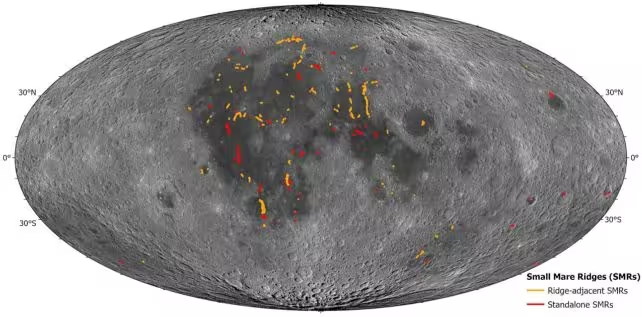
Some of the small mare ridges mapped by the team.
Methods and the math of shrinkage
Mapping is only the first step. The researchers also measured fault geometry from imagery and topographic data to infer each fault’s dip and slip magnitude. Those parameters feed into simple elastic-dislocation models that estimate how much the lunar crust has shortened. The maria, they found, have contracted by roughly 0.003–0.004 percent. That number is tiny in absolute terms but mirrors the contraction measured in the highlands, reinforcing the idea of a global stress regime.

Put another way: the Moon is cooling and losing volume. Rocks buckle. The crust wriggles. The ridges are the wrinkles. That physical process, while slow, continues to shape the surface in places humans might soon visit.
Implications for exploration and science
Future landing sites and long-term bases are likely to target the maria for their smooth terrain and scientific interest. But the presence of recent, shallow tectonic faults raises practical questions: could shallow moonquakes damage habitats, power systems, or storage depots? The study’s authors underline that SMR distribution broadens the inventory of potential seismic sources and should inform engineering risk assessments for lunar infrastructure.
Scientifically, the mapping tightens constraints on the Moon’s thermal and mechanical evolution. The parallel ages of SMRs and lobate scarps suggest a global contractional episode—or a sustained phase of stress accumulation—that affected different crustal materials similarly. That, in turn, provides clues about the Moon’s cooling rate, the rheology of mare basalts versus highland rocks, and the timing of tectonic activity late in lunar history.
Related technologies and future measurements
Seismometers will be crucial. Apollo-era data first revealed moonquakes, but modern networks and instrumentation placed across both maria and highlands would provide the resolution needed to tie mapped faults to seismic signals. Combined with continued high-resolution imaging and topography from orbiters, an expanded seismic dataset could detect active slip, measure quake depths, and refine hazard models for missions.
Expert Insight
"Discovering thousands of these ridges changes how we think about the Moon’s present-day behavior," says Dr. Aisha Kumar, a planetary seismologist at the Jet Propulsion Laboratory. "It’s not a dead, frozen sphere. It’s a body with an interior still losing heat — slowly, but with measurable surface effects. For mission planners that matters: even infrequent, shallow seismic events can stress structures over decades."
Those words nudge us from academic curiosity to practical planning. Engineers and mission architects must now fold these findings into designs. Scientists, meanwhile, gain fresh constraints on the Moon’s thermal history and a larger catalog of tectonic features to study.
The Moon’s small ridges may be subtle, but they are persistent clues — a global script written in rock that tells a continuing story of cooling, contracting, and occasional slipping. As we plan to return and stay, listening for those slips will be part of learning how to live on another world.


Leave a Comment
Comments (2)
Is this even true? 50 million yrs sounds recent, but can we really date those tiny ridges so precisely, seems a bit iffy to me
Whoa, the Moon still wrinkling? Didn't think tectonics ran that young... mind blown, but also kinda nervous about lunar bases