

2 Minutes
You may not see it, but pollution reaches deeper than the lungs. It creeps into daily life and, according to Europe's environmental watchdog, into minds as well.
Scientific context
The European Environment Agency (EEA) has reviewed decades of studies and finds repeated links between environmental pollution and poorer mental health. Airborne particles from combustion—especially fine particulate matter known as PM2.5—and traffic-related nitrogen dioxide (NO2) are associated with higher rates of depressive symptoms in adults. Short sentences. Sharp evidence.
Chemical exposures also matter. Lead, endocrine-disrupting chemicals and other toxic substances can alter brain development when exposure occurs during pregnancy or childhood, raising the likelihood of mood disorders in later life. Noise pollution—constant hums from planes and highways—shows a correlation with elevated anxiety and depression, particularly in vulnerable groups such as older adults and people in socioeconomically disadvantaged neighborhoods.
The EEA frames these findings not as isolated risks but as public-health problems that intersect with urban planning, transport policy and industrial regulation. Their analysis suggests that stronger enforcement of existing environmental laws would produce measurable mental-health benefits: fewer anxiety episodes, fewer depressive episodes, better overall well-being.
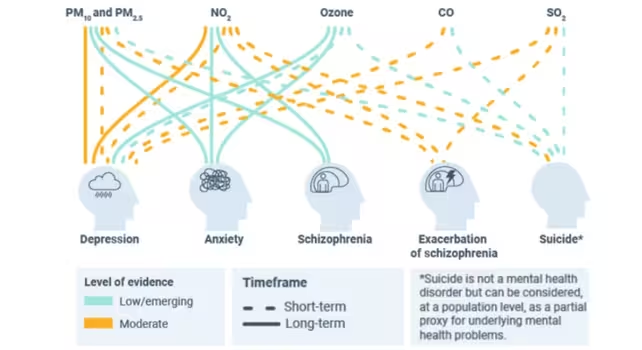
Why would nature help? Contact with green spaces lowers stress hormones, improves sleep and supports social interaction—mechanisms that reduce anxiety and depressive symptoms. Nature-based solutions therefore emerge as practical complements to pollution control, offering both ecological gains and measurable mental-health returns.
To put the stakes in perspective: in 2023 mental health disorders represented one of the largest burdens of disease across the European Union and ranked among the leading causes of death. That statistic reframes pollution as more than an environmental challenge; it is a factor in public mental health.
Policy choices matter. Reducing PM2.5 and NO2, limiting industrial chemical exposures, cutting traffic noise and investing in urban green infrastructure are levers that can change trajectories—both for cities and for the people who live in them. In short: clean air and quiet streets can be as important to mental resilience as therapy and medication.
Tackling pollution is therefore not only about preserving ecosystems or lungs—it is about protecting minds.














Leave a Comment
Comments
No comments yet. Be the first.