

4 Minutes
The malaria parasite has a blind spot. Tiny, but crucial. Scientists have uncovered a protein that malaria parasites rely on for a peculiar form of cell division — and knocking it out halts their progress. That vulnerability could steer the next generation of antimalarial strategies.
Malaria still kills. In 2024 the toll reached roughly 610,000 lives, disproportionately affecting children across sub-Saharan Africa. Vaccines and public-health measures have made dents, yet Plasmodium parasites—single-celled eukaryotes with an evolutionary history stretching back millions of years—continue to adapt and spread. Researchers are therefore hunting for molecular weaknesses that can be targeted without harming people.
How ARK1 steers an unusual cell cycle
Unlike human cells, Plasmodium divides in ways that look stranger under the microscope. Their mitosis is not a faithful replay of textbook cell division. Chromosomes and spindle machinery assemble and disassemble on a timetable and architecture unfamiliar to human cell biologists. Into this odd choreography steps a protein called Aurora-related kinase 1, or ARK1.
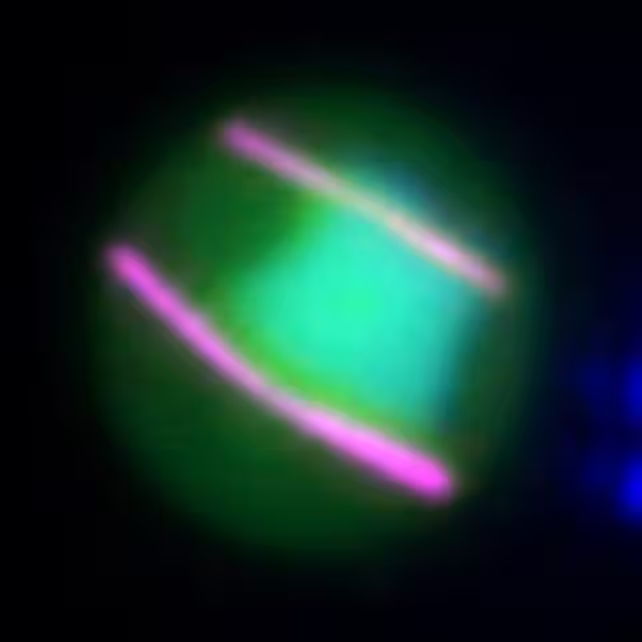
Think of ARK1 as an air-traffic controller inside the parasite nucleus. It helps organize the spindle — the molecular scaffold that pulls replicated chromosomes apart — ensuring that daughter parasites inherit complete genomes. Disable ARK1 and the spindle fails to form correctly. The parasites stutter and stall. They cannot finish the cycles of replication required to colonize a human host or to develop in an Anopheles mosquito.
That finding emerged from experiments using conditional gene knockout and knockdown approaches. By selectively switching off ARK1 at critical life stages, scientists observed widespread failure in spindle formation and a collapse of parasite replication. The effect appeared at multiple stages: parasites could not complete development inside vertebrate host cells, and their progression inside mosquitoes was also halted. The net result: transmission potential plummets.
Why this difference matters for drug design

One of the most appealing aspects of ARK1 is how dissimilar it is from the Aurora kinases found in human cells. Divergence at the sequence and structural levels means a therapeutic window may exist — drugs that bind and inhibit the parasite protein without interfering with human counterparts. As Rita Tewari, a parasite cell biologist at the University of Nottingham, points out, that divergence isn’t just academic; it’s practical. Target specificity reduces the risk of side effects, a major hurdle for antiparasitic drug development.
Ryuji Yanase, a co-first author on the study, likens the discovery to a dawn breaking on a previously murky aspect of parasite biology. The metaphor fits: identifying a protein that is both essential and distinct offers a foothold from which medicinal chemists can design inhibitors aimed squarely at the parasite’s life cycle machinery.
Targeting mitotic machinery is not a new idea in medicine — cancer therapies do it routinely — but Plasmodium’s unorthodox cell division demands fresh thinking. A compound optimized to disrupt ARK1 must account for the parasite’s lifecycle stages across host and vector, its intracellular niches, and the potential for resistance. Still, the combination of essential function and structural divergence gives ARK1 strong appeal as a drug target.
Expert Insight
“A target like ARK1 is valuable precisely because it sits at a chokepoint of parasite replication,” says Dr. Laila Mensah, a molecular parasitologist not involved in the study. “If we can design molecules that penetrate infected cells and selectively inhibit that kinase, we could block both disease progression in patients and transmission via mosquitoes. It’s a two-for-one opportunity.”
Further work will map ARK1’s interactions, identify pockets amenable to small molecules, and screen chemical libraries for inhibitors with the right balance of potency and selectivity. Structural biology, high-throughput screening, and in vivo efficacy testing in animal models will all be critical steps.
The discovery reframes a long-standing adversary. By illuminating the peculiar mechanics of Plasmodium mitosis and highlighting ARK1 as an Achilles’ heel, researchers have handed the antimalarial field a new direction. Whether that leads to a medicine that saves thousands of lives remains to be seen, but the path forward is clearer than it was before.











Leave a Comment
Comments (2)
ARK1 sounds promising but is it really that specific? parasites evolve fast, curious how they'd avoid cross-reactivity with human kinases. sounds risky
wow, ARK1 as an Achilles heel? mind blown. If we can target that without harming humans, huge win. hope resistance doesn't arise too quick