
3 Minutes
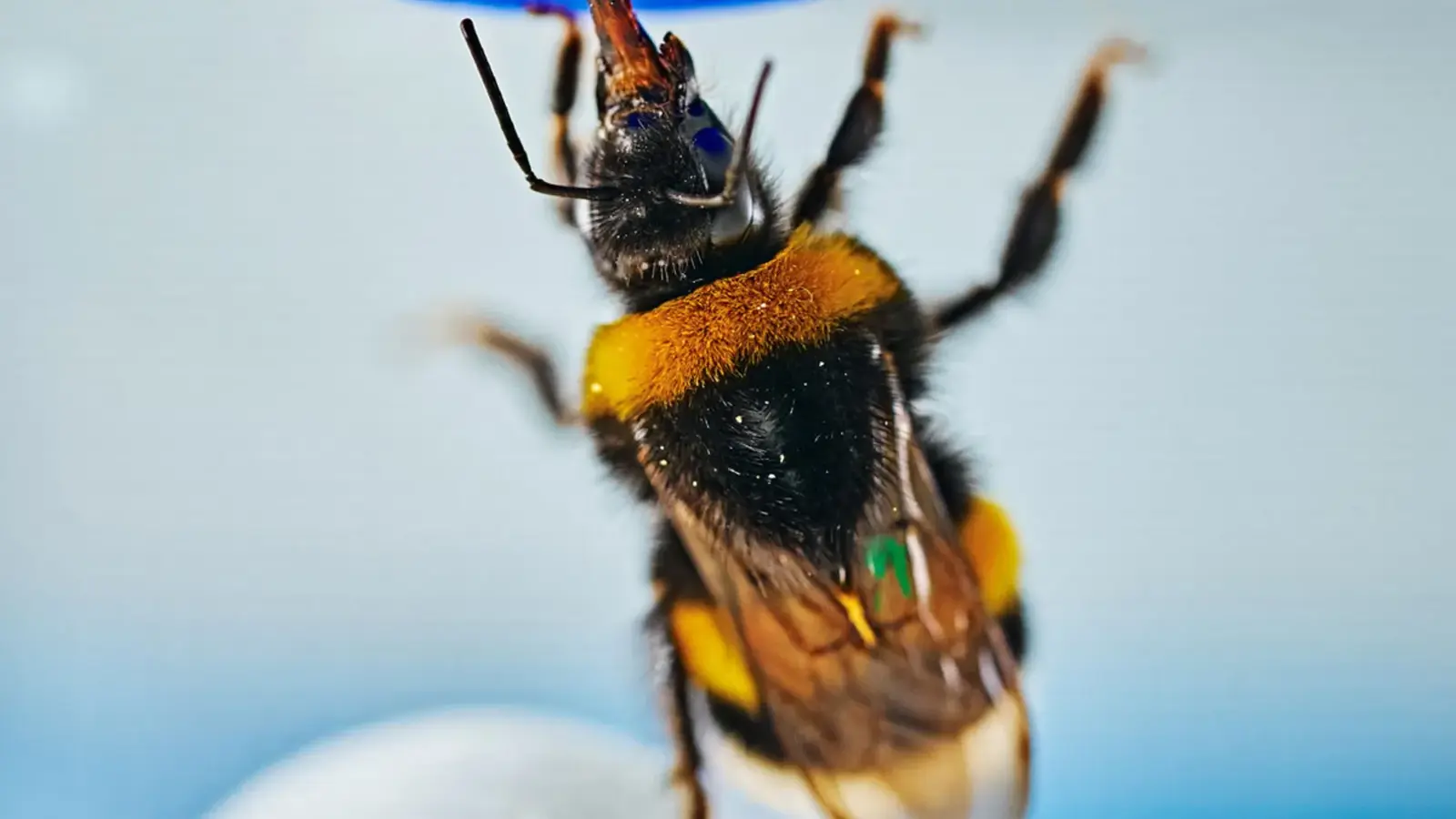
A plastic ball. A blue fake flower. A transparent box with a ceiling just out of reach. Those are the unlikely props in an experiment that asks a blunt question: how clever can a creature with a tiny brain be?
Researchers adapted the classic 'box and banana' puzzle, once used to demonstrate problem solving in chimpanzees, for bumblebees. Instead of stacking crates, the bees had to push a polystyrene ball to a marked spot, climb onto it and thereby gain access to an artificial blue flower fixed to the chamber roof. The distance was set so that flying or walking alone would not do the trick.
Crucially, the insects had no prior experience with this particular setup. Before trials began they only learned one thing: the blue flower contained a sugary reward. Even so, in the simplest version of the test, three out of four bees figured out the sequence. Seventy-five percent succeeded.
Success alone can be misleading. Was this cleverness or coincidence? To rule out accidental behavior — for example a natural tendency to bat at objects combined with an attraction to blue — the team raised the stakes.
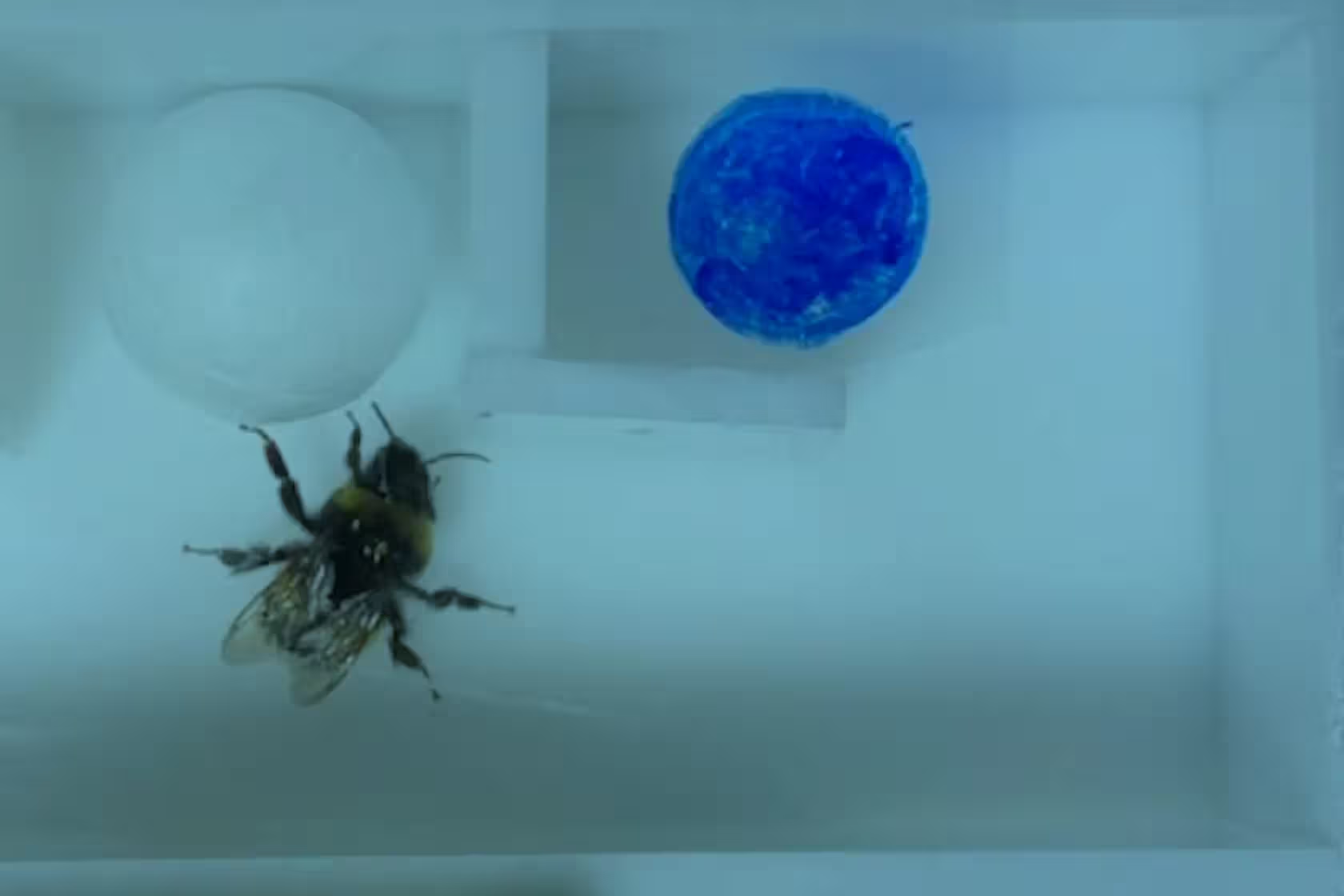
In the most stringent challenge, each bee was first allowed to inspect two side chambers, only one of which contained the rewarded flower. The ball was then placed in the arena while red light masked the blue cue, forcing the bee to rely on memory rather than sight. To solve the task the individual had to remember which chamber contained the reward and move the ball to the corresponding location. Twenty-three out of thirty bees passed this test.
These outcomes are striking because they show more than trial-and-error luck. The bees demonstrated goal-directed behavior, spatial memory and the ability to use an external object to access an otherwise unreachable resource — in short, tool use applied to a novel problem.
Dr Olli Loukola, a behavioural ecologist at the University of Oulu in Finland and lead author of the study, says the findings push back against a long-standing stereotype: that insect behavior is nothing more than hardwired reflex. "Most people think insects are reflex machines," he observed. "Our results suggest that small brains can produce flexible solutions to new problems."
Others in the field find the experiment persuasive. Professor Lars Chittka of Queen Mary University, author of the book 'The Mind of a Bee', notes that bumblebees have already surprised scientists with abilities from counting to sophisticated object manipulation. He calls this work some of the clearest evidence yet that bees understand, at some level, the relationship between an external object and a distant goal.
The study adds insects to an exclusive club of tool users — a list historically dominated by primates, elephants and certain corvids — and forces a rethink of how cognition scales with brain size. Big brains are not the only route to complex behaviour. Small neural circuits, arranged in particular ways, can produce unexpectedly rich solutions.
The research, published in the journal Science, doesn't claim bees think like humans; rather, it shows that tiny nervous systems can support flexible problem solving.
What follows from this is part scientific curiosity, part ethical unease. If insects can remember, plan and manipulate objects to gain rewards, should our view of them change? Should conservation and welfare discussions expand their remit to include cognitive capacities we once reserved for larger animals?
For now, the image of the bee as mere automaton is harder to defend. A simple ball and a blue flower have exposed a smarter, more adaptable insect — one that nudges at the boundaries of how we define intelligence in the animal kingdom.


Leave a Comment
Comments (2)
Is this even generalizable? lab set up, sugar reward and clever bees, or just conditioning? feels like a stretch to call it tool use in the wild tho...
wow... bees rolling a plastic ball to reach a blue flower? that's wild, kinda makes me rethink insects. unsettling but awesome, if true.