
4 Minutes
Under the steady hum of the operating room, something that should be silenced keeps working. Neurons deep inside the hippocampus — the brain’s archivist of memories — are not entirely switched off by general anesthesia. They are listening. And sometimes, they are even learning.
A recent study led by researchers at Baylor College of Medicine inserted high-density microelectrodes, known as neuropixels, into the hippocampi of seven patients undergoing epilepsy surgery. These probes, which capture signals from individual neurons at unprecedented resolution, revealed activity patterns that surprised everyone involved. The recordings showed that the hippocampus responded to simple tones, distinguished unusual or “oddball” sounds from repeated ones, and tracked language as it unfolded in real time.
In one experiment, repetitious tones were peppered with rare deviations. Certain neurons spiked reliably at those odd moments, and over the course of the session their responses sharpened — a hint that the brain was not only detecting change but getting better at it. In a second, more striking test, researchers played clips from educational videos and storytelling podcasts. Neural firing patterns suggested the hippocampus was parsing parts of speech — nouns, verbs, adjectives — and even forming predictions about what word might come next. Predictive coding, the kind of anticipatory processing we usually associate with wakefulness, was quietly happening under anesthesia.
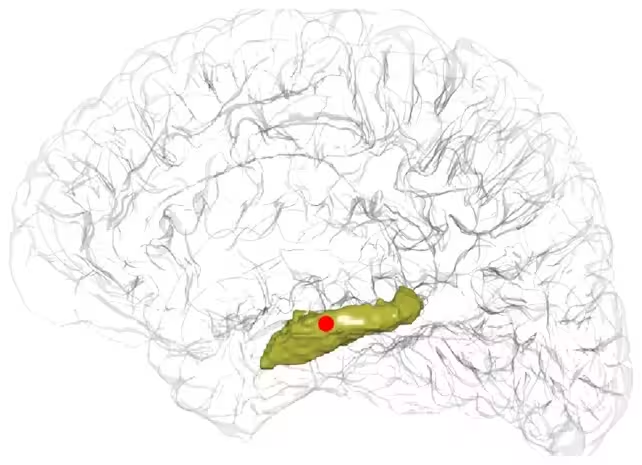
The hippocampus (shown in yellow) and the position of the probe (in red).
“Even when patients are fully anesthetized, their brains continue to analyze the world around them,” the team reports, challenging a long-held intuition: that deep anesthesia is equivalent to complete sensory blackout. Past work has found residual sensory responses in cortical regions; this new study pushes the boundary by showing those responses reach deeper, into structures central to learning and memory.
The implications are intriguing and, frankly, a little unsettling. If parts of the brain can process language and discriminate sounds while a person is clinically unconscious, what does that say about the boundary between awareness and the unconscious? Are these mere reflexes, or do they represent the scaffolding of learning that might survive even when subjective experience does not?

Caveats matter. The dataset is small — seven patients — and all received propofol as the primary anesthetic, so we cannot assume the same effects would appear with other drugs or in different states such as natural sleep or coma. Still, the consistency of the signals across participants suggests this isn’t a fluke from a single brain or a single operating theatre.
Beyond theory, there are practical avenues to explore. If the hippocampus can pick up and encode sounds without conscious awareness, could clinicians one day harness those signals to retrain damaged circuits? Could a speech prosthetic be driven by patterns detected in otherwise silent brain regions, helping people who have lost language function after stroke or injury? Those are bold questions, but the recordings open the door to considering them.

Brain cell activity spiked when "oddball" sounds were played in a series of standard tones. These recordings are from a single unit (e) and averaged across a population of neurons from two patients (f)
There is also a methodological twist worth noting: neuropixels probes have been game-changers in animal labs, but they’ve rarely been used in human hippocampus before. Bringing that level of resolution into surgical settings gives neuroscientists a new lens on how tiny ensembles of neurons cooperate when the mind appears offline.
The work nudges at a larger, persistent mystery: consciousness itself. We know so little about the neural choreography that separates awareness from blackout. Studies like this don’t solve the puzzle, but they do move a few pieces, showing that some cognitive routines — prediction, pattern discrimination, language parsing — can run without the orchestra conductor we call conscious experience.
For now, researchers will need larger cohorts, comparisons across anesthetic classes, and careful tests in sleep and coma to map how general these findings are. But one thing feels clear: even at its quietest, the brain is not entirely still. Listen closely enough, and it has stories to tell.


Leave a Comment
Comments (2)
Seven pts, all on propofol. sounds like a hint not proof. could other drugs kill this effect? curious but skeptical, needs bigger cohorts
wow this creeps me out and excites me. hippocampus learning under anesthesia?? makes me wonder about memory leaks, consent, and how much the brain records when we think it's off... weird.