
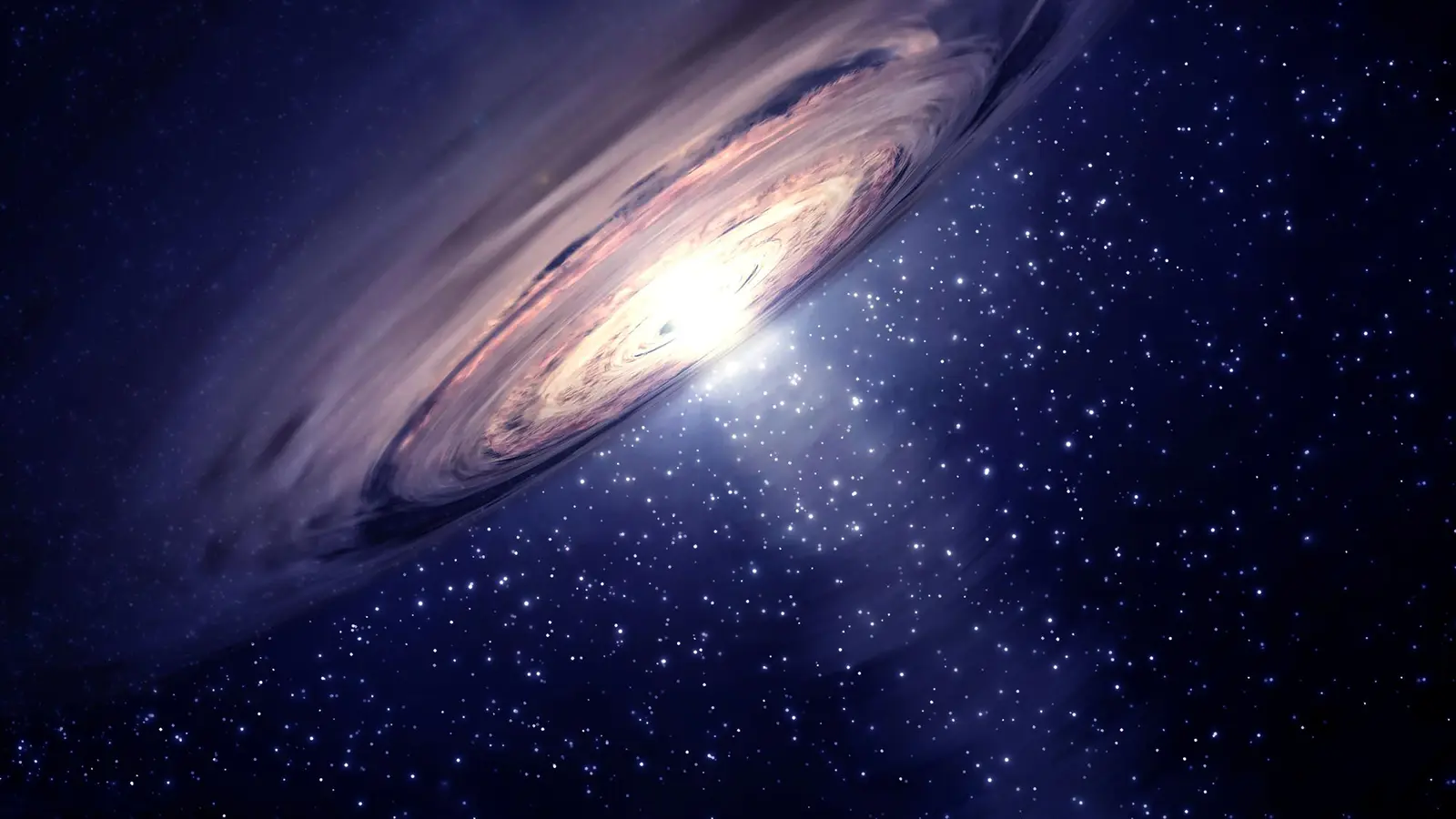
Imagine finding a fossil older than the rock it sits in. Strange thought. But that is precisely the picture some cosmologists are painting: tiny, stubborn remnants of a Universe that existed before our own.
A team led by Professor Enrique Gaztañaga at the University of Portsmouth has revived a once-controversial idea and given it a modern twist. Instead of a single, inscrutable beginning, the cosmos may have contracted and then bounced into the expansion we now observe. In that scenario, some compact objects born during the contracting phase could have weathered the turnaround and come through into our expanding Universe as relics.
What would those relics look like? Think primordial black holes, but with a story that begins before the conventional Big Bang. These would be true cosmic fossils: dense knots of gravity that survived extreme compression, carried through a high-density bounce, and continued to shape matter long after galaxies formed. Could they be the elusive dark matter that scaffolds galaxies? It is an idea gaining traction because the math allows for a population of surviving compact objects large enough to matter.
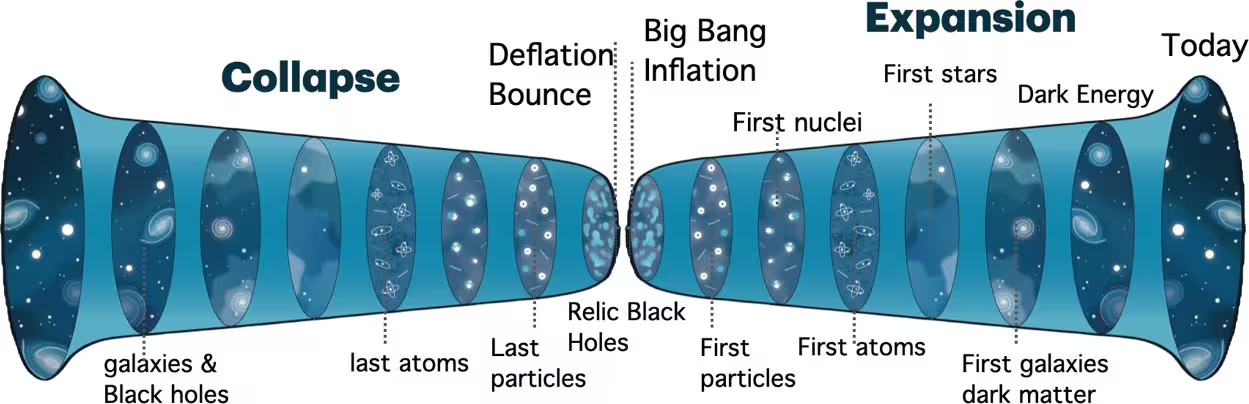
Why consider a bounce at all? General relativity points to a singularity when you extrapolate our expanding Universe backwards, a point where density and curvature blow up and the equations break. Many physicists read that breakdown as a clue that something in our description is incomplete. A bounce replaces the infinite with the enormous but finite: quantum effects generate a repulsive pressure at ultra-high densities, halting collapse and triggering re-expansion. The same physics that stops collapse in white dwarfs and neutron stars could operate on cosmic scales.
The Portsmouth model argues that quantum pressure could mimic the effects traditionally attributed to inflation, smoothing and stretching space during the rebound. It might even connect to dark energy, the mysterious driver of today's accelerating expansion. And crucially, it predicts survivors. Their calculations indicate that compact objects larger than roughly 90 meters could pass intact through the bounce. Not many, but enough to leave fingerprints on cosmic structure.

Surviving black holes would influence galaxy formation from the very start. That gives us a simple answer to a thorny observational puzzle. The James Webb Space Telescope has found surprisingly massive objects early in cosmic history, the so-called little red dots that seem too mature to fit standard timelines. If black holes predated or immediately followed the bounce, early galaxies would inherit seeds that shortcut the need to grow everything from near-zero.

There are ways to test these ideas. Relic gravitational waves from a prior contracting epoch would differ in pattern from waves produced during conventional inflation. Subtle imprints could also linger in the cosmic microwave background, small deviations in temperature or polarization that betray a pre-bounce past. And, of course, direct searches for primordial black holes—through microlensing surveys, gravitational-wave detections of unusual merger events, or their dynamical effects in galaxies—could reveal whether a hidden population exists.
Could such black holes account for dark matter? If enough formed and survived the bounce, they could contribute a substantial fraction, perhaps even all, of the missing mass. That would resolve two mysteries at once: the nature of dark matter and the origin of unexpectedly massive early structures. No single model is yet proven. The bounce scenario is a hypothesis that makes concrete predictions and, importantly, offers observational hooks.
There is skepticism, naturally. Moving from mathematical possibility to physical reality requires robust microphysics and consistency with precision cosmological data. Models must explain why the bounce leaves the specific spectrum of density fluctuations we observe, and they must avoid creating contradictions with well-measured signals in the cosmic microwave background and large-scale structure.
Still, the idea is electrifying. It nudges us to ask different questions: maybe the Big Bang is not the absolute beginning but a chapter break. Maybe our cosmos carries archaeological traces of an earlier epoch, hidden in compact, gravitationally bound objects drifting through space. If even a handful of these cosmic fossils turn up, the story we tell about origins will need to be rewritten.

Leave a Comment
Comments (2)
If relic black holes are dark matter, why haven't microlensing surveys found them? feels like a big missing piece, or am I missing something
Whoa fossils older than their rocks? mind blown. Tiny BHs surviving a bounce sounds wild but kinda plausible, curious what JWST will reveal…