
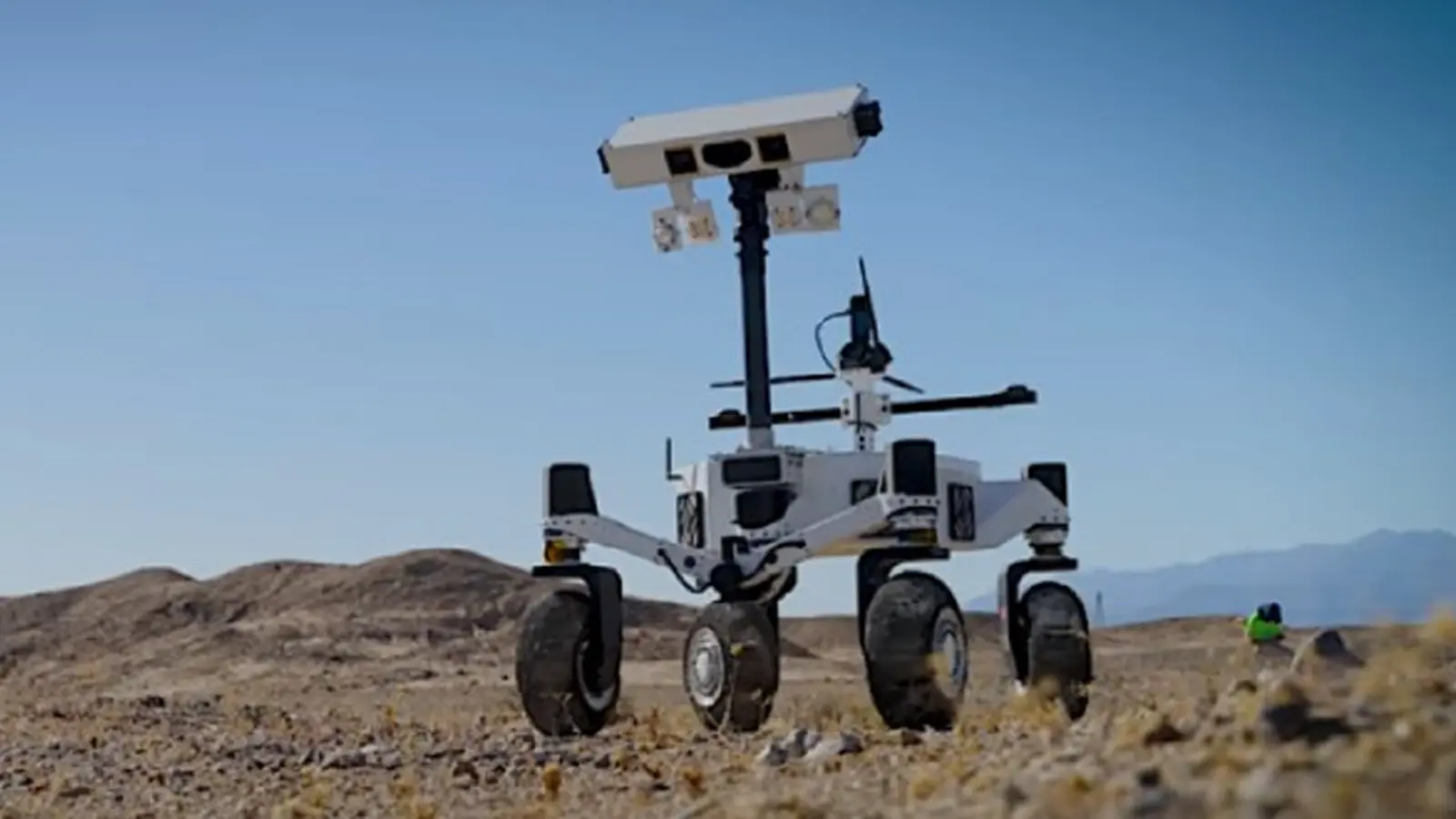
Imagine a rover that thinks on the move and covers ground like a desert courier. That’s the image engineers at JPL are chasing with ERNEST, a compact four‑wheeled prototype built to sprint across the kind of broken, sloping terrain that stalled older rovers.
At just 1.2 meters long, ERNEST—short for Exploration Rover for Navigating Extreme Sloped Terrain—looks almost cheerful next to the hulking SUVs that used to patrol test yards. Don’t let the size fool you. During recent field trials in a Colorado desert, the little rover sustained speeds near 1 kilometer per hour. By NASA’s count, that’s roughly ten times the pace of Curiosity and Perseverance when they slog through rough ground.
Speed matters. Faster traversal means covering more science in less time, and it also changes mission design: instead of inching toward a target for weeks, a rover that can think and move more quickly opens the door to road‑trip style exploration across lunar and Martian landscapes. How does ERNEST pull it off? Part mechanical savvy, part machine learning.

Underneath the compact body sits an advanced suspension system that rebalances weight across the wheels as the surface angles change. The front has two motorized joints and all four wheels can steer independently, allowing sideways maneuvers and confident climbs over obstacles that would bog down stiffer chassis designs. In plain terms: it can sidle along a slope, rotate into a gap and climb, rather than brute‑forcing a single path.
Autonomy is where ERNEST earns its stripes. Engineers at JPL trained reinforcement‑learning algorithms first in the familiar confines of the Mars Yard and then stressed them under real‑world conditions in the desert. The software doesn’t follow preprogrammed scripts. Instead, it learns from interaction with its environment, refining decisions about which routes to take, when to shift posture, and how aggressively to push for speed without risking damage.
Tests weren’t limited to daytime runs. The team even evaluated ERNEST in complete darkness to mimic low‑light scenarios such as lunar dawns and dusks where shadows deepen and visual cues fade. Those night trials helped tune sensor fusion and navigation routines so the rover can maintain long drives across varied lighting and terrain.
“We’re seeing a vehicle that can carry out a scientific tour, not just a single destination hop,” says JPL planetary scientist James Keane, describing how sustained traversal reshapes what robotic exploration can accomplish. Iza Nesnas, a technologist at JPL, adds that the hands‑on desert trials were crucial to refining both the mobility hardware and the autonomy stack for the wide range of surfaces and light conditions expected on the Moon.
A larger, faster ERNEST could one day scout entire lunar regions ahead of astronauts, mapping safe routes and finding promising sites for science.
The path from prototype to flight hardware will require scaling and qualification: tougher materials, radiation‑hard electronics, and rigorous endurance testing. Still, ERNEST’s mix of mechanical flexibility and adaptive intelligence marks a shift in rover thinking. Rather than building ever larger, slower platforms, designers are exploring agile, smart machines that can range farther and return more science per day.
If field trials continue to pay dividends, the next generation of planetary rovers may arrive not as lumbering behemoths but as quick, resilient scouts—capable of racing across a landscape to chase a cometary fragment one hour and inspect a volcanic fissure the next. Who will lead that reconnaissance? For now, a small, daring rover called ERNEST is making the case.

Leave a Comment
Comments
No comments yet. Be the first.