
3 Minutes
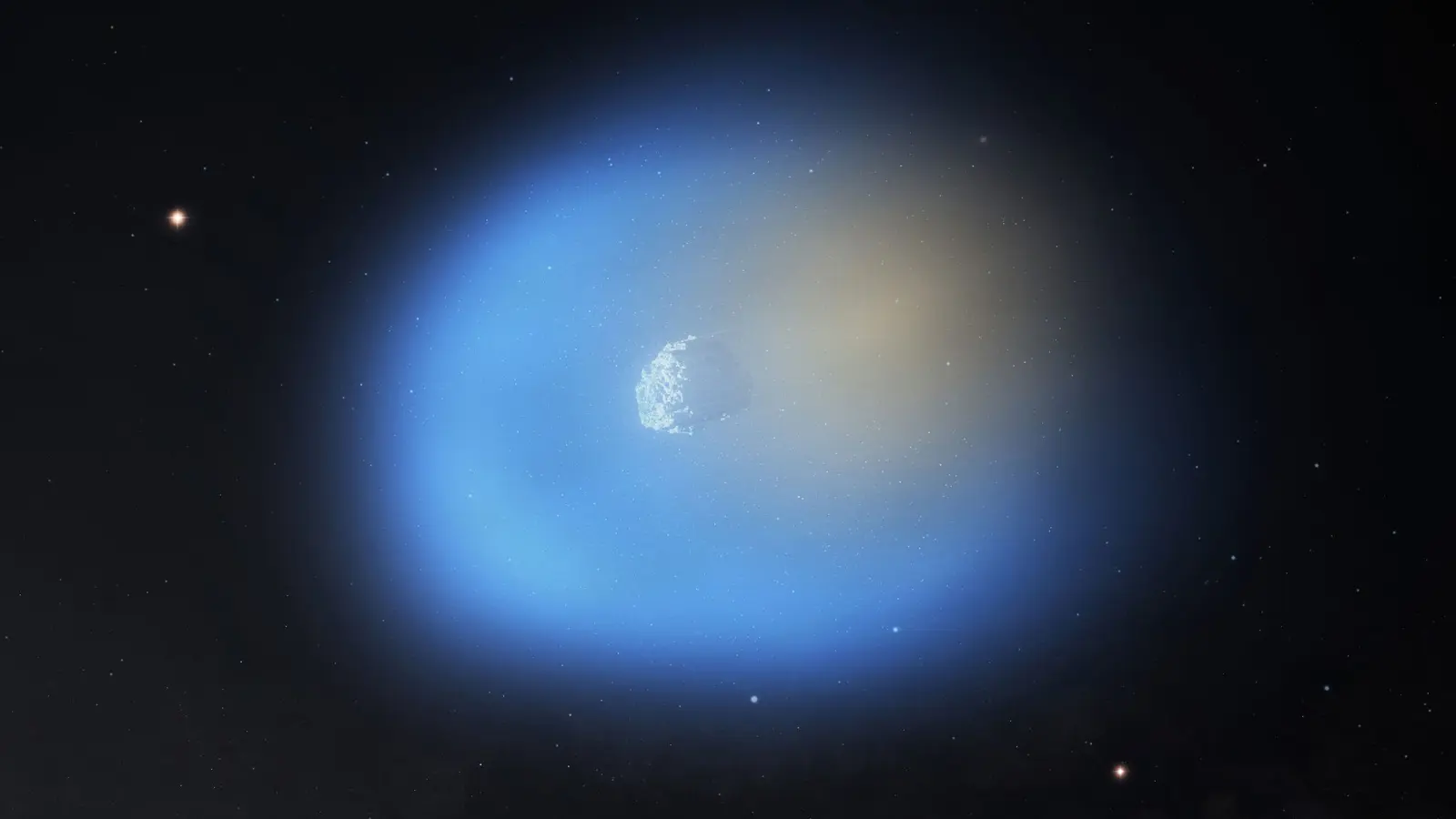
It arrived like a whisper from another star and then spoke in molecules. Comet 3I/ATLAS, the third confirmed interstellar visitor to sweep through our neighborhood, is telling a chemical story that surprised astronomers: it is unusually loaded with methanol.
Using the Atacama Large Millimeter/submillimeter Array’s Compact Array in Chile, a team tracked faint submillimeter fingerprints from the comet as it warmed on its approach to the Sun in late 2025. As solar heating lifted icy material into the coma, detectors did more than map dust and gas — they read the comet’s elemental biography.
Two molecules stole the spotlight: methanol (CH3OH) and hydrogen cyanide (HCN). Both are familiar in comets, but not in the proportions seen here. On two observing nights the ratio of methanol to HCN measured roughly 70 and 120, placing 3I/ATLAS among the most methanol-rich comets ever sampled. That’s not a small deviation. It’s a clue.
Why does that matter? Because chemistry encodes birthplace and history. A high methanol fraction suggests the ices in 3I/ATLAS formed under conditions unlike those that produced most comets in our solar system — or that the material experienced processing before it was cast out of its parent system. Earlier observations with the James Webb Space Telescope had already highlighted oddities: at larger distances, the comet’s coma was dominated by carbon dioxide. Now ALMA adds another layer to the mystery.

The way the molecules leave the comet is revealing, too. Hydrogen cyanide appears to stream directly from the nucleus, much like HCN in our local comets. Methanol, however, has two sources: it vents from the nucleus and it sublimates from tiny icy grains lofted into the coma. Think of those grains as miniature, transient comets — frozen micro-objects that release trapped organics as they heat and evaporate.
That dual origin matters because it ties composition to physical structure. If methanol is bound up in grains as well as in the nucleus, then the bulk ice in the parent system was likely ice-rich and grainy, or it experienced aggregation and thermal events that preserved methanol in small particles. The implication: planet-forming disks around other stars can produce clumps of chemistry that look very different from what we see here.
Nathan Roth, lead author of the study and a professor at American University, put it plainly: studying 3I/ATLAS is like taking a fingerprint from another solar system. The print looks family-related in some ways, but the whorls are distinct. Each interstellar visitor so far — first ’Oumuamua, then Borisov, now 3I/ATLAS — has broadened our sense of what planetary systems can make.
We’re still early in the sampling game. Observations like these are a rare chance to probe exoplanetary chemistry without leaving Earth. They force us to ask new questions about chemical diversity in disks, about how volatile reservoirs survive ejection, and about what those reservoirs might tell us about planet formation under different temperatures and radiation environments.
Will the next interstellar wanderer tell a similar tale, or something even stranger? With more sensitive surveys and faster follow-up, astronomers hope to find out — and to keep listening to the subtle, telling language of molecules.








Leave a Comment
Comments
No comments yet. Be the first.