

Ethereum market snapshot
Ethereum (ETH) has been trading in a narrow band around $1,570–$1,580 after a quiet weekend failed to remove selling pressure from the second-largest cryptocurrency. Despite limited intraday volatility, key market signals — including ETF outflows, concentrated whale selling, and subdued spot demand — keep near-term momentum tilted toward the downside.
Key takeaways
- ETH remains below the psychologically and technically important $1,800 zone that many traders view as a recovery threshold.
- Institutional flows are weak: U.S. spot Bitcoin and Ethereum ETFs recorded consecutive outflows, undermining steady spot demand.
- Large holders have recently offloaded significant amounts of ETH, creating fresh sell-side supply.
- A defended $1,583 level could stabilize the market; losing it may open the way to deeper support areas.
ETF flows and spot demand
U.S. spot crypto ETFs continued to post net outflows on June 26, with Bitcoin funds seeing roughly $445 million leave and Ethereum ETFs reporting approximately $12.848 million in net redemptions, according to SoSoValue data. Although ETH’s outflows were materially smaller than Bitcoin’s, the persistence of negative flows matters: ETFs can act as a consistent source of spot buying, and a prolonged streak of outflows weakens that baseline demand.

Ethereum spot ETF net inflow
Analysts warn that when ETF flows remain negative for multiple sessions, the cushioning effect for price weakens and makes rebounds harder when traders are already reluctant to add risk. Past coverage of Ethereum ETF dynamics showed that rising fund withdrawals had already pushed ETH into testing important support bands earlier in June, and that pressure has continued into the current period.
Whales selling into weak support
Large holders are a dominant driver of supply in periods of market stress. Chart analyst Ali Martinez reported that roughly 550,000 ETH was sold by major holders over the past week — a volume that equates to about $880 million of sell-side pressure at prevailing levels. That distribution helped push ETH below a near-term floor at $1,633 and left the token testing volume support near $1,583.
Ali’s analysis notes that if selling persists, historical high-volume demand zones could come into play near $1,237 and $1,089. Those levels are not guaranteed targets, but they illustrate where yesterday’s liquidity may attract buyers if ETH breaks materially lower. Meanwhile, the price action continues to produce lower highs, indicating sellers retain control of short-term structure.
Why whale selling matters
When large addresses offload holdings into thin spot markets, even concentrated buying (for example, institutional purchases) may be insufficient to reverse a downtrend. The week’s large-scale distributions appear to have absorbed much of the spot demand, keeping the market fragile despite occasional accumulation headlines.
Derivatives and on-chain signals

Derivatives activity and exchange-level metrics paint a similar picture. CryptoQuant analyst PelinayPA highlighted that Ethereum’s taker buy/sell ratio on Binance remains above 1, which normally implies stronger taker-side buying. Yet ETH has not responded with a significant rebound. That muted price reaction suggests larger sellers may be absorbing buy orders — buyers are present but lack the conviction to push the market higher.
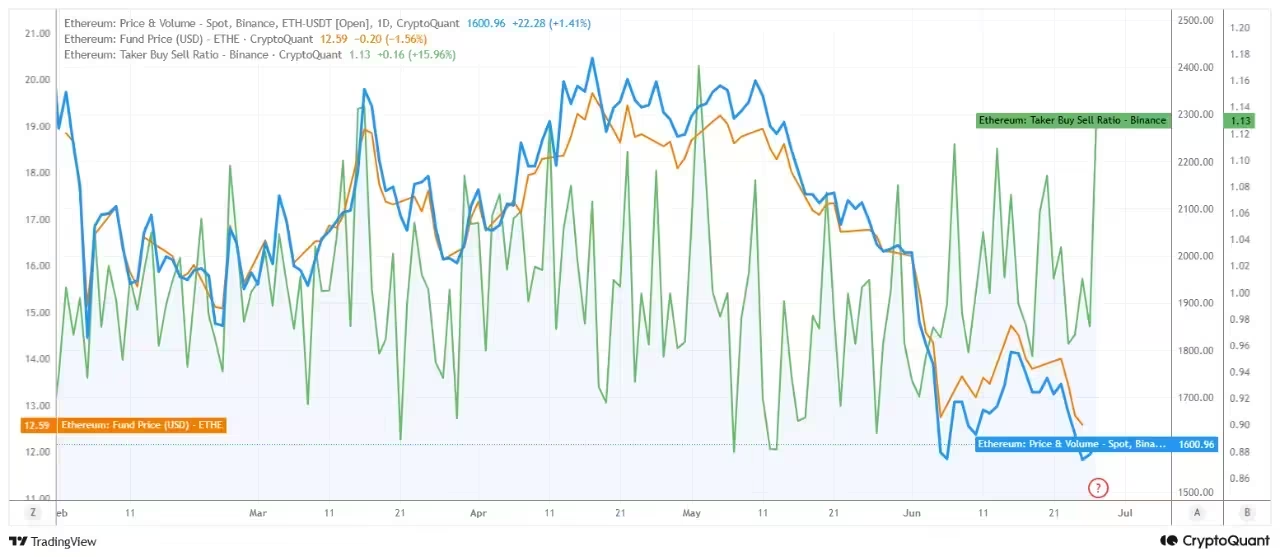
Source: CryptoQuant analyst PelinayPA
Furthermore, the fund price for ETH derivatives has been declining since April, according to the same set of on-chain indicators. This signals that traders are reducing long leverage and stepping back from risk in derivatives markets. When long exposure contracts simultaneously with persistent sell-side behavior, rallies can be used as liquidity-taking opportunities by larger players.
Analyst views: split between caution and accumulation
Market commentators are divided on the near-term path for ETH. Some warn the downside risk is meaningful: Money Ape cautioned that Ethereum could record three consecutive red quarters for the first time and suggested ETH might test sub-$1,000 levels if confidence deteriorates further.
On the more constructive side, Michaël van de Poppe framed sub-$1,800 prices as an opportunity for longer-term accumulation rather than day trading. He expects bullish divergences may be forming across multiple timeframes, but emphasizes that a clear break above $1,800 would be the confirmation traders need to shift sentiment more decisively.
Van de Poppe also flagged potential tactical buy zones in the event of further downside — near $1,505 and $1,385 — levels that could capture liquidity if the market sweeps lower.
What this means for traders
- Short-term traders should treat anything below $1,800 as structurally weak and avoid aggressive long exposure until the zone is reclaimed.
- Longer-term investors may view current ranges as an accumulation window, scaling in around established demand bands rather than trying to time micro swings.
- Risk management remains essential: tight stops or reduced position sizes can protect capital if whipsaw action intensifies.
Technical outlook and scenarios
Bull case: If buyers can defend the $1,583 volume support and push ETH back above $1,633, the next meaningful resistance sits at $1,800. A clean break and weekly close above $1,800 could signal a renewed attempt to reclaim higher levels and restore more favorable momentum.
Bear case: A decisive break below $1,583 would likely expose lower demand areas around $1,505 and $1,385. Continued whale distribution and negative ETF flows could accelerate declines and bring deeper support near $1,237 and $1,089 into focus.
Overall, the technical structure still favors sellers until a clear reversal above $1,800 occurs. Traders should watch volume confirmation and derivatives metrics for signs of durable buying interest.
Final thoughts

Ethereum is steady for now but not out of the woods. ETF outflows, concentrated whale selling, and weak derivatives positioning leave the market vulnerable to lower tests of liquidity. A defended $1,583 could stabilize price and allow a re-test of $1,800; failure to hold that level would increase the probability of deeper declines. For investors and traders in ETH, the coming sessions will be pivotal for establishing whether institutional demand returns or seller dominance extends into July.

Leave a Comment
Comments (2)
This is getting tense! Holding a bit of ETH, but that 1,583 line gives me nightmares... might buy more at 1,385 but idk, nervous rn
Wait, so ETFs bleeding and whales dumping at once? Sounds sketchy. If $1,583 fails, could be ugly.. who's actually buying now? feels fragile