
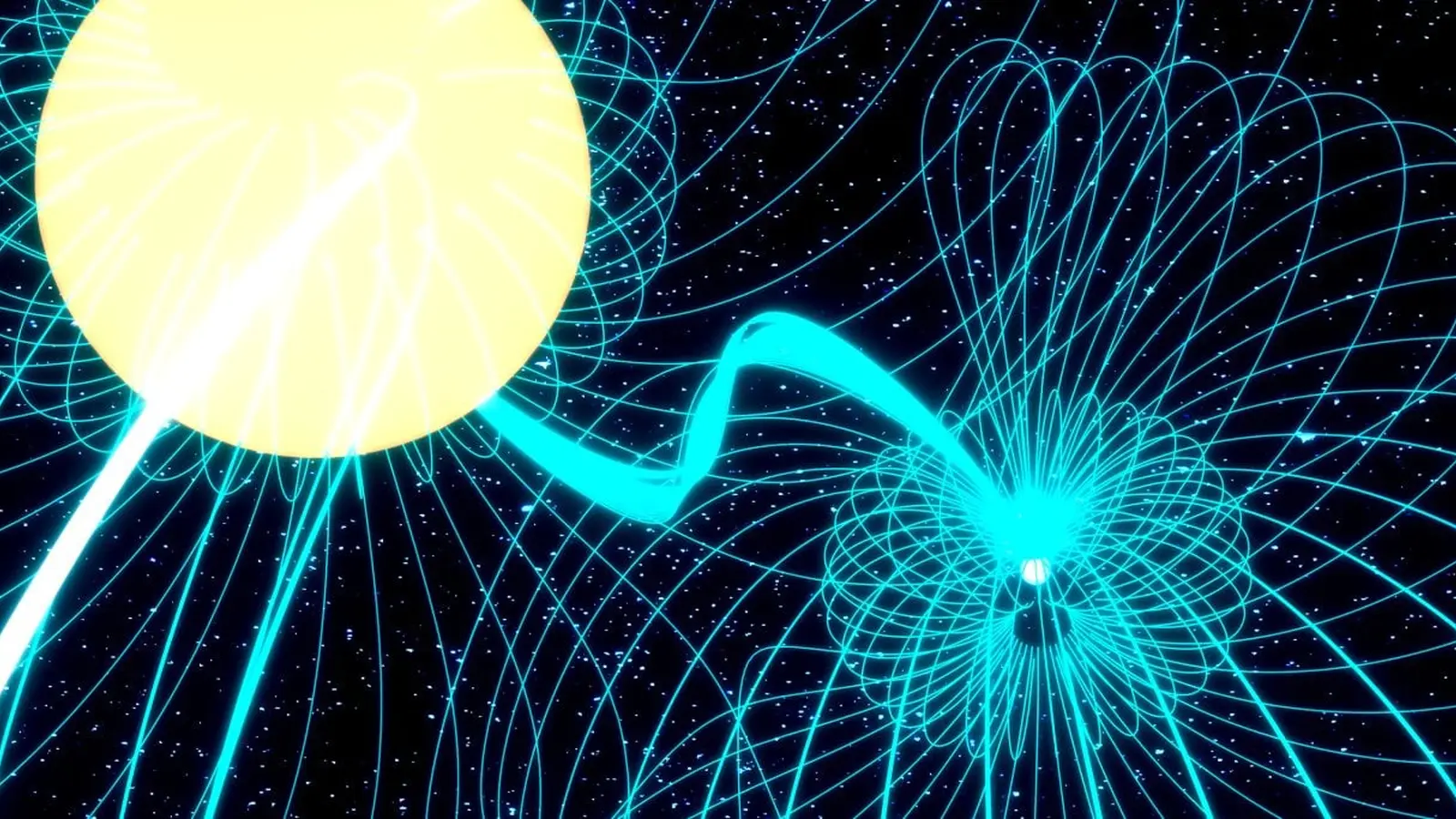
Something odd is ticking in the radio sky. Minutes stretch into hours, then silence, then a bright flash—repeat. For years these slow, stubborn radio flashes have been a nuisance and a mystery, popping up in wide-field surveys and refusing to fit tidy explanations. Now one of them, dubbed ASKAP J1745, is offering a rare look under the hood.
Found by the Australian SKA Pathfinder (ASKAP) and followed up across the spectrum, ASKAP J1745 is not just another anonymous blip. It is part of a close-knit pair of stars exchanging matter and magnetic drama. That pairing—an accreting white dwarf siphoning gas from a companion—turns out to be the missing cog for one class of these long-period transients.

Galactic map of long-period transients (LPTs), including those with evidence of binary systems, and galactic centre radio transients (GCRTs). Author-provided composite.
Why do these sources feel so alien? Because they pulse on timescales far longer than ordinary pulsars. Most radio pulsars spin in fractions of a second to a few seconds. Long-period transients blink on scales of minutes to hours. They’ve shown stubborn behaviours: some have been reliable for decades, others go quiet for days, even years. With only about a dozen of them known, each new, well-observed example is a prize.
ASKAP J1745 became that prize. Teams watched it with radio dishes, optical instruments and X-ray observatories. The result was a clean fingerprint: radio bursts and X-ray flashes matched the orbital rhythm of two stars circling each other. In plain terms, each time the pair completes an orbit, the system lights up in more than one kind of light.
That synchrony is a revelation. It rules out simple explanations like an isolated, slowly spinning neutron star. It points instead to a cataclysmic variable—a tight binary where the white dwarf’s gravity strips gas from its neighbour. That stolen gas doesn’t arrive politely. It crashes, shears, heats and funnels along magnetic fields, producing X-rays where the flow slams into the white dwarf and radio emission where charged particles gyrate in potent magnetic fields.


The ASKAP radio telescope at Inyarrimanha Ilgari Bundara, the CSIRO Murchison Radio-astronomy Observatory on Wajarri Yamaji Country in Western Australia.
Think of it like a celestial blender with a magnet. Material pours in. It slams into a compact object. Magnetic field lines twist and snap. Particles accelerate. Radio waves are born. Short sentence. Big effect.
The radio bursts are especially telling. Their properties match emission produced when relativistic electrons interact with strong, ordered magnetic fields—a process familiar in other astrophysical contexts but rarely observed tied so cleanly to an accretion cycle. The discovery ties together two ingredients: a reservoir of charged particles (accretion) and strong magnetic architecture (the white dwarf’s field and possibly the companion’s contribution). Together, they make the slow, repeating radio fireworks astronomers had been puzzling over.
There are broader implications. Until now most long-period transients floated as orphan signals: radio-only detections with little to no multiwavelength context, often hidden near the dusty plane of the Milky Way. ASKAP J1745 is a Rosetta-stone moment for that population. With radio, optical and X-ray clues in hand, astronomers can test whether similar systems—accreting white dwarfs with the right magnetic and mass-transfer conditions—explain other members of this oddball class.
It also opens a laboratory for exotic plasma physics. These binaries host flows and fields in regimes impossible to recreate on Earth: magnetized plasmas, shocks, and particle acceleration on compact scales. Watching how emission toggles with orbit lets researchers see cause and effect—how changes in accretion rate or geometry shift the radiative output. That’s gold for theorists trying to map the microphysics of magnetized accretion.
Questions remain. How many long-period transients are accreting white dwarfs versus some other exotic beasts? What controls whether a system produces bright radio pulses, steady emission, or long quiet stretches? And crucially: can these systems teach us about magnetic interactions in other compact binaries, including those that might one day merge?

ASKAP J1745 doesn’t close the book. It turns the page and gives us a plot we can follow—one orbit, one burst at a time.

Leave a Comment
Comments (2)
Hmm, is this even true? Sounds neat but could be selection bias or just one weird system. Need stats, more examples, repeatability pls
Whoa this is wild! White dwarf as a magnetized blender... minutes-long radio pulses synced to orbit? If true, could explain many orphan blips. More follow up pls