
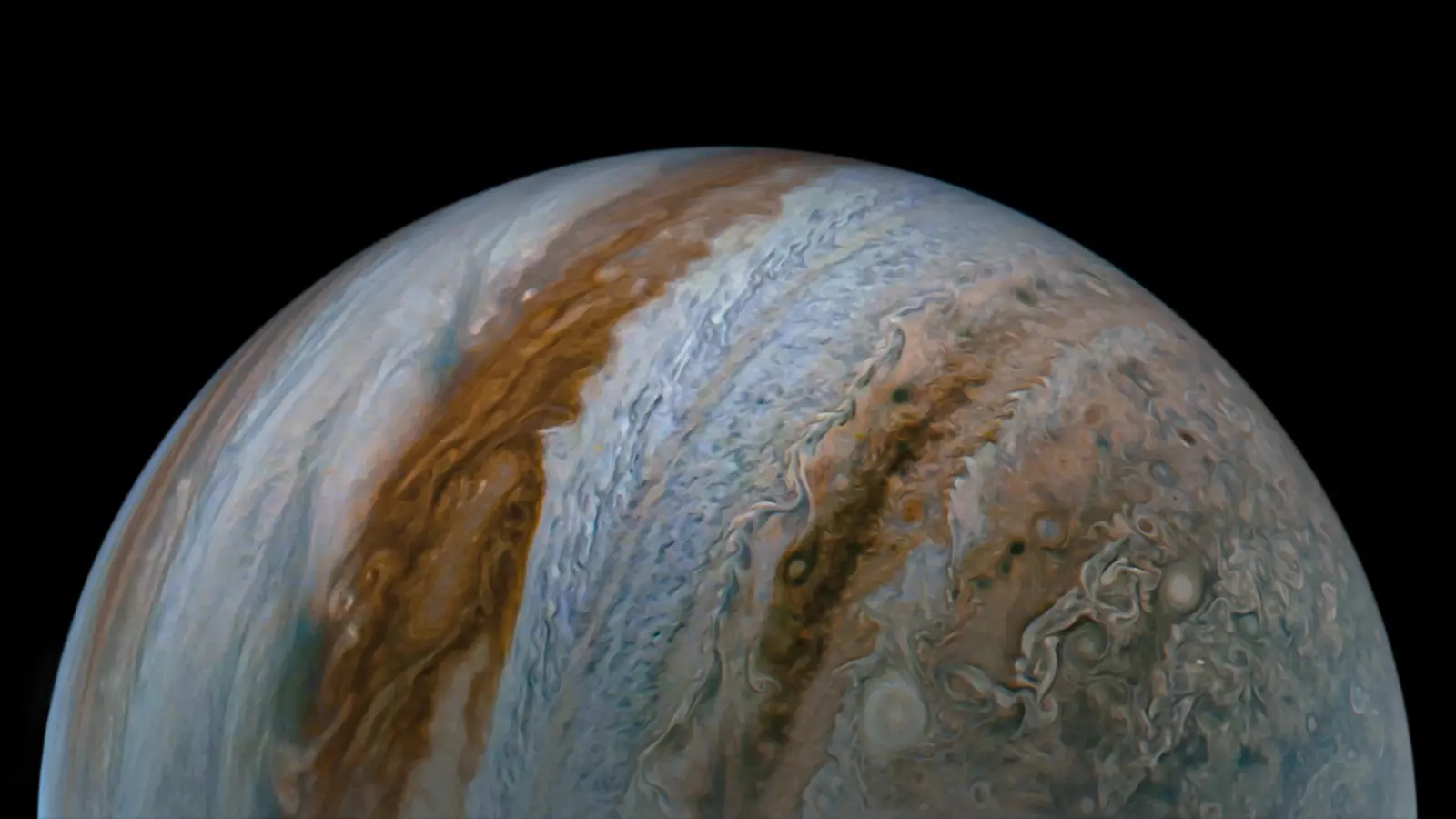
Juno didn't just skim Jupiter's magnetic frontier — it found choreography. Instead of a single, blunt barrier, the gas giant stages a layered defense that tames the Sun's supersonic breath with a surprising mix of waves and smaller shocks.
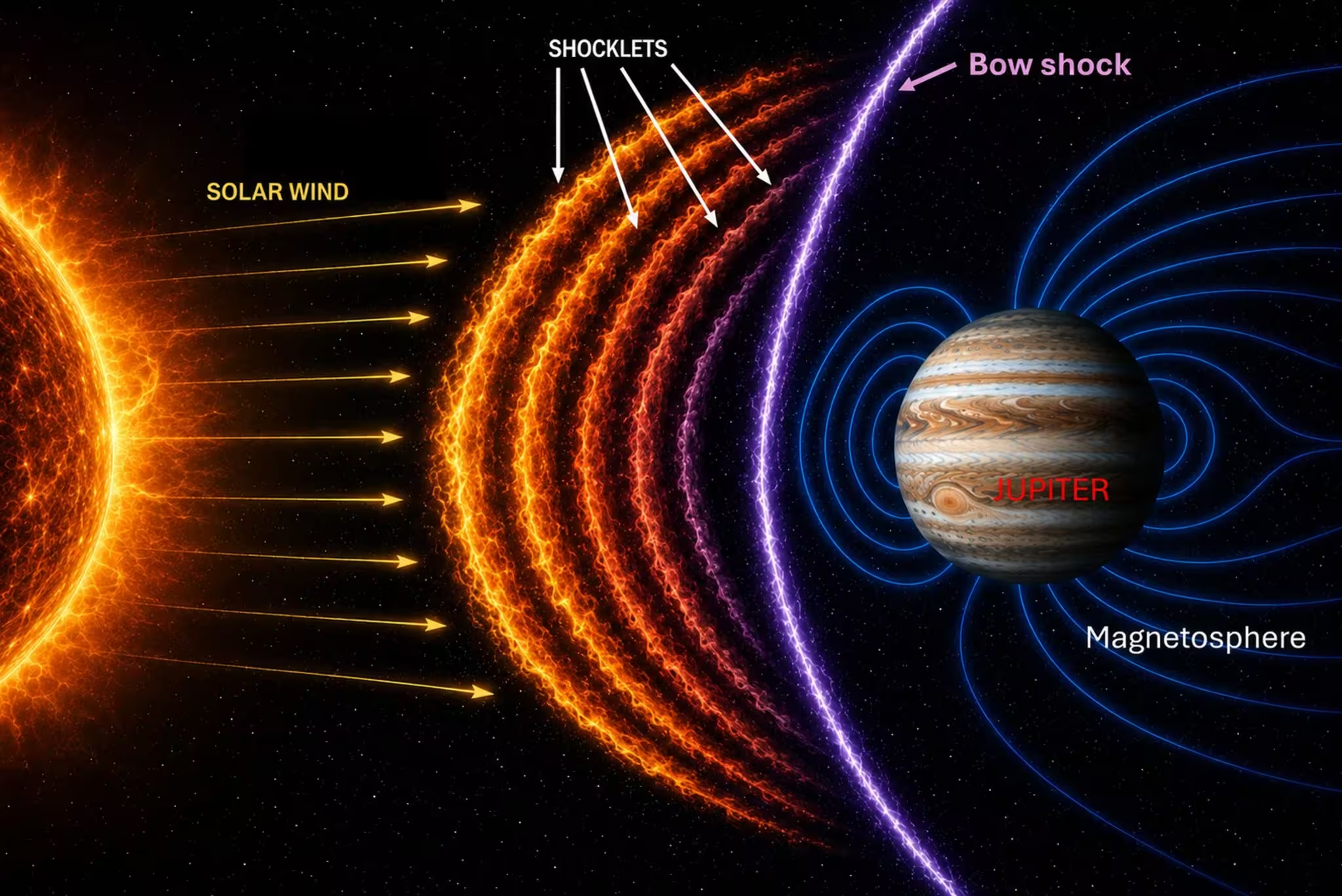
The Juno spacecraft, during passes that included a close encounter in December 2024, recorded the most detailed measurements yet of Jupiter's bow shock, the vast boundary where the solar wind slams into the planet's magnetosphere. What emerged from the data is a picture very different from Earth's cleaner, single-boundary solution: Jupiter spreads the workload across many frequencies of plasma waves and a string of miniature shock regions known as shocklets.
Think of Earth's bow shock as a single dam holding back a river. Jupiter builds a cascade. Plasma waves at multiple harmonics — a richer spectral mix than seen at Earth — interact with incoming particles across a wider energy range, heating and slowing them before they ever reach the main shock. The result is a staged deceleration rather than one big, violent turn.
'Jupiter has found its own way to deal with the solar wind, through plasma waves that are stronger and exhibit richer harmonic structures,' says Jayasri Joseph, a postdoctoral researcher at the University of Iowa and the paper's lead author. 'Multiple frequencies can heat more particles and slow them down more gradually.'
Juno also mapped repeated brief compressions ahead of the main boundary — the shocklets. These patches act like speed bumps in the flow of charged particles, softening the blow in stages. Bill Kurth, a research scientist at the University of Iowa who helped lead instrument development for Juno, notes that Earth rarely needs such pre-processing because our bow shock faces less extreme conditions.
Why does this matter beyond planetary science? Because shock physics are universal. The same basic processes that convert bulk flow into heat and energetic particles at Jupiter also operate in far more extreme places, such as the expanding shocks of supernova remnants. Jupiter can't reproduce those cosmic extremes, but it gives scientists an accessible, nearby laboratory where instruments can measure the messy, multi-scale physics up close.
The Waves instrument aboard Juno — designed and built by University of Iowa physicists — made these discoveries possible by resolving the complex spectrum of radio and plasma waves inside Jupiter's magnetosphere. Earlier missions established the presence of a bow shock; Juno revealed its inner life.
By revealing harmonic-rich plasma waves and a chain of shocklets, Jupiter's bow shock shows how nature can tame violent space weather through layered, multiscale interactions.
As Juno continues its tour of the Jovian system, each new crossing refines our understanding of how giant planets sculpt their space environments — and how those same processes might scale up to shape the most energetic shocks in the universe.

Leave a Comment
Comments
No comments yet. Be the first.