
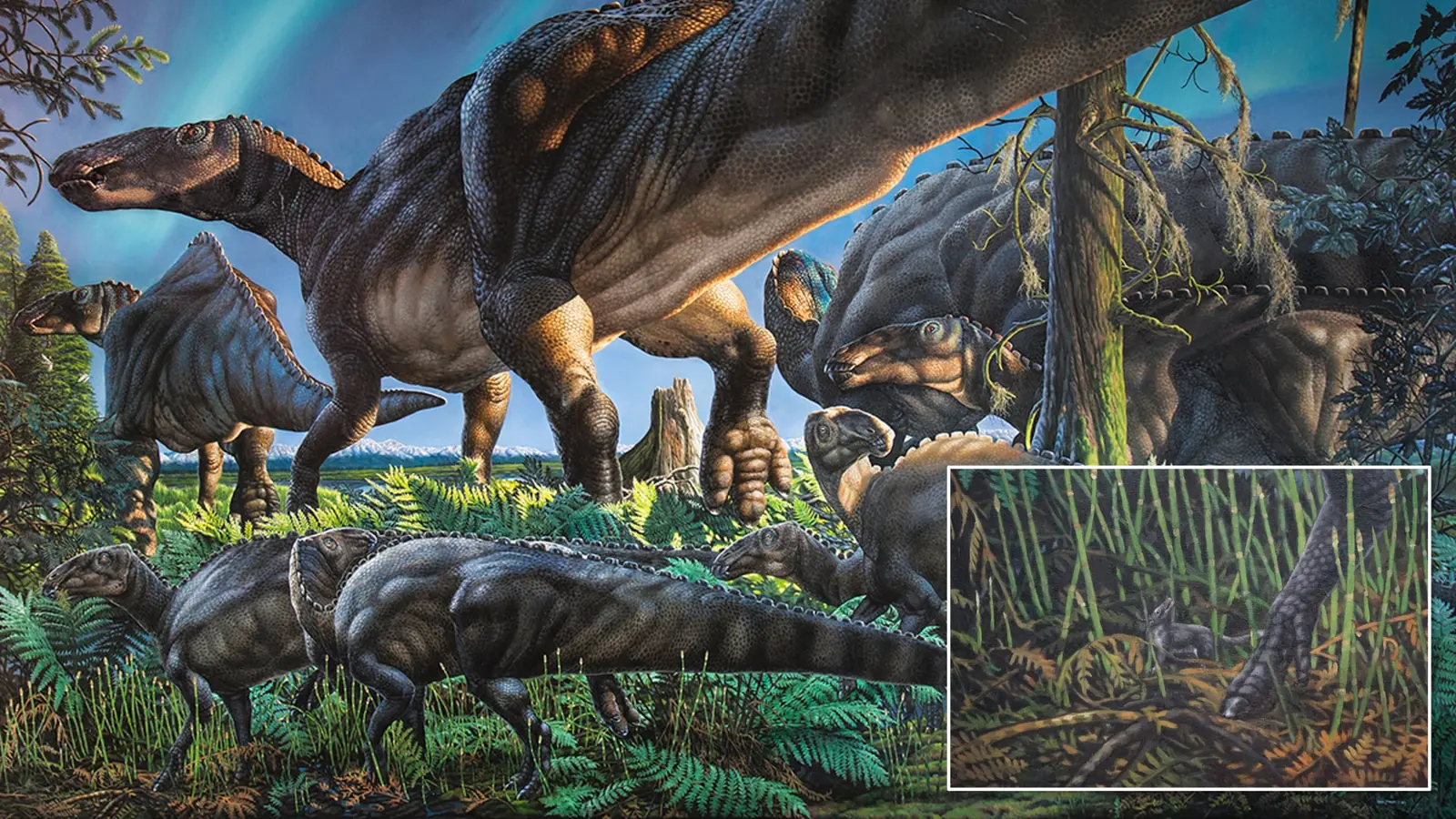
A breadcrumb trail of teeth changed a long-held story about the ancient North: tiny, curved and ornamented molars pulled from Alaskan rock show that the Arctic was far from a biological backwater during the age of dinosaurs.
These teeth come from the Prince Creek Formation, a windy, fossil-rich stretch of northern Alaska. They belong to three previously unknown multituberculate mammals—mouse- to rat-sized survivors of deep time—whose dental differences tell a tale of niche-splitting, survival, and movement across continents. The fossils date to roughly 73 million years ago, when months of polar darkness and seasonal scarcity made life a high-stakes game.

The Colville River image shows field camp on a gravel bar in the middle of the river, while the small orange boat is pulled up along the far bank at an active fossil locality.
Names matter here: Camurodon borealis—“northern curved-tooth”—has tooth shapes that point to a largely herbivorous diet. Qayaqgruk peregrinus, borrowing from Alaskan Inuit lore, looks like a generalist, munching on both insects and plants. Kaniqsiqcosmodon polaris, the “polar ornamented tooth,” seems to tip toward plant-heavy fares. Three species. Three ways to eat. In a landscape where food could vanish for long stretches, that dietary diversity likely let several similar species coexist instead of competing each other into oblivion.
Multituberculates are mammals with staying power. They persisted for more than 100 million years—surviving fluctuating climates and even the asteroid that ended the reign of nonavian dinosaurs. Why they lasted so long has puzzled paleontologists; these new teeth suggest part of the answer lies in flexible feeding strategies. When the menu changes, adaptability matters.
But the story gets bolder. Analysis shows Qayaqgruk peregrinus is closely related to a species known from what is now Mongolia. That kinship implies an ancestral route between East Asia and North America—far earlier than many scientists expected. One estimate puts the migration at about 92 million years ago, hinting that land corridors for small mammals were open and active deep into the Cretaceous.

The shape of the tooth suggests that Camurodon borealis was likely a herbivore.
Who would have guessed that tiny mammals were among the earliest regular cross-continental travelers? The idea reshapes how we picture ancient biogeography. Instead of an isolated Arctic refugium, think of a crossroads where lineages arrived, adapted, and blended into local ecosystems. Land bridges, shifting sea levels, and changing climates stitched continents together and allowed life to disperse in surprising ways.
Fieldwork details anchor the imagination: a remote gravel bar on the Colville River, orange tents, a small boat, long days of sifting rock and grit for microscopic fossils. The collaboration—led by researchers at the University of Colorado Boulder, the University of Lincoln, and the University of Alaska Fairbanks—places the material in the Proceedings of the National Academy of Sciences, and gives the teeth context beyond mere curiosities.
There’s a human lesson in these enamel shards. Deep time refuses simple categories like 'native' or 'introduced' when viewed on geological scales. Landscapes and their inhabitants are palimpsests—overwritten again and again by migrations, extinctions, and recoveries. The Arctic today is austere, but 73 million years ago it was dynamic and connected, a place where small mammals evolved strategies that may have buffered them against extreme change.
These fossils show the Arctic was an evolutionary crossroads: small mammals diversified here, migrated across continents, and persisted through environmental upheavals.
As paleontologists continue to pick through the Prince Creek Formation and other polar outcrops, more tiny teeth will likely rewrite more chapters of Earth’s story. Who knows what the next molar will reveal?


Leave a Comment
Comments
No comments yet. Be the first.