
3 Minutes
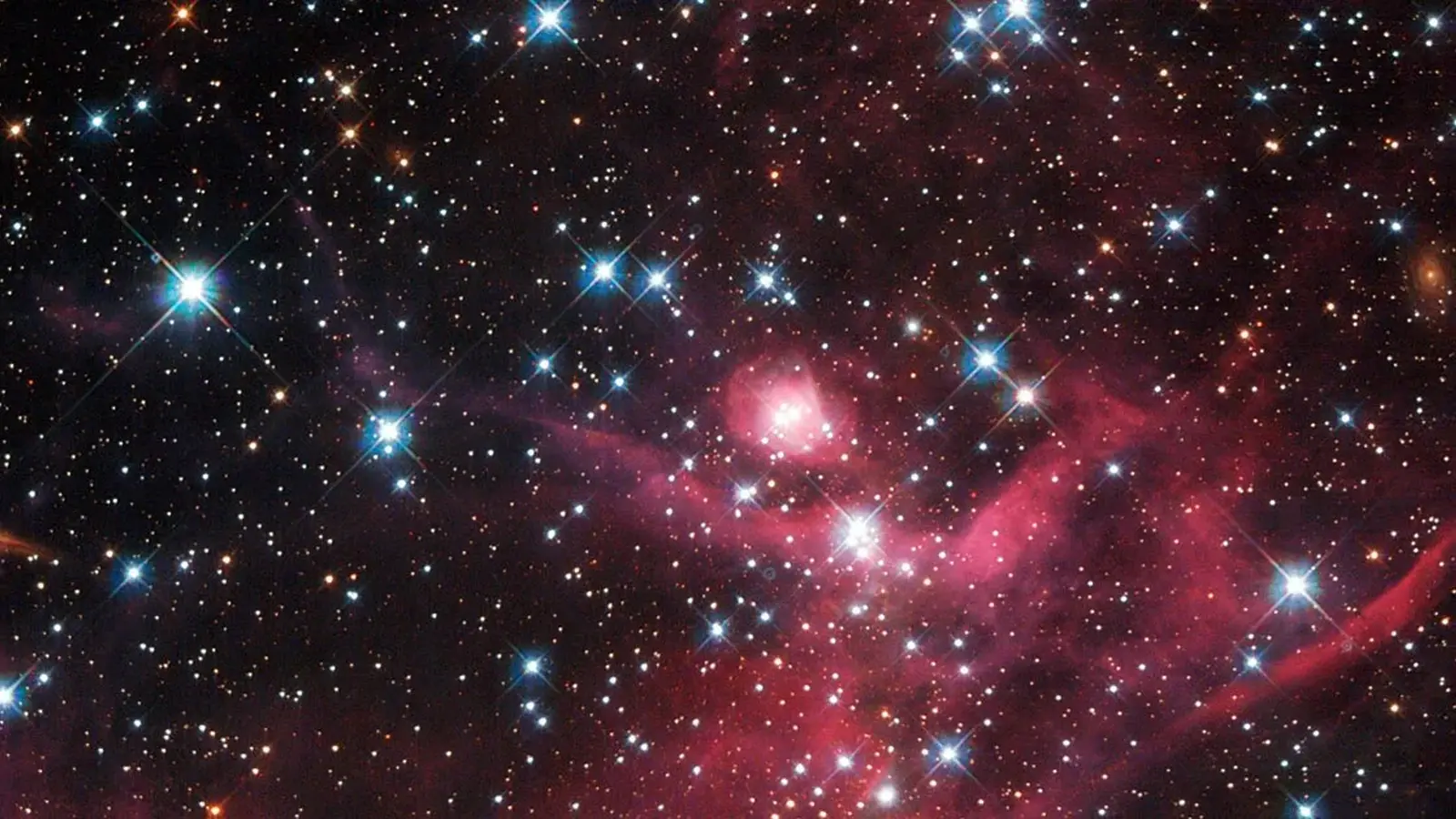
It looks like fireworks smoldering in a violet night—brilliant blue stars set against a wash of crimson gas and slashed by dark ribbons of dust. That is LH 95, a stellar nursery in the Large Magellanic Cloud, captured in extraordinary detail by the Hubble Space Telescope.
At first glance the colors seem poetic. They are, in fact, physics. Hubble’s palette maps different wavelengths: the bluest tones trace shorter visible light, the reds include longer visible light and a touch of near-infrared, and the intense crimson glow is dominated by hydrogen alpha emission, the unmistakable fingerprint of newborn stars lighting up the surrounding gas.
What makes LH 95 so compelling is the company the young stars keep. Massive blue giants—each at least three times the Sun’s mass—blast the neighborhood with ultraviolet radiation and stellar winds. These energetic outflows heat the hydrogen, hollow out cavities, and sculpt the nebula into the filaments and voids we see. Yet some dusty strands stubbornly persist, standing like black scars across the luminous backdrop because they resist erosion better than their surroundings.
Look deeper and a subtler story appears. Hidden in the glow are thousands of fledgling objects still gathering mass. Many are pre-main-sequence stars, contracting and accreting from surrounding disks but not yet hot enough inside to sustain hydrogen fusion. LH 95 contains roughly 2,500 of these immature stars, making it an exceptional nearby laboratory for studying how stars assemble their mass.

A glowing landscape of gas and dust is heated and illuminated by a thriving population of young stars in the LH 95 region of the Large Magellanic Cloud.
How long do these young stars keep growing? Observations of LH 95 show that accretion slows with age, as expected, but it can continue for several million years—longer than some earlier models assumed. That extended window affects how disks evolve and how planetary systems might begin to form around these stars.
There is also a generational quality to this celestial nursery. Star formation here has not been a single, dramatic burst but a drawn-out process. Different cohorts of stars coexist: some are a few million years old, while at least one behemoth near the top center of the image clocks in at roughly 60 to 70 solar masses and appears younger by about a million years than many neighbors. Massive stars live fast and die young; when they end their lives in supernovae, they will reshape the region yet again.
Why study LH 95 rather than a dusty cradle inside our own Milky Way? Because this patch of the Large Magellanic Cloud offers a clearer view. There is less intervening dust to obscure the scene, so astronomers can trace pre-main-sequence populations, accretion behavior, and spatial patterns of star formation with less ambiguity than in many Galactic nurseries.
Hubble’s image is another reminder that decades-old observatories continue to teach us new things when paired with modern analysis. Its optical vision complements infrared observatories such as the James Webb Space Telescope, which peels back cooler dust, and will be further augmented by the Nancy Grace Roman Space Telescope when it launches. Together these instruments will keep revealing the choreography of star birth in places like LH 95.
The picture feels alive: stars igniting, disks thinning, winds carving space, and the promise of future explosions that will seed the next generation. Who knows what the next deep image will reveal about how ordinary clouds of gas transform into brilliant stellar cities?











Leave a Comment
Comments
No comments yet. Be the first.