
3 Minutes
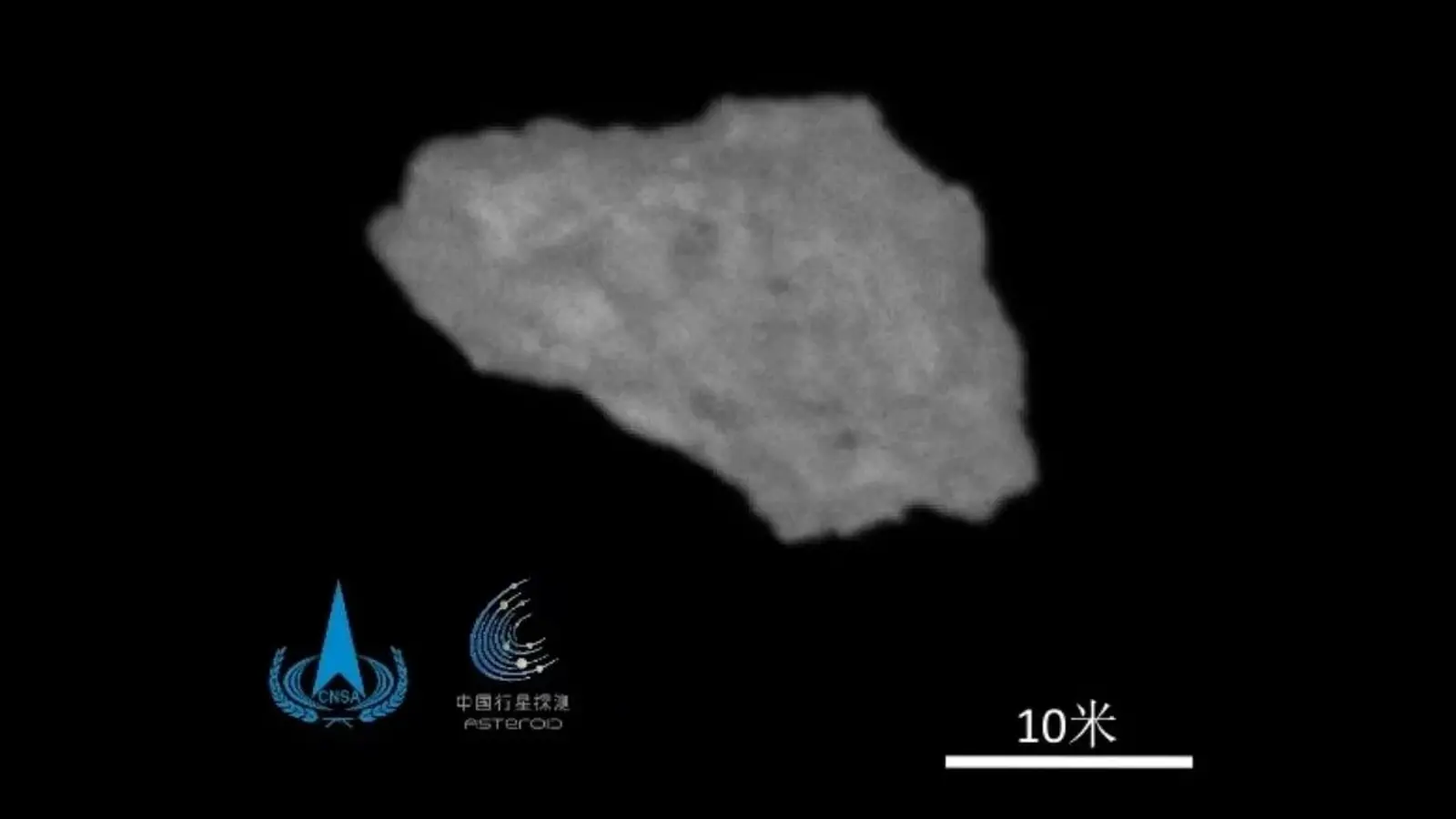
Imagine a tiny, distant companion caught in a quiet dance around our planet. That’s Kamoʻoalewa — a diminutive body catalogued as asteroid 2016 HO3 — and for the first time a human-made probe has returned a face-on image of this so-called "minimoon."
The picture arrived thanks to China National Space Administration’s Tianwen-2 mission, which lifted off on 29 May 2025. After roughly 13 months and nearly a billion kilometres of travel, the spacecraft reached its primary target and began stationing itself near the asteroid in early July 2026.
Fast, small, curious. Tianwen-2 detected Kamoʻoalewa optically on 6 June, closed to within about 2,000 kilometres by 19 June, and by 2 July had slipped to roughly 20 kilometres — close enough to snap the new portrait we’re now seeing. Up close, this rock looks ordinary and mysterious at once: a compact, irregular shape that might be a rubble pile or a single, solid chunk of ancient material.
Why the fuss over something only a few dozen metres across? Because Kamoʻoalewa is not a typical asteroid. It belongs to the Apollo family and occupies a rare orbital niche known as a quasi-satellite: it follows the Sun but stays near Earth over many orbits, trading places with our planet in a long, slow pas de deux. Only a handful of such co-orbital companions are known, and each offers a unique laboratory for understanding near-Earth dynamics.

Tianwen-2 probe image of asteroid 2016HO3, taken from a distance of about 20 kilometers on 2 July 2026.
Estimates put Kamoʻoalewa’s diameter between about 40 and 100 metres, which could make it the smallest object ever visited by a sample-return mission if Tianwen-2 succeeds. Scientists want to know whether it contains water-bearing minerals, whether solar radiation has altered its surface, and whether its chemistry links it to other populations — perhaps even our Moon. Telescope observations have hinted at a tantalising possibility: that this chunk might be lunar ejecta. Direct samples could settle that debate.
Tianwen-2 will collect in-situ observations and return samples to Earth during a planned flyby, then continue on to a second target in the main belt. The follow-up destination is comet 311P, an oddball with multiple dust streams that fan into a bizarre, six-pronged tail. The comet sits beyond Mars and provides a rich counterpoint to the tiny, sunward-hugging quasi-satellite.
The mission is a study in contrasts: a long, precise choreography of trajectory adjustments to reach a pebble-sized world, then a hop across tens of millions of kilometres to a dusty comet. Each step is designed to probe origin stories — of Earth’s near-space neighborhood, of small-body evolution, and of material exchange across the inner Solar System.
There’s a human side to this too. Watching a distant rock become a destination reminds us how far our engineering and curiosity have come. Small objects often hide big answers. Keep watching; the samples, when they arrive, will do most of the talking.












Leave a Comment
Comments
No comments yet. Be the first.