
4 Minutes
Imagine a small, flattened animal crawling along a dim seafloor and consistently favoring one side as it turned. Strange as it sounds, that’s what fossils from South Australia now seem to reveal: a preference for the right, preserved in stone for more than half a billion years.
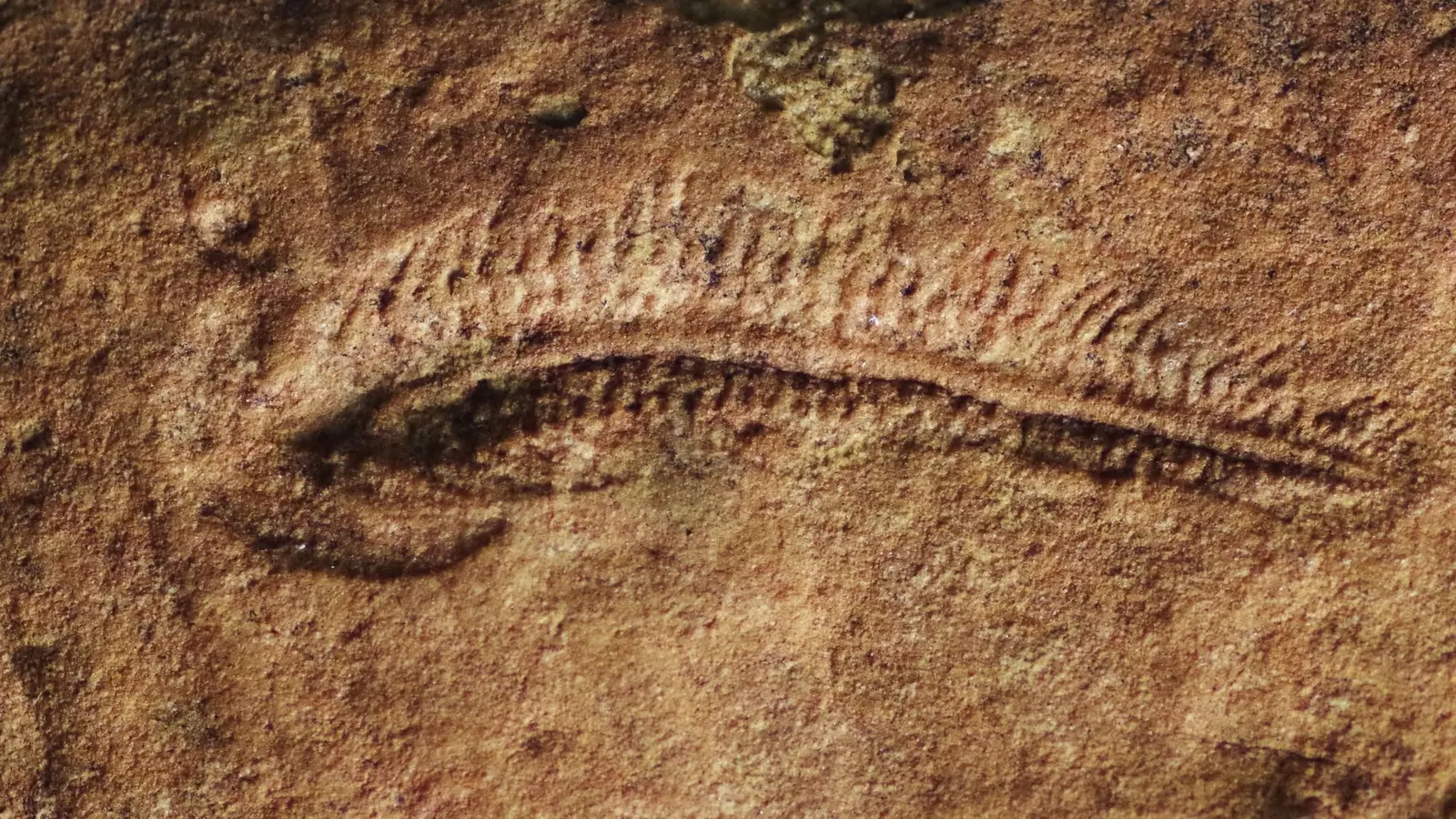
Researchers studying the Ediacaran fossil Spriggina floundersi examined over a hundred exquisitely preserved specimens from Nilpena and museum collections in Adelaide. Those fossils don’t show the animals themselves but mirror-image impressions left in sediment. A bend that looks left on the rock actually records a rightward turn in life. Once that reversal was accounted for, an unexpected pattern emerged: Spriggina curved right about twice as often as left.

Fossils of Spriggina floundersi collected in South Australia. Because these fossils preserve mirror-image impressions of the original animals, a leftward bend in the rock represents an animal that bent to the right in life.
Why does that matter? Because a consistent population-wide bias—what we might call handedness—signals more than a quirky habit. Lateralized behavior in modern animals often reflects organized sensory processing and neural circuitry that favor one side of the body. The new work pushes the earliest evidence for such asymmetry into the Ediacaran Period, roughly 550 million years ago, long before most familiar animal groups appeared.
The team behind the study spanned institutions including the American Museum of Natural History, Florida State University, Harvard, and UC Riverside. Their approach was simple but careful: quantify shape differences across many specimens, correct for the mirror-image effect of preservation, and test whether the distribution of left-versus-right bends could arise by chance. The result was consistent enough to suggest biological bias rather than random taphonomic noise.


The research team worked in the Flinders Ranges and surrounding region of South Australia. Excavation of individual beds at Nilpena Ediacara National Park reveals communities of the Ediacara Biota buried during storm events, capturing snapshots of the seafloor 550 million years ago.
Spriggina is a familiar face in Ediacaran research. With a bilateral body plan—front to back, left and right, top and bottom—it foreshadows the organization shared by humans and most animals. Found in storm-buried seafloor beds in the Flinders Ranges, the fossil remains preserve whole communities in life-like arrangement. Reg Sprigg, who first recognized their importance, lent his name to the creature that later became South Australia’s state fossil.
Spriggina's rightward bias suggests lateralized behavior existed at least 550 million years ago. That’s a neat, even startling, takeaway: a behavior associated today with complex nervous systems appears very early in animal history.
Does this mean Spriggina had a brain like ours? Not at all. But the pattern raises the possibility that neural organization capable of processing sensory inputs asymmetrically was already emerging in the deep past. If consistent turning reflects sensory preference—or even asymmetrical internal wiring—then the building blocks of what we call ‘handedness’ could be much older than previously believed.
Fossils of Spriggina floundersi collected in South Australia. Because these fossils preserve mirror-image impressions of the original animals, a leftward bend in the rock represents an animal that bent to the right in life.
There are still puzzles. Fossil impressions preserve form, not behavior, and researchers must tread carefully when inferring neurology from shell impressions and sedimentary curls. Yet the population-level signal in these South Australian fossils is hard to dismiss as mere coincidence. It invites a different picture of the Ediacaran seafloor: not a world of passive mats and amorphous blobs, but one where multicellular animals were experimenting with directional movement and organized sensory responses.

So when you think of being right- or left-handed, remember this: the roots of that preference might reach back to a tiny Ediacaran crawler leaving a rightward curl in soft mud—an echo of behavior that survived in stone for half a billion years.

Leave a Comment
Comments (2)
wow this actually gives me chills! a half-billion-year old righty? Mind blown 🤯 curious if it was species-wide or just local oddity, tho
Wait, neat find but how can they rule out taphonomic bias? Mirror-imaging is tricky, and populations maybe sampled from one bed only… are the stats really rock-solid across sites?