
3 Minutes
Who really wants to live forever? The question has always been partly philosophical. Now, a new mathematical model gives it a biological answer: probably not.
A team led by computational biologist Dmitrii Kriukov at the Skolkovo Institute built simulations to ask a stark thought experiment — if every other cause of aging were neutralized, would random DNA errors alone still stop us from living indefinitely? The short answer: yes.
The model tracks how somatic mutations — the tiny, random DNA mistakes that accumulate every time a cell divides — chip away at organ function over a lifetime. Our bodies patch most of these errors, but repair isn’t perfect. Over decades, especially in cells that rarely renew, damage piles up. Heart muscle and neurons in the brain are chief offenders here: they persist for years and keep collecting mutations, while tissues such as skin and liver continually replace cells and are therefore more resilient.
What emerged from the simulations is a striking ceiling. Under optimistic assumptions, median lifespans fall in the roughly 146–194 year range, with common scenarios clustering around 150–190 years. Some rare individuals might exceed that span, but immortality is off the table.
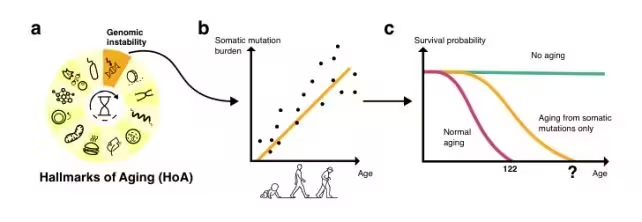
The model assumes somatic mutations accumulate throughout life and estimates how much they contribute to declining survival, independent of other hallmarks of aging.
Somatic mutations alone could set a hard ceiling well below biological immortality.
Important caveats apply. This was not an experimental forecast of what will happen to people. Instead, it’s a careful, quantitative framework designed to isolate one contributor to aging. That distinction matters: the paper frames its results as a tool for parsing how much each biological process — from protein aggregation to inflammation — contributes to declining survival.
Why does this matter for researchers and the public? Because aging isn’t a single villain. If random DNA errors are only part of the story, then therapies aimed at mutation reduction would help, but won’t solve aging alone. The model suggests a hierarchy: fixable, replaceable tissues respond differently from long-lived cells that act like ticking clocks.
The authors argue their framework offers a new way to prioritize interventions. Which mechanisms should we target first? Which organ systems deserve the most attention? Quantitative answers to those questions can guide everything from drug discovery to regenerative medicine strategy.
Debate over the somatic mutation theory of aging has been long-running. This study doesn’t settle that dispute. It does, however, force a useful recalibration: mutations are likely a meaningful piece of aging’s mosaic, but they interact with many other processes that together determine how long and how well we live.
Published in npj Aging, the work invites collaboration across genetics, neurology, cardiology, and computational biology to build a fuller, mechanistic map of aging. It’s a reminder that even the boldest longevity dreams must reckon with the quiet arithmetic of molecular mistakes — and with the stubborn biology of the cells that keep our hearts and minds running.
.avif "Science-Backed Strategies to Slow Biological Aging and Boost Longevity")

Leave a Comment
Comments
No comments yet. Be the first.