
3 Minutes
Imagine the brain as a secluded garden that suddenly becomes overrun by gardeners from the outside—well-meaning workers who, in their zeal, pull up the very roots that keep the place alive. That's the picture emerging from fresh research in Nature Neuroscience: Alzheimer's damage may be driven not only by rogue proteins inside neurons, but by immune actors primed beyond the brain's borders.
Researchers led by neurologist David Holtzman at Washington University examined how immune signaling outside the central nervous system can escalate into an internal assault. The culprits are not generic immune cells, but a specific partnership: conventional type 1 dendritic cells, or cDC1s, and CD8+ T cells. cDC1s act like molecular detectives, presenting antigens to CD8+ T cells and instructing them to eliminate perceived threats. In some mouse models of tauopathy, that instruction ends up sending cytotoxic cells into the brain.
Why does this matter? Because when the cDC1–CD8+ axis is intact, mice with accumulating tau protein show worse neurodegeneration and inflammation. Disable the cDC1s or blunt their ability to 'cross-present' antigens, and the flood of CD8+ T cells into the brain drops sharply—and with it, the neuronal damage. Curiously, the amount of tau itself barely budges, hinting that the immune attack, not the sheer protein burden, may be the proximate cause of cell loss.
Where are these immune conversations happening? The study points to the deep cervical lymph nodes, the neck's drainage hubs that sit downstream from the brain's lymphatic outlets. Antigens shed during tau-driven neuronal injury may be swept into those nodes, captured by cDC1 sentinels, and used to prime CD8+ T cells. Those activated killers then migrate back toward the brain and, upon entry, contribute to neuroinflammation and degeneration.
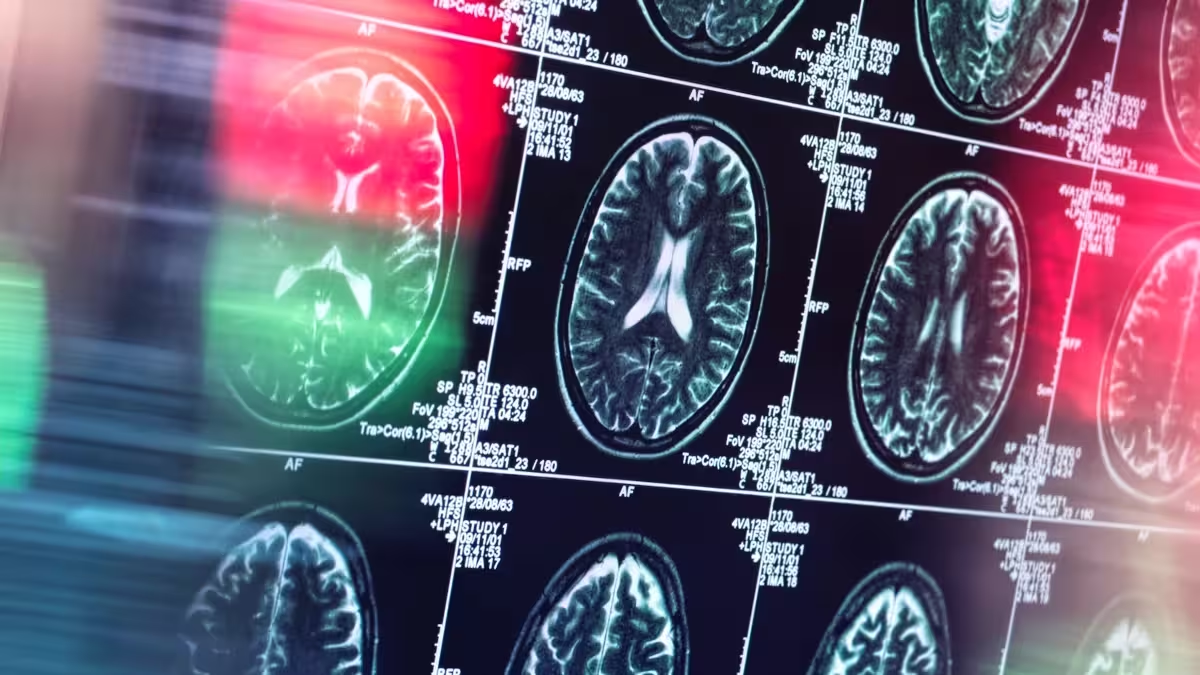
An immune response from beyond the brain could end up attacking it, research suggests.
It flips a long-standing assumption. For years, Alzheimer’s was treated, conceptually and clinically, as a problem locked behind the blood-brain barrier. If the immune system outside the skull is the one raising the alarm and dispatching reinforcements, then the therapeutic map changes dramatically. How do you treat a siege when the enemy is knocking from outside the gate?
Targeting peripheral immune processes may be an easier and more tractable way to slow neurodegeneration than trying to shove drugs past the blood-brain barrier.
That idea has practical appeal. Clinicians already have drugs and techniques to modulate T cells in cancer and autoimmune diseases. Repurposing or adapting those approaches for neurodegeneration could bypass some thorny delivery problems. Instead of engineering molecules to slip into the central nervous system, interventions might focus on lymphatic drainage, antigen presentation pathways, or the mobility of specific T cell populations.
Of course, many questions remain unanswered. How exactly are tau-derived antigens trafficked from injured neurons to cervical lymph nodes? What molecular signals permit CD8+ T cells to breach brain borders and persist there? And crucially, would dampening peripheral immunity come with unacceptable trade-offs, like increased infection risk or cancer susceptibility?
For now, the study reframes Alzheimer’s as a disorder where the boundary between brain and body matters less than we thought—where peripheral immune processes can tip the balance toward destruction. It invites a different kind of drug design and a new line of inquiry into the brain’s lymphatic plumbing. If the immune system outside the skull is pulling the strings, can we learn to cut those strings with precision? The next experiments will tell us how far this doorway to treatment can open.


Leave a Comment
Comments
No comments yet. Be the first.