
3 Minutes
Under conditions that sound more like science fiction than laboratory work, water turns into something neither solid nor liquid, and the resulting material could rewrite how we picture the deep interiors of ice giants.
The discovery came from an experiment that squeezed and heated tiny droplets of water until they behaved in ways ordinary ice never does. Using diamond anvils to generate pressures exceeding 200 gigapascals (roughly 2.3 million times Earth’s atmospheric pressure) and focused lasers to raise temperatures to more than 2,600 kelvins, the team probed the atomic scaffolding with a pinpoint synchrotron X-ray beam.
Researchers led by Alexis Forestier observed hexagonal close-packed (hcp) superionic ice forming at extreme pressures and temperatures, a phase long predicted by theory but never clearly seen in the lab until now.
What makes superionic ice so peculiar is its split personality: oxygen atoms freeze in place, arranging themselves into a crystalline lattice, while hydrogen nuclei—essentially protons—flow through that lattice like a liquid. That mobility gives the material electrical and transport properties unlike any familiar solid.
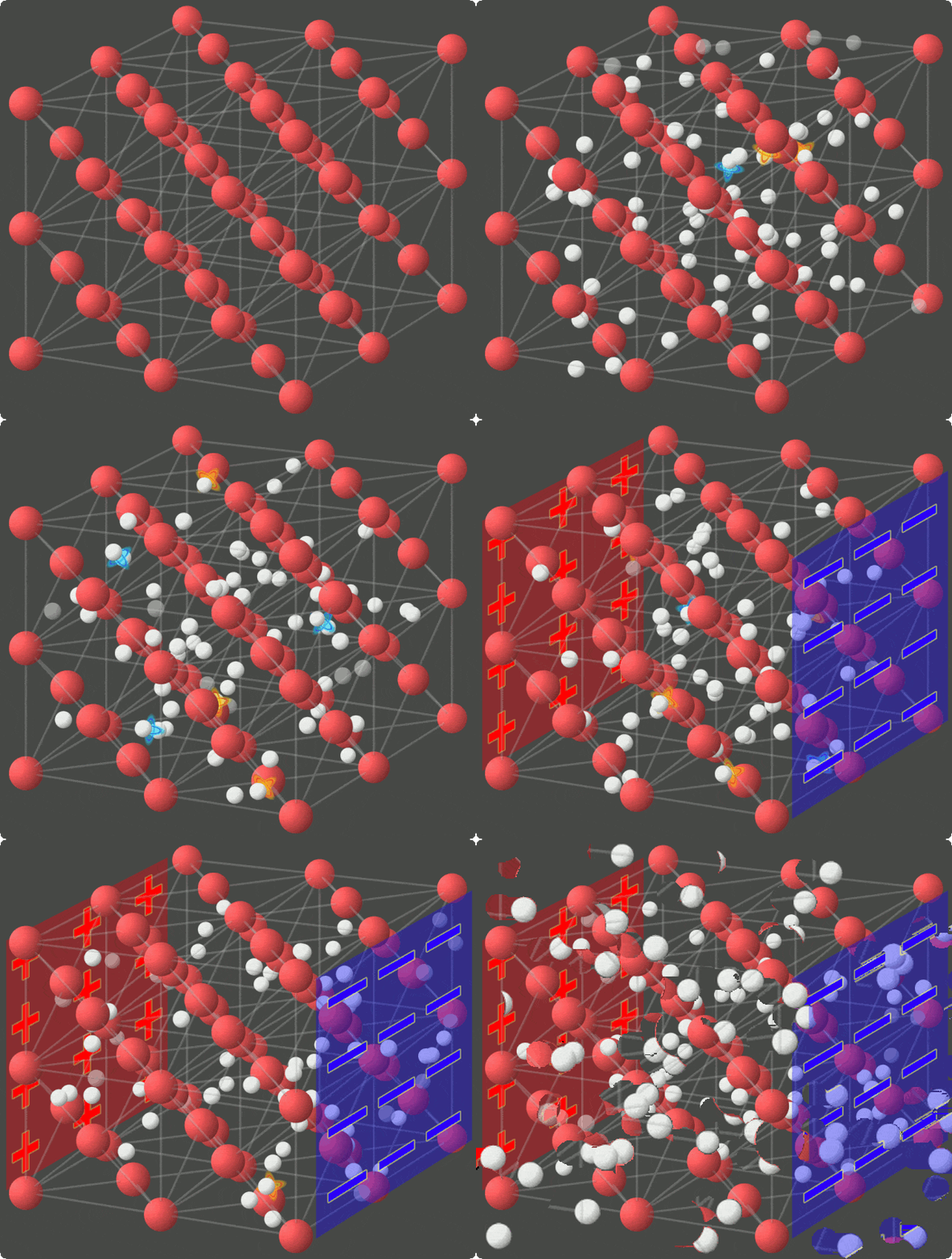
The oxygen-hydrogen do-si-do of superionic ice.
Previous experimental work had already revealed a face-centered cubic (fcc) superionic arrangement. In Forestier’s experiments, however, X-ray diffraction patterns revealed a different stacking of oxygen layers—the hexagonal close-packed motif—emerging and strengthening as pressure and temperature climbed. At about 1,700 kelvins the lattice showed signatures consistent with the onset of superionic behavior. By roughly 2,200–2,600 kelvins and pressures above 197 gigapascals, the hcp signal dominated the spectra.
The shift from fcc to hcp is subtle on the atomic scale—it’s a change in how identical layers of oxygen spheres are stacked—but subtle does not mean insignificant. Materials with different atomic arrangements can conduct electricity and deform under stress in drastically different ways. If hcp superionic ice conducts charge or yields mechanically in a manner unlike its fcc cousin, that could alter models for how charge and heat move through the mantles of Uranus and Neptune.
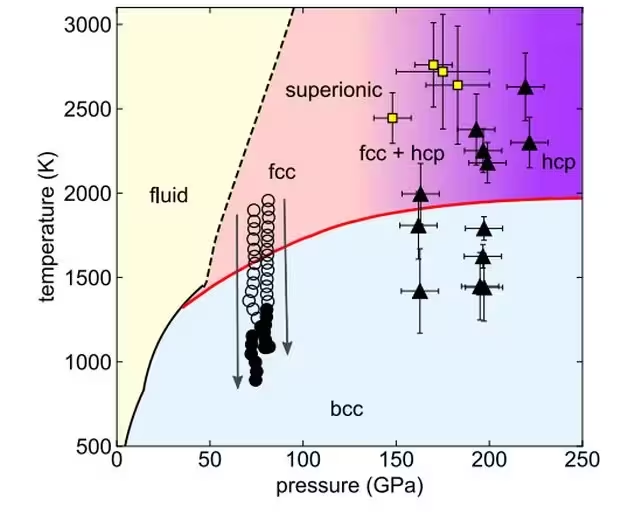
The conditions under which the researchers observed the new hcp ice phase (filled triangles and filled circles) show its emergence at extreme pressures and temperatures.
Why care about that? Because those two planets behave oddly. Their magnetic fields are unusually tilted and offset, messy compared with the tidy dipole we see at Earth. One leading idea is that exotic, conductive forms of water ice in their interiors help generate those strange fields. Finding a new stable phase of superionic ice adds a new piece to the puzzle.
The experimental path to this result mixed brute force with finesse. Diamonds supplied the squeeze, lasers supplied the burn, and the synchrotron revealed diffraction peaks—tiny fingerprints of atomic order. The team even reexamined earlier data and found a faint diffraction peak above 130 gigapascals that now reads as an early hint of hcp—evidence the phase may have been produced before but escaped recognition.
There is still work to do. The paper reports the structural discovery and provides pressure–temperature coordinates for where hcp emerges, but questions remain about how electrically conductive or mechanically plastic this new phase is, and how easily it converts back and forth from fcc under changing conditions. The authors invite theoretical and experimental follow-ups to map out those properties and pin down the stability boundaries.
At first glance, it’s an atomic rearrangement. At a planetary scale, it could be a game changer.
Forestier and colleagues published their findings in Physical Review Letters in 2026. The next step: find out what this ice can actually do when it’s humming away inside a planet.

Leave a Comment
Comments
No comments yet. Be the first.