
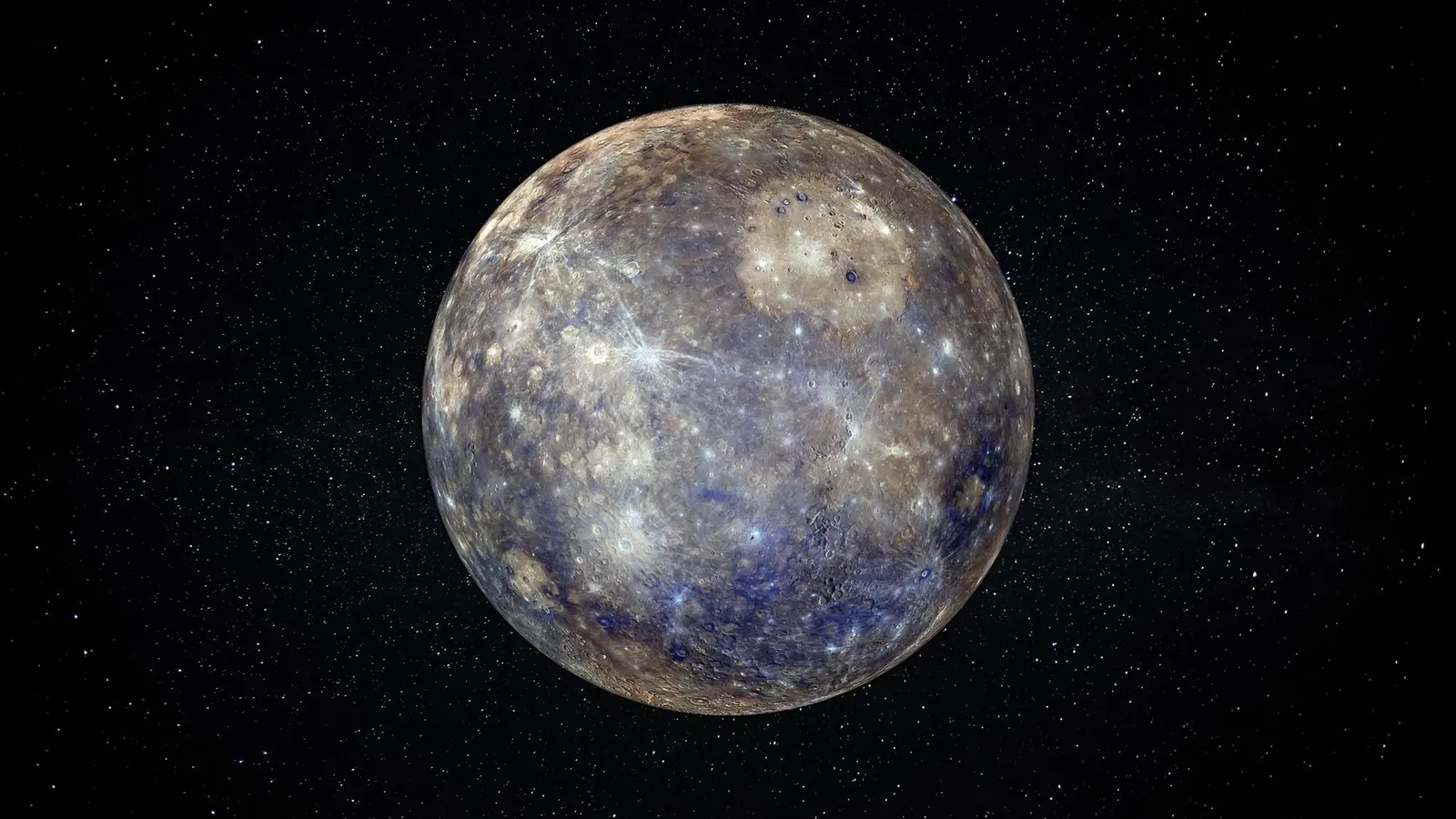
How hot was Mercury’s interior when it was young? The short answer: hotter than many of us expected. A fresh infrared study, calibrated with clever laboratory tricks and checked against the Moon, paints a picture of a planet whose surface contains far less silicon dioxide than prior estimates suggested.
Silicon dioxide — SiO2 — is the mineral backbone of many terrestrial rocks on Earth. Basalts and granites can be loaded with it. But Mercury appears stingy. The international team led by researchers at the Max Planck Institute for Solar System Research used a three-step approach to peg the planet’s surface composition and landed on a surprising figure: roughly 37 percent SiO2 by mass, up to about 25 percent lower than earlier calculations.
Why does that matter? Because silica content encodes a planet’s cooling and melting history. On a young world, as the mantle cools, the first solids that crystallize do not trap much silica, leaving the residual melts increasingly silica-rich over time. So a surface with relatively low silica hints that the magmas that erupted on Mercury came from melts produced at higher temperatures or from deeper parts of the mantle than previously imagined. In plain terms: Mercury’s early interior was likely fierier and more extreme than our earlier models allowed.

Three steps to Mercury. Step 1: Using laboratory measurements, the researchers established a relationship between infrared radiation and SiO2 content. Step 2: They verified this relationship using measurement data from the Moon and lunar samples. Step 3: Using infrared data from Mercury, the researchers were then able to determine the SiO2 content of Mercury’s surface.
There is another possibility worth keeping in mind. The planet could once have been more oxidized and richer in silica, and then lost oxygen through processes that gradually altered its crustal chemistry. Without rock samples, both scenarios remain plausible. And that brings us to the cleverness of the team’s method: they didn’t need a rover to touch Mercury’s stones to arrive at a robust estimate.
First, in the lab the researchers made tiny calibrated glass beads with known SiO2 concentrations — think of them as spectral yardsticks. They measured how those beads emitted and reflected infrared light. Next, they tested this calibration against the Moon, using high-resolution infrared maps from NASA’s Lunar Reconnaissance Orbiter and comparing the results to actual lunar samples returned by Apollo, Luna, and Chang’e missions. The lunar test worked. That validation allowed the researchers to confidently apply the same infrared-to-composition relationship to Mercury, using ground-based infrared observations including data from the Bok Telescope in Arizona.

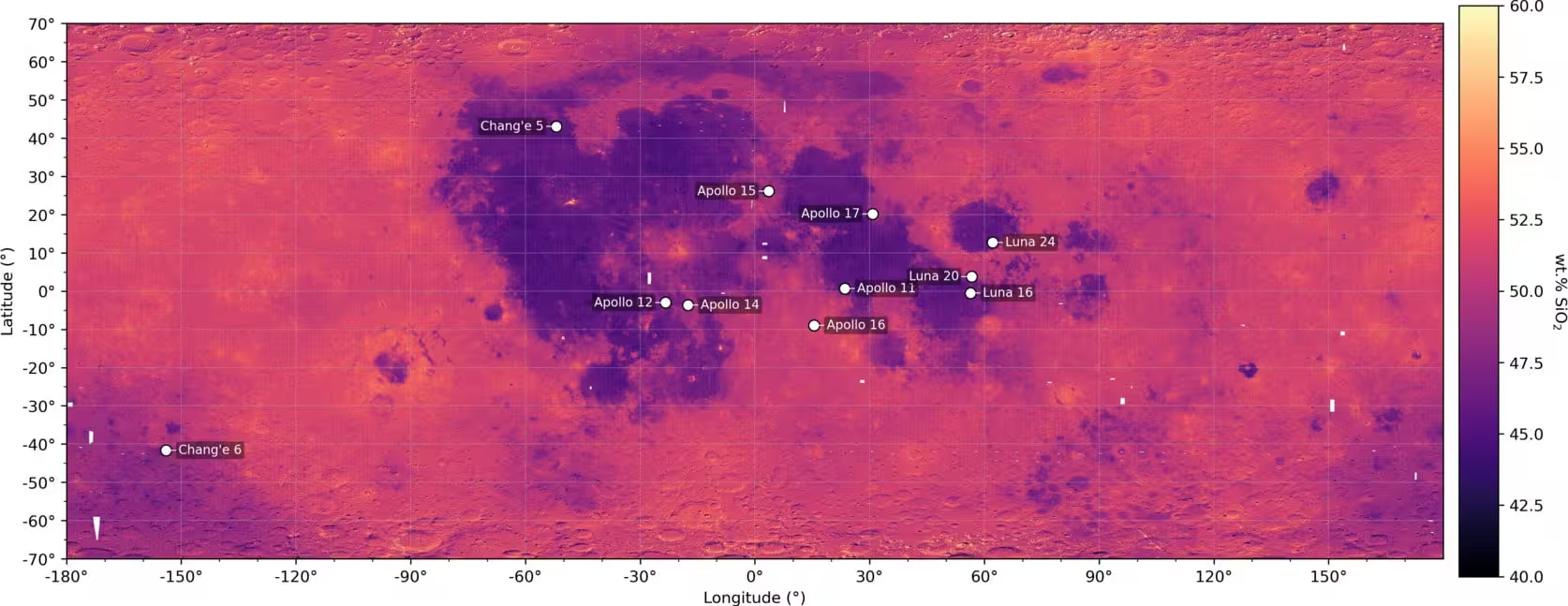
First global map of the SiO2 content on the Moon’s surface. The white, labeled dots show the landing sites from which the Apollo, Luna, and Chang’e missions brought lunar samples back to Earth. The samples made it possible to verify the accuracy of the map.
The headline: Mercury’s surface averages about 37% SiO2 — significantly lower than earlier estimates — signaling melts from a hotter, deeper mantle or a crustal history altered by oxygen loss.
These findings change how we should imagine Mercury’s volcanic chapters. The planet, small and close to the Sun, cooled relatively quickly compared with Earth and shut down much of its volcanic activity roughly a billion years after formation. The new silica estimate suggests those early eruptions tapped a different mantle regime than terrestrial volcanism, emphasizing depth and temperature over the silica enrichment trends familiar to Earth-bound geologists.

In November of this year, the ESA spacecraft BepiColombo will enter orbit around Mercury.
All of this will be sharpened soon. In November 2026, ESA and JAXA’s BepiColombo mission is scheduled to enter Mercury orbit. Its MERTIS instrument has been designed to collect thermal-infrared data with much higher precision and resolution than past observations. The current study lays the calibration groundwork so MERTIS can translate its spectra into composition with confidence.

No sample-return mission has yet brought Mercury’s rocks to Earth. But this new, human-sized workaround — lab calibration, lunar validation, then planetary application — is the kind of creative science that moves us forward. Expect the surprising portrait of Mercury to gain resolution as BepiColombo begins to whisper back the planet’s thermal secrets.

Leave a Comment
Comments (2)
Interesting, but is SiO2 alone enough to pin mantle temps? Could surface oxidize or lose O and skew results, if that’s real then... seems tentative without rocks tho
Wow, Mercury way hotter than I pictured. Those glass bead calibrations are neat, brilliant shortcut. BepiColombo gonna be fun to watch lol