
3 Minutes
Imagine a circuit board that grows. Tiny colonies take the place of chips; chemical whispers pass information instead of electrons. It sounds like science fiction, but MIT researchers have built exactly that—a printed, living circuitry made from engineered bacteria.
Instead of stuffing an entire logic network into a single cell, the team redesigned individual microbes to act like transistors and relays. Two strains behave as switch-like transistors, and three more serve as signal converters. Combine them and you get a flexible toolkit capable of routing and processing signals on a Petri dish.
The work centers on Pantoea agglomerans, a surface-dwelling bacterium often found on plants. Researchers programmed two transistor variants that respond to an input molecule called OC-6—one switches on when OC-6 is present, the other switches off. Both types also sense a second molecule, OC-12, and produce a downstream signaling molecule named OHC-14 only under specific conditions. The relay strains then translate OHC-14 into fresh outputs, passing the message along like wires on a board.
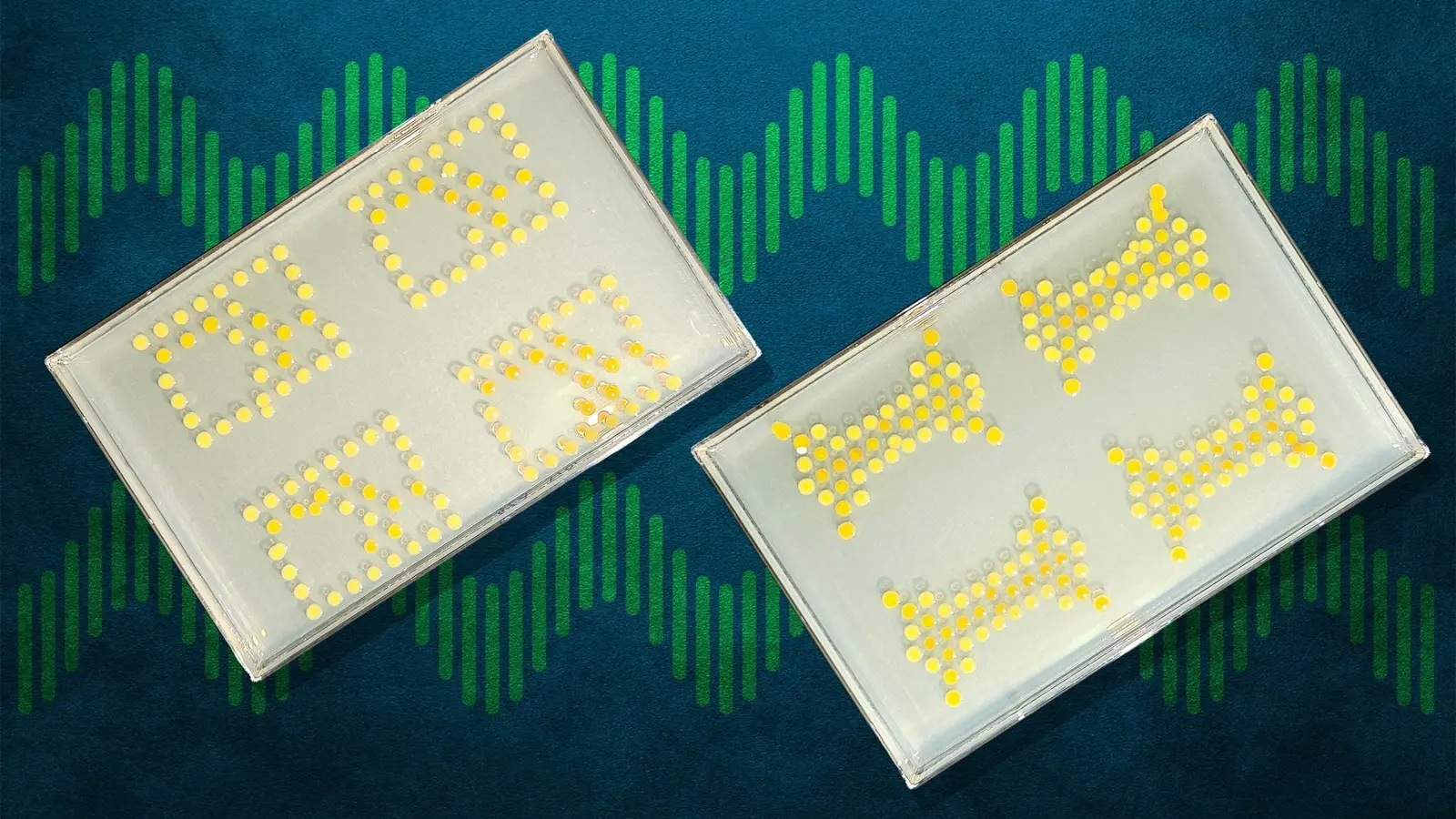
Physical layout matters. Colonies were printed onto agar about five millimeters apart so each chemical signal reaches only the nearest neighbor. That limited diffusion creates a controlled, stepwise flow of information, essentially wiring the components in one direction. The researchers used this property to build bidirectional switches, demultiplexers, adders, and other logic arrangements by arranging colonies in different patterns.

The researchers created their circuits by printing colonies of bacteria onto plates containing agar, a growth medium. This GIF shows a time-lapse of the bacteria growing over 7 days.
One transistor can take on multiple logical roles depending on where it sits in the network: multi-input gates, OR gates, even implication operations. The group assembled circuits that add two inputs and a demultiplexer that steers a single signal to selected outputs. The largest demonstration linked 24 colonies to perform an addition operation—proof that more complex functions can emerge from simpler, single-cell parts.
These living circuits are slow—each computation unfolds over hours rather than nanoseconds—but they are optimized for biology, not benchmarks.
Speed aside, the value is in placing computation where biological decisions are already made. A plant leaf or root equipped with a bacterial circuit could monitor local conditions—drought stress, pathogen attack, nutrient signals—and trigger targeted biological responses, such as producing a protective compound. Overnight processing is fast when the timescale you care about is a growing season.
Technically, the system relies on molecular inputs (OC-6, OC-12) and outputs (OHC-14) to orchestrate behavior, and the modular design of five strains means many different circuit layouts are possible. The researchers also demonstrated the system visually by printing colonies that grow and communicate over several days, revealing the choreography of living logic in action.
There are hurdles ahead: robustness in complex environments, maintaining function on real plant surfaces, and ensuring safety and containment. But the concept reframes computation itself—moving it off silicon and into ecosystems that can use it directly. If circuits can be printed onto leaves or embedded at roots, what new kinds of agricultural intelligence might sprout overnight?


Leave a Comment
Comments
No comments yet. Be the first.