

4 Minutes
Have you ever watched someone’s eyes and felt they told a story? Researchers are starting to listen to the subtler language of the eye: tiny changes in pupil size that mirror how attention rises and falls.
A team at the Indraprastha Institute of Information Technology Delhi reexamined eye-tracking recordings from 50 children in Chile to ask a focused question: do pupils carry a fingerprint of attention differences in children with ADHD? The dataset included 28 children diagnosed with combined-type ADHD and 22 peers without neurodevelopmental conditions. Ages ranged from 10 to 12.
The experiment looked nothing like a clinical interview. Kids played a memory game on a screen: dots popped up on a grid, a distracting image interrupted the flow, and then another dot appeared. The task—repeated 160 times—forced participants to hold, ignore, and decide. Meanwhile an eye tracker logged pupil diameter at 1,000 samples per second. Eyes were not just following light; they were broadcasting effort, arousal, and the micro-ebb and flow of attention.

Instead of averaging pupil size across the whole session, lead analyst Saumya Yadav and colleagues examined how pupils changed from trial to trial and within each trial. That subtle shift in perspective mattered. After controlling for age, IQ and task difficulty, their model estimated roughly 23 percent greater variability between trials in the unmedicated ADHD group compared with controls. In plain terms: from one round of the game to the next, children with ADHD showed more fluctuation in their pupil responses.
But it wasn’t a simple story. Within individual trials, those same unmedicated children showed smaller moment-to-moment fluctuations. Two different kinds of variability—between trials and within trials—appear to capture distinct dynamics of the pupil and, by extension, attention.
Linking physiology to performance, the team found that greater between-trial pupil variability in the unmedicated ADHD group tended to accompany lower task accuracy. The pupils seemed to echo lapses or shifts in engagement. That said, pupil size is an indirect marker. It reflects many internal states—fatigue, surprise, cognitive load—and cannot be read as a one-to-one measure of attention.

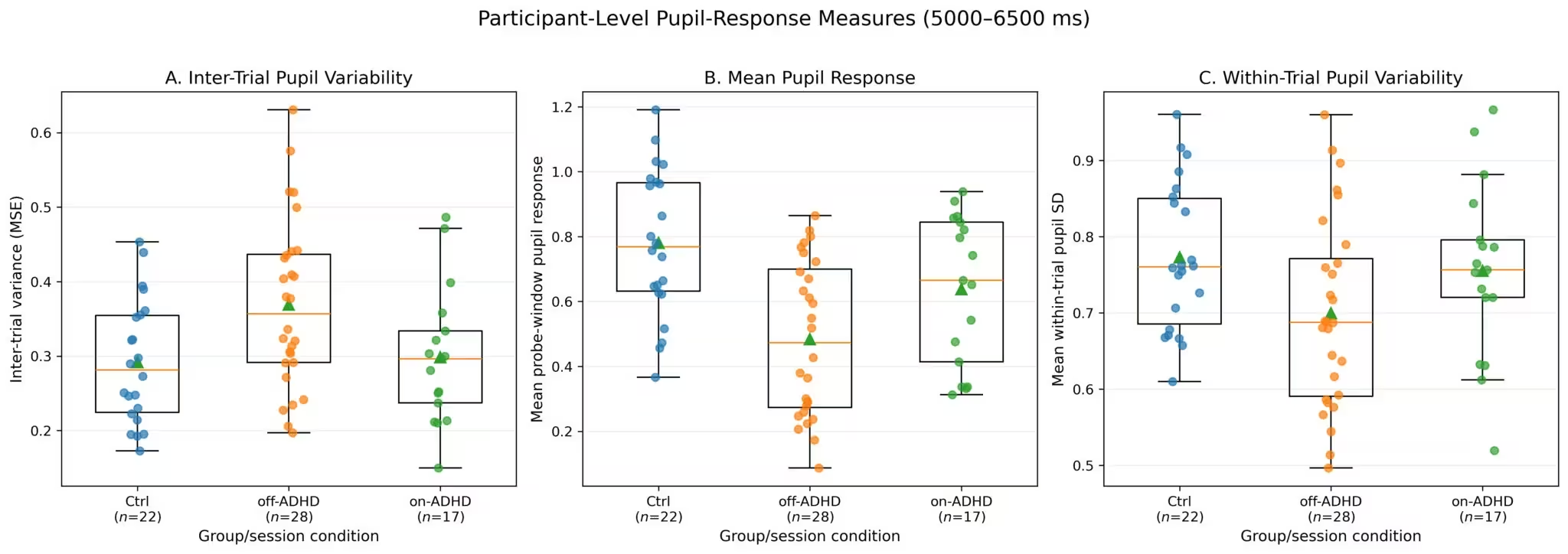
Trial-to-trial variability was higher in the unmedicated ADHD group, while within-trial variability was lower.
Another layer of the study complicates any quick takeaway. Seventeen children with ADHD completed the task twice: once off medication for about 24 hours, and once while on their usual methylphenidate. When medicated, those children showed stronger pupil responses during the task and reduced variability between rounds; their response profiles looked more similar to the control group. Tempting to call that a normalization effect? The authors resist that label.
Methylphenidate acts on physiological systems that influence pupil size, so changes could reflect the drug’s direct bodily effects, cognitive improvements, or both. The researchers also lacked data on exact dosages and drug formulations, and the two testing sessions were separated by roughly six months. Practice, maturation, or other time-related factors might also play a role.
Statistical caution is woven through the results. The model analyzing thousands of trials flagged increased variability, but direct participant-by-participant comparisons fell just short of statistical significance after correcting for multiple tests. And while greater pupil variability correlated with lower accuracy among unmedicated children with ADHD, that relationship was not meaningfully stronger than the pattern seen in controls.
The team’s headline is modest: these pupil dynamics are a subtle clue, not a clinical test. The study was small, laboratory-based, and built from previously collected data. Classrooms, with their noise and unpredictability, present a far messier signal. Before eye tracking could be suggested as a diagnostic aid or monitoring tool, larger, independent, and longer-term studies would have to confirm that these patterns hold across diverse settings and developmental stages.
Still, the idea has practical appeal. Eye tracking wouldn’t replace interviews, clinical observation, or behavioral assessments. It might, however, become a noninvasive complement—one that reveals how an individual’s attention fluctuates over time or responds to treatment in objective, time-resolved detail.

Published in Scientific Reports, the study opens a gentle window on attention’s rhythm: not a definitive diagnosis, but a way to map how attention drifts, returns, and responds—one tiny pupil change at a time.

Leave a Comment
Comments (1)
Huh? Pupil size as a fingerprint for ADHD sounds neat but is this really specific? meds, fatigue, testing order could skew it. idk.