
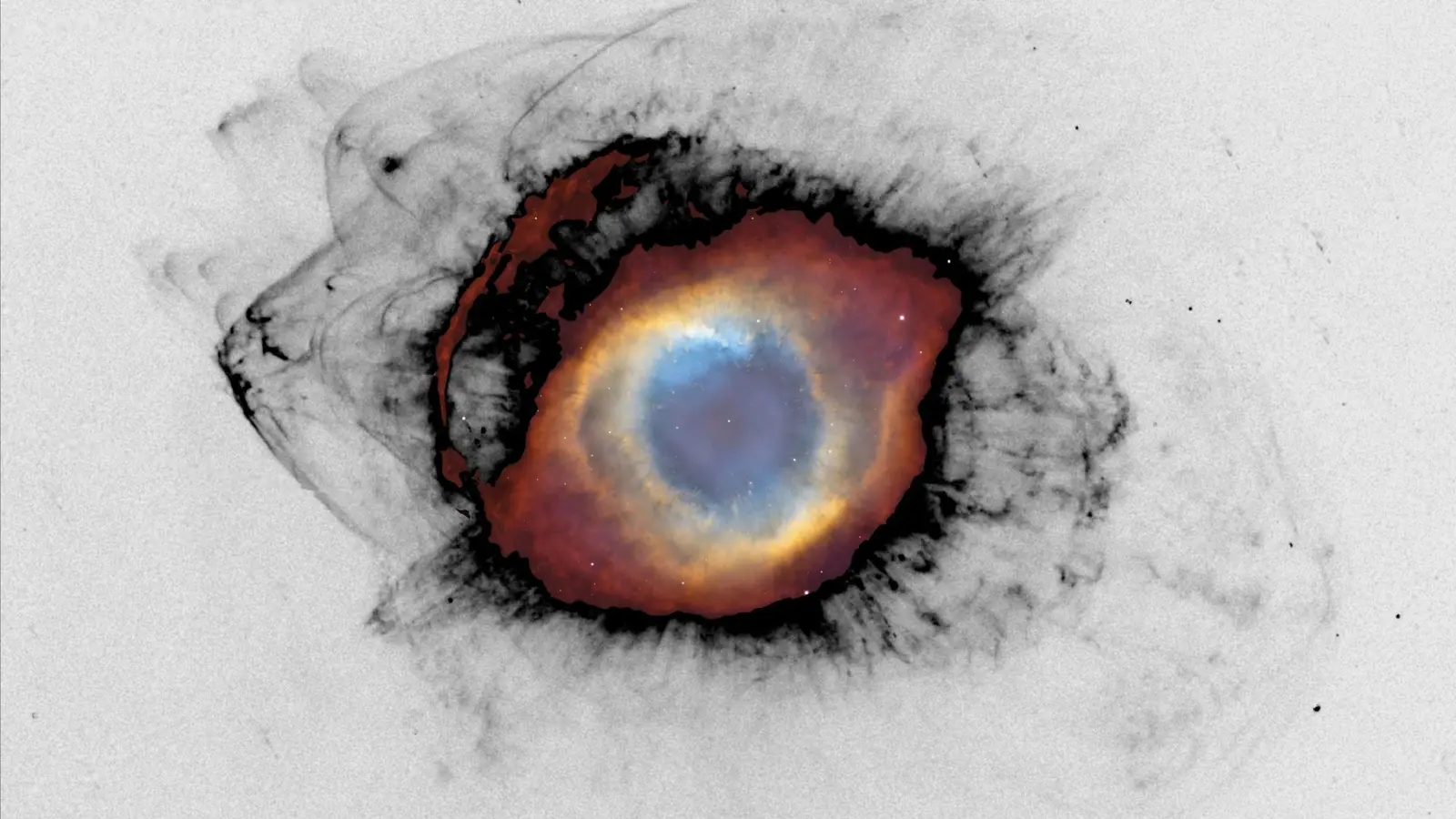
It looks like a cosmic eye, but the Helix Nebula is doing something far stranger: leaking itself back into the Milky Way.
About 650 light-years away in Aquarius, the Helix has long been admired for its bright ring and the lonely white dwarf at its center. That familiar glow, though, was only the beginning. New observations push well beyond the eye-like core and expose an extremely faint outer halo where the true drama unfolds.
There, on the nebula’s eastern flank, astronomers found a forest of glowing arcs — bow-shaped shock waves that trace unseen clumps of stellar debris plowing through the thin gas between stars. Think of a speedboat cutting through water; the wake marks the passage. In this case, the wakes mark material left behind by a dying star as it slams into interstellar gas.
We are seeing stellar material being stripped, shredded, and folded back into the galaxy — a direct snapshot of cosmic recycling.
The structures change with distance. Close to the central star the shocks are broad and crisp. Move outward and they grow smaller, fuzzier, falling apart into fragments. From that pattern the team infers a surprisingly brief lifetime for each clump once it starts interacting with the surrounding medium: on the order of ten thousand years before it is largely torn to pieces and smeared into the interstellar soup.
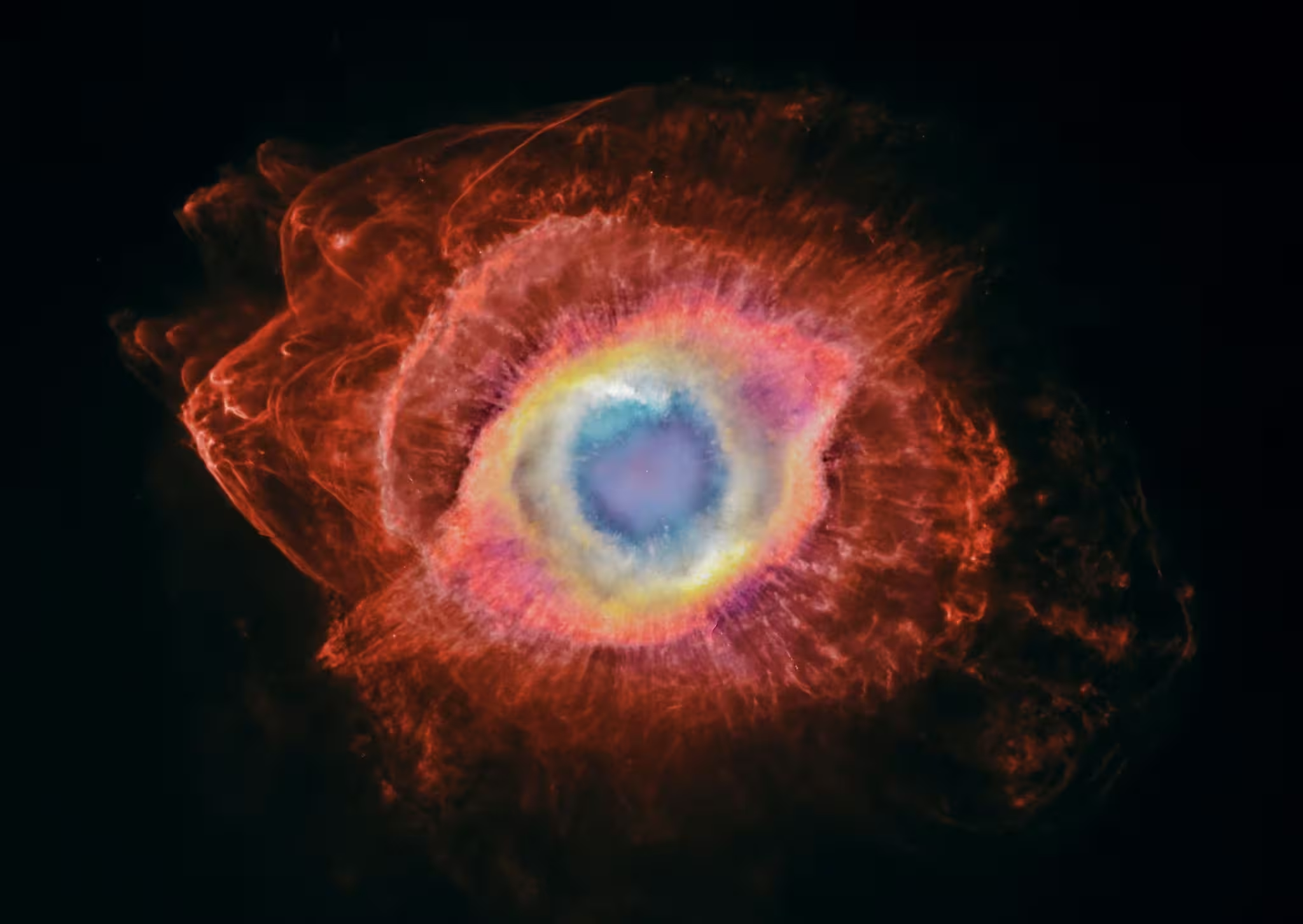
The outer structures of the Helix Nebula reveal stellar material being stripped, fragmented, and mixed back into space, offering a view of cosmic recycling in action. New MOTHRA data appears in black, while earlier Hubble and Kitt Peak observations are shown in color.
Oddly enough, the discovery came while the researchers were running a test. The instrument is called MOTHRA, a modular array of telephoto lenses and narrow filters being assembled at El Sauce Observatory in Chile. MOTHRA was not yet finished; the observations were meant to calibrate the system. But even in that early state it revealed features missed by earlier surveys, offering a preview of what the full array—1,140 lenses total—might uncover.
Lead scientist Pieter van Dokkum and colleagues, including Imad Pasha and Roberto Abraham from the Dragonfly-focused research network and partners at Northwestern and the University of Toronto, published the results in Nature. Their work connects a visible, recognizable shell of stellar material to the diffuse gas between the stars — a transition astronomers have long suspected but rarely seen in such detail.
Why care? Because this is the fate awaiting our own Sun. Far in the future it will peel off its outer layers and those atoms will rejoin the galactic cycle, perhaps seeding new clouds, stars, and planets. We may not be around to watch. But now we know what to look for when the galaxy performs this quiet act of transformation again.

Leave a Comment
Comments
No comments yet. Be the first.